

The United Nations Office at Geneva
Multimedia Newsroom
Headline:
“An abject failure to regulate the risks that surveillance technologies pose for every human being on the planet”, UN Special Rapporteur on Terrorism
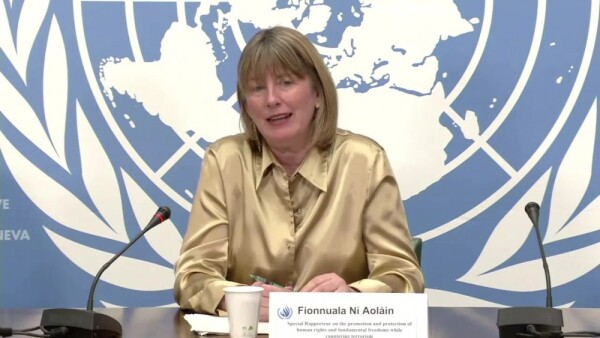
In a report to the ongoing session of the UN Human Rights Council in Geneva, the UN Special Rapporteur on the promotion and protection of human rights while countering terrorism, Fionnuala Ní Aoláin, warned of an alarming misuse of high-risk technologies in the global fight against terrorism.
This includes drones, biometrics, artificial intelligence (AI) and spyware, which is being ramped up in the ongoing fight against terrorism, without due regard for the rule of law, governance and human rights, she said.
“One of the biggest challenges we see in the increased use of drones for surveillance is that it is ordinary people whose data is being collected, ordinary people who have no right to the information that’s been collected on them and no or little regulation of the use of that data by the State,” said Ms. Ní Aoláin when speaking on Wednesday to media at the United Nations in Geneva.
The Special Rapporteur pointed out that States and private actors are using counter-terrorism and security rhetoric to justify and accelerate the deployment and transfer of new high-risk surveillance technologies without regulation. Exceptional justifications for the use of surveillance technology often turn into mundane regular use, Ms Ní Aoláin said.
“Counter-terrorism are security kind of fears or rationales that are often used as the legal and policy basis to adopt them, meaning States say ‘we have this threat, we need this technology’," Ms. Ní Aoláin said. “Now, when that happens the pattern we see is that States say ‘But we are only going to use this technology in a very limited way to counter this specific kind of threat’. But what we are seeing happening in practice is that that exceptional rationale does last very long.”
The Special Rapporteur added that “this slippage from exceptional use justified by counter-terrorism to regular use for all kinds of purposes – some of them quite nefarious - speaks to the real challenges that we are facing in regulating these technologies and ensuring that they don’t pose risks to the protection of human rights.”
The Human Rights Council-appointed independent expert expressed concern about the growing domestication of the use of drones in several countries, the widespread misuse of spyware technology against civil society groups, dissidents and journalists, and the increasing adoption of biometric data collection.
“There is consistently in the adaption of these new technologies either no or very little human rights, or at best a kind of performative note to human rights”, she said. “But very little mainstreaming of human rights protection into what are essentially high-risk technologies. And the result of that, I think, has been an abject failure to – in a way - regulate the risks that these technologies pose for every human being on the planet.”
The UN expert expressed concern about the growing domestication of the use of drones in several countries. “What we are seeing is that drone technology is proliferating at remarkable speed. In many countries you can pick one up at a store and build it in your backyard”, she said. “The result of that in the context where there is no global regulation of drone technology is a massive gap in human rights protection when such technologies are deployed.”
The expert presented in her report also a new and innovative approach to spyware regulation, focusing on ensuring that minimum human rights standards are applied by both governments and companies in the development but also in the use of high-risk surveillance technologies.
One of Ms. Ní Aoláin recommendations are that “if you are going to collect data, counter terrorism data at national level, you have to have in correspondence national legislation that protects data of the persons whose data is being collected, used, transferred and stored.” She added that “all of us have a right to that as a fundamental human right. It seems to me that in a digital age, we don’t have those rights, we actually loose an enormous space of protection.”
-ends-
STORY: Special Rapporteur on Terrorism – Report launch
TRT: 3 min 02s
SOURCE: UNTV CH
RESTRICTIONS: NONE
LANGUAGE: ENGLISH/NATS
ASPECT RATIO: 16:9
DATELINE: 15 March 2023 GENEVA, SWITZERLAND
SHOTLIST
- Medium shot, UN Geneva flag alley.
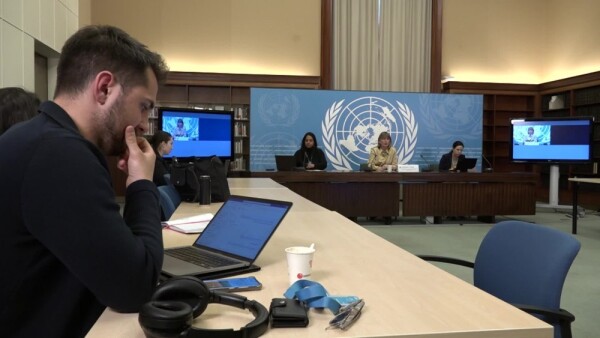
- Wide shot, press room with speaker at podium
- SOUNDBITE (ENGLISH) - Fionnuala Ní Aoláin, Special Rapporteur on the promotion and protection of human rights and fundamental freedoms while countering terrorism: “One of the biggest challenges we see in the increased use of drones for surveillance is that it is ordinary people whose data is being collected, ordinary people who have no right to the information that’s been collected on them and no or little regulation of the use of that data by the state”.
- Medium shot, journalists in front of screen with speakers
- SOUNDBITE (ENGLISH) - Fionnuala Ní Aoláin, Special Rapporteur on the promotion and protection of human rights and fundamental freedoms while countering terrorism: “Counter-terrorism are security kind of fears or rationales that are often used as the legal and policy basis to adopt them, meaning states say ‘we have this threat, we need this technology’. Now, when that happens the pattern we see is that States say but we are only going to use this technology in a very limited way to counter this specific kind of threat. But what we are seeing happening in practice is that that exceptional rationale does last very long”.
- Medium shot, journalists
- SOUNDBITE (ENGLISH) - Fionnuala Ní Aoláin, Special Rapporteur on the promotion and protection of human rights and fundamental freedoms while countering terrorism: “This slippage from exceptional use justified by counter-terrorism to regular use for all kinds of purposes – some of them quite nefarious - speaks to the real challenges that we are facing in regulating these technologies and ensuring that they don’t pose risks to the protection of human rights”.
- Medium shot, panel with speaker
- SOUNDBITE (ENGLISH) - Fionnuala Ní Aoláin, Special Rapporteur on the promotion and protection of human rights and fundamental freedoms while countering terrorism: “There is consistently in the adaption of these new technologies either no or very little human rights, or at best a kind of performative note to human rights. But very little mainstreaming of human rights protection into what are essentially high-risk technologies. And the result of that, I think, has been an abject failure to – in a way - regulate the risks that these technologies pose for every human being on the planet”.
- Mediun shot, journalist writing
- SOUNDBITE (ENGLISH) - Fionnuala Ní Aoláin, Special Rapporteur on the promotion and protection of human rights and fundamental freedoms while countering terrorism: “What we are seeing is that drone technology is proliferating at remarkable speed. In many countries you can pick one up at a store and build it in your backyard. The result of that in the context where there is no global regulation of drone technology is a massive gap in human rights protection when such technologies are deployed”.
- Medium shot, journalists with speaker at the podium
- SOUNDBITE (ENGLISH) - Fionnuala Ní Aoláin, Special Rapporteur on the promotion and protection of human rights and fundamental freedoms while countering terrorism: “If you are going to collect data, counter terrorism data at national level, you have to have in correspondence national legislation that protects data of the persons whose data is being collected, used, transferred and stored. All of us have a right to that as a fundamental human right. It seems to me that in a digital age, we don’t have those rights, we actually loose an enormous space of protection”.
- Medium shot, speaker at podium
- Medium shot, journalists
- Close up, hands typing
Similar Stories

1
1
Edited News | OHCHR , UNOG
UN Human Rights Chief Volker Türk on Friday provided and oral update to the 63rd session of the Human rights Council on Ukraine.

1
1
1
Edited News | OHCHR , UNOG
UN Human Rights Chief Volker Türk on Friday provided and oral update to the 63rd session of the Human rights Council on the human rights situation in Haiti.

1
1
1
Edited News | WHO
Repeated delays in bringing lifesaving medicines, prosthetics and more from Israel into Gaza risk having devastating consequences on Palestinians who urgently need them in the wartorn enclave, the UN World Health Organization (WHO) said on Friday. “A truck full of non-priority supplies or the right supplies arriving too late, doesn't save lives. That's the question that actually matters," said Dr Reinhilde Van De Weerdt, WHO Representative in the OPT.
1
1
1
Press Conferences | OCHA , UN WOMEN , UNHCR , WFP , WHO , WTO , UNEP
OCHA – $160M CERF allocation to 12 underfunded crises; UNHCR – 5.8M refugee children remain out of school amid funding cuts; UN Women – Middle East escalation and food security among women/girls; WHO – Gaza supplies and overall situation; WFP – Yemen food insecurity and impact on global hunger ; UNEP - First International Conference of the Global Framework on Chemicals in Geneva | 16-20 November 2026

1
1
1
Edited News | WHO
DRC: Early access to care and oxygen decisive for Ebola patients’ survival – WHO
In the Democratic Republic of the Congo (DRC), health workers fighting the country’s largest-ever Ebola outbreak are struggling to overcome critical challenges to patient care, the UN World Health Organization (WHO) warned on Tuesday.
1
1
1
Press Conferences | UNHCR , WHO
Yemen's health system nears collapse amid conflict, causing rising casualties and medicine shortages.

1
1
1
Edited News | OCHA , UN
Civilians in Iran are continuing to feel the consequences of months of conflict and military escalation, the UN’s top official in the country has said, as loss of life, damage to civilian infrastructure and mounting economic pressures leave many facing continued uncertainty.
1
1
1
Press Conferences | HRC
Update by the Expert Mechanism to Advance Racial Justice and Equality in Law Enforcement

1
1
1
Edited News | WHO , UNICEF
Aid agencies in Yemen highlighted the growing hunger emergency sparked by renewed fighting between Houthi opposition forces and Government troops, after mobile health clinics reported that hundreds of children displaced by the violence are suffering from the most deadly form of malnutrition.
1
1
1
Press Conferences | WIPO , WHO , UNICEF , UNHCR , IOM , WFP , FAO
WIPO Global Innovation Index 2026 launch and press conference, WHO Composition of influenza vaccines for the 2027 Southern Hemisphere flu season, UNICEF Yemen hunger and malnutrition; UNHCR Sudan displacement into Chad; IOM Ebola and population movements in DRC; WFP emergency food assistance in Nepal; and FAO food loss and waste.
2
1
2
Press Conferences | UNCTAD
Gaza reconstruction needs reach $71.5 billion as Palestinian economy and public finances face severe strain. Latest UNCTAD report documents the loss of decades of development gains, economic collapse in Gaza and tightening economic constraints in the West Bank.
The report identifies three immediate priorities: transferring withheld Palestinian revenues, safeguarding the banking system and aligning reconstruction support with the documented scale of damage and economic losses.
1
1
1
Press Conferences | HRC
Press conference on the situation of human rights in Nicaragua by the UN Group of Human Rights Experts