

The United Nations Office at Geneva
Multimedia Newsroom
Edited News | UNDP , WHO
Bi-Weekly Press Briefing: Earthquake Response Update Syria,Türkiye UNDP - WHO - IFRC
STORYLINE
1.5 million homeless in Türkiye after earthquake disaster: UNDP
As the death toll from the 6 February earthquake disaster topped 41,000 in Türkiye, the UN development experts said on Tuesday that 1.5 million people have been made homeless in the south of the country, where at least 500,000 new homes will need to be built.
“The death toll so far, and this is yesterday’s figures, so we don't have an updated one, but today is 41,156,” said Louisa Vinton, UN Development Programme (UNDP) Türkiye Resident Representative. “So, this makes this clearly the largest earthquake disaster in Türkiye’s history and perhaps the largest natural disaster the country has ever faced.”
Two further earthquakes measuring 6.4 and 5.8 on the Richter Scale killed six more on the Türkiye-Syria border on Monday, with “another 294 people injured and another few buildings collapsed in the region around Hatay and some on the on the Mediterranean coast”, the UNDP official continued.
In northwest Syria, where the international humanitarian response has continued, a total of 227 trucks loaded with supplies have crossed from Türkiye since 9 February; 195 using the Bab al-Hawa crossing, 22 across Bab al-Salam and 10 across Al Ra’ee.
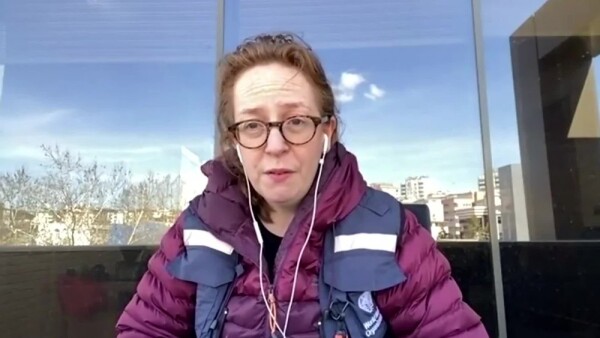
Speaking to journalists via video link from Gaziantep in southern Türkiye, Dr Catherine Smallwood, Earthquake Incident manager for the UN World Health Organization (WHO) in Europe noted that the agency had transported “close to 100 tonnes across the border from Türkiye” since the disaster, in addition to the supplies that were already pre-positioned within Syria.
These supplies included essential medicines, consumables, anaesthesia drugs, surgical equipment and other medical supplies for an additional 40,000-49,000 interventions for people who need surgical support or medical support for earthquake specific injuries
The WHO official said that 55 medical facilities have been damaged and several “completely destroyed”, but that six mobile clinics had been redeployed to the towns and communities surrounding Jindires, one of the most affected areas in northwest Syria.
“These are roaming clinics that provide support, support and medical services directly to the populations,” Dr. Smallwood explained.
Potentially positive news also emerged concerning cross-line aid deliveries from Damascus into Idlib, which is largely controlled by opposition armed forces, after well over a decade of war in Syria.
“On Sunday 19 February and Monday 20, three Syrian Arab Red Crescent convoys of humanitarian assistance crossed to Sheikh Maqsood, a non-government controlled area north of Aleppo. And so, we are speaking about cross lines here,” confirmed Tommaso Della Longa, spokesperson for The International Federation of Red Cross and Red Crescent Societies (IFRC).
Highlighting the staggering scale of the reconstruction challenge ahead, UNDP’s Louisa Vinton explained that an estimated 116 to 210 million tonnes of rubble would have to be cleared away first. “To give you a frame of reference, the last major earthquake in Türkiye in 1999, which also had a high number of casualties - although less than half of what we're seeing now - that resulted in 13 million tonnes of rubble,” she said.
In past disasters after earthquakes and explosions in Nepal, Haiti, Lebanon, and also Ukraine, UNDP has partnered projects to ensure that rubble is dealt with in an environmentally safe way. “Much of it can be recycled for construction and it can also be used as a way of generating income short term,” Ms. Vinton explained.
ends
STORY: Earthquake Relief Update Syria, Türkiye: UNDP, WHO, IFRC
TRT: 2’05”
SOURCE: UNTV CH
LANGUAGE: ENGLISH/NATS
ASPECT RATIO: 16:9
DATELINE: GENEVA, SWITZERLAND
RELEASED: 21 February 2023
SHOTLIST
- Exterior wide, UN flag alley, UN Geneva.
- Medium-wide of speakers and journalists in press room, UN backdrop to rear.
- SOUNDBITE (ENGLISH) Louisa Vinton (Zoom from Istanbul) UNDP Türkiye Resident Representative: “The death toll so far, and this is yesterday's figures, so we don't have an updated one, but today is 41,156. So, this makes this clearly the largest earthquake disaster in Türkiye’s history and perhaps the largest natural disaster the country has ever faced.”
- Medium, hands typing on laptop, multimedia paraphernalia.
- SOUNDBITE (ENGLISH) Louisa Vinton (Zoom from Istanbul) UNDP Türkiye Resident Representative: “There were another six casualties last night, another 294 people injured and another few buildings collapsed in the region around Hatay and some on the on the Mediterranean coast.”
- Medium, journalists working on laptops, podium speaker to rear.
- SOUNDBITE (ENGLISH) Dr Catherine Smallwood (Zoom from Gaziantep), Earthquake Incident manager for WHO/Europe: “We do know that 55 health facilities have been damaged, several of those completely destroyed. In addition to the supplies that we distributed that were already within Syria, we have moved close to 100 tonnes across the border from Türkiye.”
- Close: laptop screen in foreground, journalists to rear.
- SOUNDBITE (ENGLISH) Tommaso Della Longa, The International Federation of Red Cross and Red Crescent Societies (IFRC): “On Sunday 19 February and Monday 20, three Syrian Arab Red Crescent convoys of humanitarian assistance crossed to Sheikh Maqsood, a non-government controlled area north of Aleppo. And so, we are speaking about cross-lines here.”
- Medium, journalists facing podium.
- SOUNDBITE (ENGLISH) Louisa Vinton (Zoom from Istanbul) UNDP Türkiye Resident Representative: “And just to give you a sense of the scale, our estimate is that 1.5 million people have been left homeless by this, these earthquakes, with the need to rebuild at least 500,000 new housing units going forward.”
- Medium-wide, journalists listening and working on laptops.
- SOUNDBITE (ENGLISH) ) Louisa Vinton (Zoom from Istanbul) UNDP Türkiye Resident Representative: “Our estimate right now is that the total volume of the rubble that will need to be dealt with is between 116 and 210 million tonnes.”
- Close, TV camera with viewfinder showing podium speaker.
- Medium, TV camera operator.
- Close, laptops in profile.
Similar Stories

1
1
1
Edited News | OCHA , UNICEF , WFP
Aid agencies warned on Friday of the fast-developing humanitarian emergency inside Taiz City in Yemen, which has been encircled by de facto Houthi forces fighting government troops along the country’s west coast.

2
17
1
2
Edited News , Press Conferences , Images | OCHA , WMO
Two UN agencies teamed up on Wednesday to issue an appeal for immediate assistance to help communities already being impacted by the strongest El Niño on record.

3
16
2
2
Edited News , B-roll , Conferences , Images | UNITED NATIONS , UNOG
Sixth Consultative Meeting on Enhancing Coordination of Peace Initiatives and Efforts for Sudan

1
1
1
Edited News | UNICEF , WHO , UNHCR
Yemen war continues to force families from homes amid hunger and disease
More than 250,000 people have now fled renewed fighting in Yemen, the UN said on Tuesday, citing particular concern for those sheltering in the southwestern city of Taiz and the wider governorate, where access is “essentially blocked”.

1
1
1
Edited News | UNICEF
A little over one year since a ceasefire agreement was announced between Hamas fighters and Israel, more than 340 children have been reported killed and hundreds more injured, the UN Children’s Fund, UNICEF, said on Friday.

1
1
1
Edited News | UNICEF , IFRC
Six weeks after Nepal’s deadly flooding disaster, communities are still struggling to rebuild their lives, but they will need sustained help as global warming increases the risk of another Himalayan catastrophe, the UN Children’s Fund (UNICEF) said on Friday.

1
1
1
Edited News | WHO
In suspected Russia plague death, testing and monitoring underway – WHO
The death of a lab worker in Russia’s Siberia region has sparked concerns about plague being the cause, the UN World Health Organization (WHO) said on Tuesday, adding that it was following the situation closely.

1
1
Edited News | OHCHR , UNOG
UN Human Rights Chief Volker Türk on Friday provided and oral update to the 63rd session of the Human rights Council on Ukraine.

1
1
1
Edited News | OHCHR , UNOG
UN Human Rights Chief Volker Türk on Friday provided and oral update to the 63rd session of the Human rights Council on the human rights situation in Haiti.

1
1
1
Edited News | WHO
Repeated delays in bringing lifesaving medicines, prosthetics and more from Israel into Gaza risk having devastating consequences on Palestinians who urgently need them in the wartorn enclave, the UN World Health Organization (WHO) said on Friday. “A truck full of non-priority supplies or the right supplies arriving too late, doesn't save lives. That's the question that actually matters," said Dr Reinhilde Van De Weerdt, WHO Representative in the OPT.

1
1
1
Edited News | WHO
DRC: Early access to care and oxygen decisive for Ebola patients’ survival – WHO
In the Democratic Republic of the Congo (DRC), health workers fighting the country’s largest-ever Ebola outbreak are struggling to overcome critical challenges to patient care, the UN World Health Organization (WHO) warned on Tuesday.

1
1
1
Edited News | OCHA , UN
Civilians in Iran are continuing to feel the consequences of months of conflict and military escalation, the UN’s top official in the country has said, as loss of life, damage to civilian infrastructure and mounting economic pressures leave many facing continued uncertainty.