

The United Nations Office at Geneva
Multimedia Newsroom
Syria: fears of a ‘bloodbath’ as shelling nears terrified, traumatised displacement camps
Around a million civilians in northwest Syria could face “a real bloodbath, a real massacre” amid an ongoing push by Government forces in the country’s last opposition-held region, a senior UN humanitarian warned on Monday.
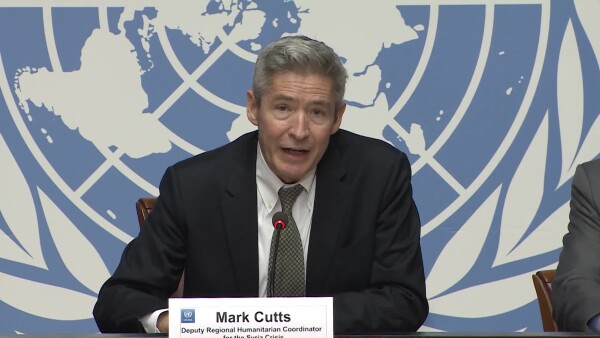
“The fighting is now coming dangerously close to the area where more than a million are living in tents and makeshift shelters, so it’s an extremely alarming situation, because if airstrikes move and shelling move any further into that area, we are no doubt going to see a real bloodbath, a real massacre of civilians in that area,” said Mark Cutts, Deputy Regional Humanitarian Coordinator for the Syria Crisis.
Speaking in Geneva, Mr. Cutts told journalists that as people have fled violence, seeking shelter close to the country’s border with Turkey, “the bombs have just been following them from place to place. And these people feel abandoned by the entire world. They are dumbfounded that no-one seems to be coming to their rescue.”
He added: “What people are asking for at the moment is not just tents and blankets and food, they’re calling for the killing of civilians to stop. They want the fighting to stop, the carnage to stop.”
The violence – which has seen more than 900,000 civilians displaced in northwest Syria since 1 December, according to the UN Office for the Coordination of Humanitarian Affairs (OCHA) - has been marked by continuing attacks on public infrastructure and built-up areas which are protected under international law.
To date, more than 70 health facilities have been put “out of service” in the affected zone, Mr. Cutts said, citing reports of medical staff in a paediatric hospital “at a loss for what to do” with some 80 infants being cared for in incubators who need evacuating, but have nowhere to go.
“Huge numbers of hospitals and schools and marketplaces and bakeries and water stations have been hit by airstrikes and shelling in the past few months, and there’s a population now that is terrorised and traumatised and living in fear,” he said.
Help is reaching the affected communities via cross-border aid deliveries from Turkey, but much more assistance is needed, Mr. Cutts explained, as he announced an upscaled Emergency Response Plan appeal for $500 million for 1.1 million people.
“In January, we had 1,200 trucks of aid go in; in February so far, we’ve already had more than 700 trucks of aid go in. So the aid is flowing, there is a big aid operation. But the reality is, it’s simply not enough.”
- Wide shot: exterior, flag alley, Palais des Nations, United Nations Geneva.
- Wide shot: Press briefing room, journalists, podium with speakers and UN logo.
- SOUNDBITE (EN) — Mark Cutts, Deputy Regional Humanitarian Coordinator for the Syria Crisis: “The fighting is now coming dangerously close to the area where more than a million are living in tents and makeshift shelters, so it’s an extremely alarming situation, because if airstrikes move and shelling move any further into that area, we are no doubt going to see a real bloodbath, a real massacre of civilians in that area.”
- Medium shot: journalists looking at laptop, conferring.
- SOUNDBITE (EN) — Mark Cutts, Deputy Regional Humanitarian Coordinator for the Syria Crisis: “People have been fleeing in fear to the border area and what we’ve seen is the bombs have just been following them from place to place. And these people feel abandoned by the entire world. They are dumbfounded that no-one seems to be coming to their rescue.”
- Medium shot, journalist typing on mobile phone.
- SOUNDBITE (EN) — Mark Cutts, Deputy Regional Humanitarian Coordinator for the Syria Crisis: “Huge numbers of hospitals and schools and marketplaces and bakeries and water stations have been hit by airstrikes and shelling in the past few months, and there’s a population now that is terrorised and traumatised and living in fear.”
- Medium shot: journalist looking at mobile phone.
- SOUNDBITE (EN) — Mark Cutts, Deputy Regional Humanitarian Coordinator for the Syria Crisis: “What people are asking for at the moment is not just tents and blankets and food, they’re calling for the killing of civilians to stop. They want the fighting to stop, the carnage to stop.”
- Medium shot: journalist checking phone, seated in front of laptop.
- SOUNDBITE (EN) — Mark Cutts, Deputy Regional Humanitarian Coordinator for the Syria Crisis: “In January, we had 1,200 trucks of aid go in; in February so far, we’ve already had more than 700 trucks of aid go in. So the aid is flowing, there is a big aid operation. But the reality is, it’s simply not enough.”
- Wide shot: journalists, seated, semi-profile.
- SOUNDBITE (EN) — Mark Cutts, Deputy Regional Humanitarian Coordinator for the Syria Crisis: “Today, we are launching a revised Emergency Response Plan. Where we are appealing for $500 million for 1.1 million people, so we’d like to revise those figures upwards.”
- Medium shot: journalist looking at laptop.
- Wide shot: podium, speakers, UN logo, mural.
- Wide shot: Press room, journalists, seated.
Similar Stories
1
1
1
Edited News | OCHA , UNICEF , WFP
Aid agencies warned on Friday of the fast-developing humanitarian emergency inside Taiz City in Yemen, which has been encircled by de facto Houthi forces fighting government troops along the country’s west coast.

2
17
1
2
Edited News , Press Conferences , Images | OCHA , WMO
Two UN agencies teamed up on Wednesday to issue an appeal for immediate assistance to help communities already being impacted by the strongest El Niño on record.

3
16
2
2
Edited News , B-roll , Conferences , Images | UNITED NATIONS , UNOG
Sixth Consultative Meeting on Enhancing Coordination of Peace Initiatives and Efforts for Sudan

1
1
1
Edited News | UNICEF , WHO , UNHCR
Yemen war continues to force families from homes amid hunger and disease
More than 250,000 people have now fled renewed fighting in Yemen, the UN said on Tuesday, citing particular concern for those sheltering in the southwestern city of Taiz and the wider governorate, where access is “essentially blocked”.

1
1
1
Edited News | UNICEF
A little over one year since a ceasefire agreement was announced between Hamas fighters and Israel, more than 340 children have been reported killed and hundreds more injured, the UN Children’s Fund, UNICEF, said on Friday.

1
1
1
Edited News | UNICEF , IFRC
Six weeks after Nepal’s deadly flooding disaster, communities are still struggling to rebuild their lives, but they will need sustained help as global warming increases the risk of another Himalayan catastrophe, the UN Children’s Fund (UNICEF) said on Friday.

1
1
1
Edited News | WHO
In suspected Russia plague death, testing and monitoring underway – WHO
The death of a lab worker in Russia’s Siberia region has sparked concerns about plague being the cause, the UN World Health Organization (WHO) said on Tuesday, adding that it was following the situation closely.

1
1
Edited News | OHCHR , UNOG
UN Human Rights Chief Volker Türk on Friday provided and oral update to the 63rd session of the Human rights Council on Ukraine.

1
1
1
Edited News | OHCHR , UNOG
UN Human Rights Chief Volker Türk on Friday provided and oral update to the 63rd session of the Human rights Council on the human rights situation in Haiti.

1
1
1
Edited News | WHO
Repeated delays in bringing lifesaving medicines, prosthetics and more from Israel into Gaza risk having devastating consequences on Palestinians who urgently need them in the wartorn enclave, the UN World Health Organization (WHO) said on Friday. “A truck full of non-priority supplies or the right supplies arriving too late, doesn't save lives. That's the question that actually matters," said Dr Reinhilde Van De Weerdt, WHO Representative in the OPT.

1
1
1
Edited News | WHO
DRC: Early access to care and oxygen decisive for Ebola patients’ survival – WHO
In the Democratic Republic of the Congo (DRC), health workers fighting the country’s largest-ever Ebola outbreak are struggling to overcome critical challenges to patient care, the UN World Health Organization (WHO) warned on Tuesday.

1
1
1
Edited News | OCHA , UN
Civilians in Iran are continuing to feel the consequences of months of conflict and military escalation, the UN’s top official in the country has said, as loss of life, damage to civilian infrastructure and mounting economic pressures leave many facing continued uncertainty.