

The United Nations Office at Geneva
Multimedia Newsroom
A new era has dawned for researchers of international diplomacy wanting to mine the archives of the United Nations predecessor, the League of Nations: 10 linear kilometers of paper documents have been digitalized, providing unlimited access online to the institutional memory of the League of Nations.
At a press briefing held this morning, the Director-General of the United Nations Office at Geneva and the Library and Archives of UN Geneva presented the new platform as a breakthrough for the knowledge on the history of multilateralism.
“We sometimes do not know how important these archives are for our current work. But quite often, in order to find answers and solutions to current challenges, it’s really important to learn lessons from the past. That’s why this institutional memory is so very important”, said Director General Tatiana Valovaya.
The platform democratizes access to the exceptional wealth of archival documents managed by the UN Library & Archives Geneva, including early international peace movements, the League of Nations, the United Nations Office at Geneva and other UN entities. It gives unrestricted access to people worldwide, emphasized Francesco Pisano, Director of the UN Library & Archives in Geneva --not only to diplomats, academics, journalists, but also students sitting in any country with internet access.
“This is a massive project: for the substance in terms of archiving, digitalizing all the archives. This is one of the biggest that was ever attempted in the world. It’s massive for the UN”, Mr. Pisano said
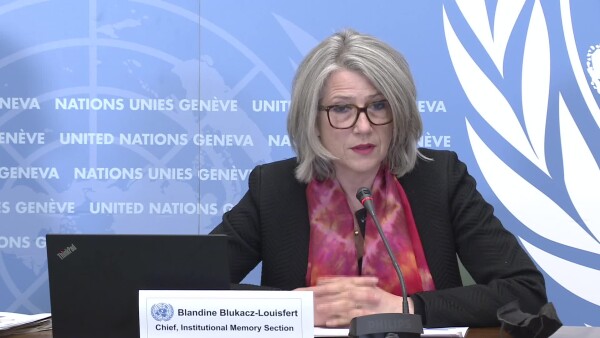
In years past, some 150 persons per year were coming in person to consult the archives at the UN Office at Geneva. According to Blandine Blukacz-Louisfert, Chief, Institutional Memory Section, UN Geneva, since the launch of the platform last December, “more than 1’200 people, visited the platform. So, it's really a huge difference. We got some feedback from users, and they really insist on the democratization of access to these archives.”
The platform represents an outstanding opportunity for researchers all over the world to develop new perspectives and new methodologies. It will contribute to a better understanding of multilateralism, according to the UN Geneva officials. It allows the public to interact with UN Geneva archivists and get their assistance to navigate through the collections. It also highlights new services and research partnerships, which can contribute to the renewal of studies on the history of multilateralism.
By the end of 2022, the entirety of the archives will be freely available online. The platform also includes visual material, such as the Photo Collection of the League of Nations. Those archives are registered on the UNESCO’s Memory of the World Register and document the activities of the predecessor institution to the UN, from 1919 to 1946.
Preserving and fostering access to primary sources is at the core of the UN Library & Archives Geneva’s mission. Its new platform can contribute to better understand the world.
“This is just the beginning of the project,” concluded Ms. Valovaya. “We are presenting you an idea of Geneva as a center of history of multilateralism and a center of knowledge.”
SHOTLIST
UNOG - Geneva 28 January 2022:
- Exterior wide shot, United Nations Palace of Nations, Geneva. UN flags flying.
- Wide shot of press room UN Geneva.
- SOUNDBITE (English) Blandine Blukacz-Louisfert, Chief, Institutional Memory Section, UN Geneva: “In 2017, when we started this digital access to the League of Nations Archives project, we had 15 million pages of paper. Most of it 100 years old, very fragile and heterogeneous. We had these 15 million pages in front of us to turn into digital files and in the end, at the end of the project, end of this year, we will have 250 Terabytes of data.”
- Cutaway, Wide shot of press room with speakers at the podium
- SOUNDBITE (English) Tatiana Valovaya, Director-General, United Nations Office at Geneva: “As a result of this project, we have unlimited access online to the institutional memory of League of Nations. That, I would say, is a milestone.”
- Cutaway, Wide shot of press room
- SOUNDBITE (English) Tatiana Valovaya, Director-General, United Nations Office at Geneva: “We sometimes do not know how important these archives are for our current work. Because quite often we think about the League of Nations, we think about history. But quite often, in order to find answers and solutions to current challenges, it’s really important to learn lessons from the past. That’s why this institutional memory is so very important.”
- Cutaway, Slide of the presentation of Blandine Blukacz-Louisfert’s showing 15 million pages turned into 250TB
- SOUNDBITE (English) Francesco Pisano, Director, Library & Archives, UN Geneva: “This is a massive project: for the substance in terms of archiving, digitalizing all the archives. This is one of the biggest that was ever attempted in the world. It’s massive for the UN.”
- Cutaway, archives documents and photographs from the UN Library showing the UN Office in Geneva building underway
- SOUNDBITE (English) Francesco Pisano, Director, Library & Archives, UN Geneva: “When we started, we didn't know what the technology could be applied to the preservation of the digital material. So, it's a little bit like inventing something at the time of the floppy disk and asking yourself, “how do I make this technology, floppy disc,readable in 50 years?” And you know it's not the floppy, but you don't know the cloud because it hasn't been invented yet!”
- Cutaway, archive letter dated in 1920
- SOUNDBITE (English) Blandine Blukacz-Louisfert, Chief, Institutional Memory Section, UN Geneva: “Before, as Francesco mentioned, people had to come in person. We had about 150 persons coming and consulting the archives per year. Now, we launched the platform in December (2021), and since December, we know that more than 1’200 people, different people, different individuals visited the platform! So, it's really a huge difference. We got some feedback from users, and they really insist on the democratization of access to these archives.”
- Cutaway, archive showing drawings
- SOUNDBITE (English) Tatiana Valovaya, Director-General, United Nations Office at Geneva: “This is just the beginning of the project. And apart from all these, I would say practical things of course, we are presenting you an idea of Geneva as a center of history of multilateralism and a center of knowledge.”
FILE shot in 2019 – MUTE:
- Library & Archives employees at work at UN Geneva
- Close-up of hands manipulating archive documents
- Medium shot of Library & Archives employees at work
- Wide shot of Library & Archives employees at work
- Close-up of hands scanning documents
- Medium shot of employee scanning documents
- Close-up of old passports
- Medium shot of employee working on scanned documents on her computer
- Various of Library & Archives offices at UN Geneva
Similar Stories
1
1
1
Edited News | OCHA , UNICEF , WFP
Aid agencies warned on Friday of the fast-developing humanitarian emergency inside Taiz City in Yemen, which has been encircled by de facto Houthi forces fighting government troops along the country’s west coast.

2
17
1
2
Edited News , Press Conferences , Images | OCHA , WMO
Two UN agencies teamed up on Wednesday to issue an appeal for immediate assistance to help communities already being impacted by the strongest El Niño on record.

3
16
2
2
Edited News , B-roll , Conferences , Images | UNITED NATIONS , UNOG
Sixth Consultative Meeting on Enhancing Coordination of Peace Initiatives and Efforts for Sudan

1
1
1
Edited News | UNICEF , WHO , UNHCR
Yemen war continues to force families from homes amid hunger and disease
More than 250,000 people have now fled renewed fighting in Yemen, the UN said on Tuesday, citing particular concern for those sheltering in the southwestern city of Taiz and the wider governorate, where access is “essentially blocked”.

1
1
1
Edited News | UNICEF
A little over one year since a ceasefire agreement was announced between Hamas fighters and Israel, more than 340 children have been reported killed and hundreds more injured, the UN Children’s Fund, UNICEF, said on Friday.

1
1
1
Edited News | UNICEF , IFRC
Six weeks after Nepal’s deadly flooding disaster, communities are still struggling to rebuild their lives, but they will need sustained help as global warming increases the risk of another Himalayan catastrophe, the UN Children’s Fund (UNICEF) said on Friday.

1
1
1
Edited News | WHO
In suspected Russia plague death, testing and monitoring underway – WHO
The death of a lab worker in Russia’s Siberia region has sparked concerns about plague being the cause, the UN World Health Organization (WHO) said on Tuesday, adding that it was following the situation closely.

1
1
Edited News | OHCHR , UNOG
UN Human Rights Chief Volker Türk on Friday provided and oral update to the 63rd session of the Human rights Council on Ukraine.

1
1
1
Edited News | OHCHR , UNOG
UN Human Rights Chief Volker Türk on Friday provided and oral update to the 63rd session of the Human rights Council on the human rights situation in Haiti.

1
1
1
Edited News | WHO
Repeated delays in bringing lifesaving medicines, prosthetics and more from Israel into Gaza risk having devastating consequences on Palestinians who urgently need them in the wartorn enclave, the UN World Health Organization (WHO) said on Friday. “A truck full of non-priority supplies or the right supplies arriving too late, doesn't save lives. That's the question that actually matters," said Dr Reinhilde Van De Weerdt, WHO Representative in the OPT.

1
1
1
Edited News | WHO
DRC: Early access to care and oxygen decisive for Ebola patients’ survival – WHO
In the Democratic Republic of the Congo (DRC), health workers fighting the country’s largest-ever Ebola outbreak are struggling to overcome critical challenges to patient care, the UN World Health Organization (WHO) warned on Tuesday.

1
1
1
Edited News | OCHA , UN
Civilians in Iran are continuing to feel the consequences of months of conflict and military escalation, the UN’s top official in the country has said, as loss of life, damage to civilian infrastructure and mounting economic pressures leave many facing continued uncertainty.