

The United Nations Office at Geneva
Multimedia Newsroom
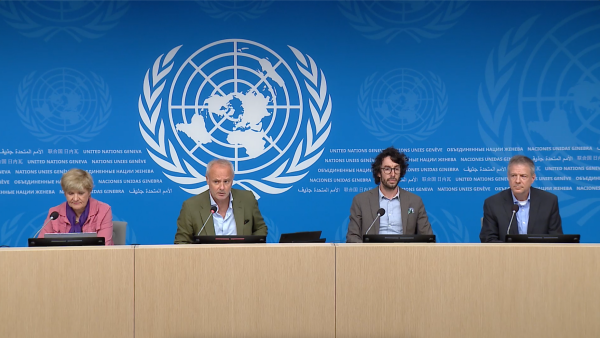
Update on the Human Rights Council
Rhéal LeBlanc, for the United Nations Information Service in Geneva, said that on the morning of 12 November, the Human Rights Council Working Group on the Universal Periodic Review was reviewing the human rights situation in Slovenia. In the afternoon, it would adopt reports in respect of reviews it had held the previous week – on Kazakhstan, Angola and the Islamic Republic of Iran. On 13 November, the Working Group would review the human rights situation in Egypt in the morning, and in Bosnia and Herzegovina in the afternoon.
Syria
Rhéal LeBlanc, for the United Nations Information Service in Geneva, said that the next Security Council briefing by the Special Envoy for Syria, Geir O. Pedersen, would take place on Friday, 22 November. The Syrian Constitutional Committee would resume on 25 November, and more information would be available shortly.
Responding to a question from a journalist, Andrej Mahecic, for the United Nations Refugee Agency (UNHCR), said that, since 14 October 2019, 14,779 people had crossed into Iraq from Syria, seeking refuge.
Democratic Republic of the Congo
Displaced people face widespread human rights violations
Babar Baloch, for the United Nations Refugee Agency (UNHCR), made the following statement:
“UNHCR, the UN Refugee Agency, is alarmed that hundreds of thousands of forcibly displaced people in eastern Democratic Republic of the Congo (DRC) are not only living in dire conditions without proper assistance but are unprotected and exposed to extreme human rights violations almost on a daily basis. Some 300,000 people, mainly women and children, were displaced in the aftermath of a wave of brutal attacks in June 2019 by various armed groups in the country’s Ituri and North Kivu provinces. Prior to this, an estimated four million people were already displaced across DRC – some 10% of the global population of internally displaced people.
Five months on from June’s attacks, killings, sexual violence and abductions persist amid continuing conflict. Many women and children are still living in precarious conditions, sleeping in the open or in overcrowded public spaces further exposing them to risks of harassment, assault or sexual exploitation, which according to the displaced people are widespread. In October alone, UNHCR staff recorded at least 1,000 human rights violations in the two eastern provinces. Civilians live in fear of death and destruction. On 30 October, a 38-year-old displaced man was killed by armed men in Djugu Territory, only one instance of incidents that take place on a near daily basis in this area.
UNHCR has stepped up its response to the growing displacement crisis in eastern DRC, but needs additional resources to continue its support and improve conditions. We are deploying additional staff and have built communal hangars and emergency family shelters to help keep displaced people safe. Basic items such as blankets, laundry soap and jerry cans have also been distributed, while women and girls receive sanitary items for their personal health and hygiene.
UNHCR needs USD150 million to respond to refugees and displaced people’s needs in DR Congo this year, but so far only 57 per cent has been received. Funding shortages are severely affecting the displaced people’s ability to meet their own basic needs.”
Responding to questions from the press, Mr. Baloch said that more than 100 armed groups in DRC had been unleashing violence on the general public. There were reports that many human rights violations were linked to conflict involving armed groups and to the illegal exploitation of natural resources. Many people were also affected by the ongoing military operation recently launched by the Government on armed groups. Many of those who had been forced to leave their communities in the eastern part of the country wished to return home, but were not able to because of the daily violence. The majority of internally displaced persons were being supported by local communities, where resources were already sparse. To help them, security was crucial, and so too were additional resources.
Ebola virus disease
Responding to questions about the impact of the ongoing violence in DRC on the Ebola epidemic, Babar Baloch, for the United Nations Refugee Agency (UNHCR), said the combination of violence and Ebola was indeed a dangerous mix. There had been reports that health clinics had also suffered attacks.
Responding to further questions about the Ebola epidemic, Christian Lindmeier, for the World Health Organization (WHO), said as of 10 November, there had been 3,287 total cases of Ebola, with 2,193 reported deaths and 1,067 survivors; the remaining cases were under care. Although the number of cases had stabilized in recent weeks, the risk of reintroduction of Ebola in hotspots remained high, as the situation was highly contingent on access and security. Approximately half the cases reported in the past three weeks had been diagnosed outside of the health zone in which they had been infected, clearly showing that mobility was a factor. With the majority of movements originating from the Mandima Health Zone, points of entry and points of control continued to be strengthened by the response teams based on the movement of cases and populations. The outbreak was evolving in an extremely complex environment marked by poor infrastructure, political instability, community mistrust of authorities and ongoing conflict involving militia groups. The response to Ebola must strike a delicate balance to provide accessible care, maintain neutrality and protect staff and patients from attacks. United Nations or police protection was sometimes required when transiting through insecure areas, but neither the health authorities nor response partners supported or used coercive measures to obtain participation in response activities.
Asked about the impact of the recent killing of a radio broadcaster in DRC, Mr. Lindmeier said while it was not possible to measure the immediate impact of that individual incident, anything that hampered the broadcast of Ebola updates and awareness-raising messages or that prevented the efforts of response teams endangered the whole operation. Securing community engagement was crucial anywhere that was affected by Ebola.
Responding to questions about the Ebola vaccine, Mr. Lindmeier said that, in a landmark decision for global health, on 11 November, the European Commission had approved the licensing of an Ebola vaccine. WHO pre-qualification – the next step – was expected to follow in the coming days. WHO had developed a road map for accelerating pre-qualification, which served to confirm that WHO was satisfied with the vaccine’s quality, safety and efficacy data; pre-qualification would, in turn, help expedite licensing, access and roll-out to countries where the vaccine was most needed. Licensing would necessarily be carried out in accordance with domestic legislation. In any event, the news was not expected to affect the vaccination scheme currently in place in DRC. Licensed doses would be available only from mid-2020. WHO had played a major role in bringing a candidate vaccine through the approval process, by supporting research and trial phases, as well as supporting African health regulation authorities.
Plurinational State of Bolivia
Asked to comment on ongoing political developments in the Plurinational State of Bolivia, Rhéal LeBlanc, for the United Nations Information Service in Geneva, drew attention to a statement made by the Secretary-General on 10 November, in which he took note of the resignation of President Evo Morales and urged all Bolivians to refrain from violence, reduce tension and exercise maximum restraint. He also called on all actors to abide by international law, notably fundamental human rights principles, and appealed to all actors to commit to achieving a peaceful resolution of the current crisis and to ensuring transparent and credible elections.
Australia
Clare Nullis, for the World Meteorological Organization (WMO), said extreme to catastrophic fire dangers were forecast for eastern New South Wales and parts of Queensland on 12 November. The fires were expected to impact communities, including in the greater Sydney area, that had already been affected by dozens of ongoing fires that had caused loss of life and considerable devastation.
According to the Australian Bureau of Meteorology, weather conditions were being driven by a cold front that was moving up the east coast on 12 November. Ahead of the front had been very dry and gusty conditions. The cold front would bring a shift in wind direction, and the air would remain dry, with little to no rain in the forecast, according to Australia’s Bureau of Meteorology, which had described the situation as “evolving and dangerous.
The current fires were due to a combination of factors, including low soil moisture, heat and, importantly, wind direction and wind speed. Apart from the immediate physical threat, the fires would affect air quality and human health.
According to the Bureau of Meteorology, Australia had just experienced the second-warmest period comprising January–October on record for the country, with rainfall being the second-lowest on record for Australia as a whole. The state of New South Wales had just seen its driest 34-month period on record, which made it clear that the current emergency had not been generated overnight.
As for the influence of climate change on the current situation, the incidence of wildfires was greatly influenced by natural variability in the climate, including precipitation and wind, as well as other factors unrelated to climate, such as land and forest management and building practices. According to the Australia’s 2018 State of the Climate report, there had been a “long-term increase in extreme fire weather, and in the length of the fire season, across large parts of Australia.”
The most extreme 10 per cent of fire weather days had increased in recent decades across many regions of Australia, especially in southern and eastern Australia. There had been an associated increase in the length of the fire weather season. Climate change, including increasing temperatures, was contributing to those changes. The climate of Australia had warmed by just over 1°C since 1910, leading to an increase in the frequency of extreme heat events. There had been a decline of around 11 per cent in rainfall for the period April–October in south-eastern Australia since the late 1990s. Australia was projected to experience further increases in temperatures and decreases in rainfall across southern Australia.
The WMO provisional statement on the state of the climate in 2019 would be released for United Nations Climate Change Conference in Madrid.
Geneva announcements
Clare Nullis, for the World Meteorological Organization (WMO), said WMO would release its annual Greenhouse Gas Bulletin on atmospheric concentrations of carbon dioxide and other major greenhouse gases on 25 November. A press conference with the Secretary-General of WMO would take place on that day at 11 a.m., in Room III.
Catherine Huissoud, for the United Nations Conference on Trade and Development (UNCTAD), said Global Entrepreneurship Week was a global campaign that took place across the world annually to raise awareness and promote entrepreneurship initiatives. UNCTAD, IOM and UNHCR planned to hold a joint photo exhibition featuring the contributions of migrant and refugee entrepreneurs to the development of their host and origin countries. The initiative built on the ongoing tripartite partnership that had led to the joint UNCTAD/IOM/UNHCR Policy Guide on Entrepreneurship for Migrants and Refugees, launched in October 2018. The 30 photos would be featured alongside a collective sculpture by artist Romain Langlois, created in collaboration with twenty migrants and refugees in France.
Rhéal LeBlanc, for the United Nations Information Service in Geneva, said that on the morning of 12 November, the Committee against Torture was beginning its consideration of the report of Uzbekistan, which would continue in the afternoon of 13 November. In the course of its sixty-eighth session, the Committee would consider the reports of Burkina Faso, Cyprus, Latvia, the Niger, Portugal and Uzbekistan.
Mr. LeBlanc also drew attention to the Secretary-General’s message on the occasion of World Diabetes Day, which would be observed on 14 November 2019.
Similar Stories
1
12
1
1
Press Conferences , Images | UNOG
Closing Press Conference following the Sixth Consultative Meeting on Enhancing Coordination of Peace Initiatives and Efforts in Sudan

2
17
1
2
Edited News , Press Conferences | OCHA , WMO
Two UN agencies teamed up on Wednesday to issue an appeal for immediate assistance to help communities already being impacted by the strongest El Niño on record.
1
1
1
Press Conferences | CITES
Wildlife trade and conservation policy discussions at the 81st meeting of the CITES Standing Committee (SC81)
1
1
1
Press Conferences | UNHCR , UNCTAD , WMO , OCHA , UNICEF , WHO
UNHCR Hungary’s 1956 Refugee Crisis: 70 Years On, UNCTAD World Investment Forum 2026, Doha, WMO Greenhouse Gas Bulletin and Climate Update for COP31, OCHA Afghanistan: Malnutrition, Girls’ Education and Recovery, UNICEF Yemen: Child Malnutrition and Unsafe Water in Taiz, WHO Inequalities in Noncommunicable Diseases and Risk Factors

1
1
1
Press Conferences | UNHCR
End of UNHCR's 77th Annual Executive Committee (ExCom) meeting week

1
1
1
Press Conferences | UNICEF , IOM , UNHCR
UN Special Assistant to the Personal Envoy Office (SUDAN): Peace Initiatives and Efforts in Sudan; UNICEF: Dire situation of children in Gaza; IOM: Damaged Homes and Energy Attacks Risk Displacing Ukrainians for this winter; UNHCR: update on EXCOM week

1
1
1
Press Conferences | IOM , UNDRR
UN stresses importance of household preparedness for disaster risk reduction.

1
1
1
Statements , Press Conferences | OHCHR

1
1
1
Press Conferences | UNHCR , UNICEF , IFRC , OHCHR , UN WOMEN , IOM , OCHA , WHO
UNHCR – ExCom Meeting, UNICEF – Nepal Recovery, IFRC – Flash Floods, WHO – Mental Health, IOM – South Sudan Floods, OCHA – DRC Humanitarian aid, UNHCR – Sahel Displacement, UNICEF – Yemen Update, IOM – Gaza Shelter, UN Women – Gaza Women, OHCHR – Arrests and detentions of Syrians by Israeli force

2
1
2
Press Conferences | UNCTAD
Presentation of the Trade and Developement Report 2026
Embargoed until 9 October 2026 at 11 a.m. (Geneva Time)
UNCTAD: UNCTAD’s flagship report finds that governments increasingly use industrial, trade, financial and technology policies to pursue economic and national security objectives. Market access and the ability to move into higher-value activities now depend more heavily on technology, finance and geopolitics.

1
1
1
Press Conferences | UPU
Release of the State of the Postal Sector Report 2026
1
1
1
Press Conferences | IOM , ITU , UNECE , UNICEF , WHO , WMO
UNICEF: Ebola, DRC - children orphans or separating them from parents and caregivers; IOM: Humanitarian needs in Djibouti amid arrivals from Yemen and increased migrant movements; WHO: Darfur, scale of health needs far exceeds available resources; WMO co-sponsored Global Heat Forum, Bangkok, monthly Global Seasonal Climate Update; UNECE: UN Forum of Mayors; ITU Plenipotentiary Conference 2026; WHO: child and adolescent obesity guidelines and new global roadmap to tackle pregnancy hypertension, a leading cause of maternal mortality