

The United Nations Office at Geneva
Multimedia Newsroom
US tariffs move could see three per cent fall in global trade, says top UN economist
Global trade could shrink by three per cent as a result of the United States’ new tariff measures which in the longer term could reshape and boost as-yet untapped regional commercial links, a top UN economist confirmed on Friday.
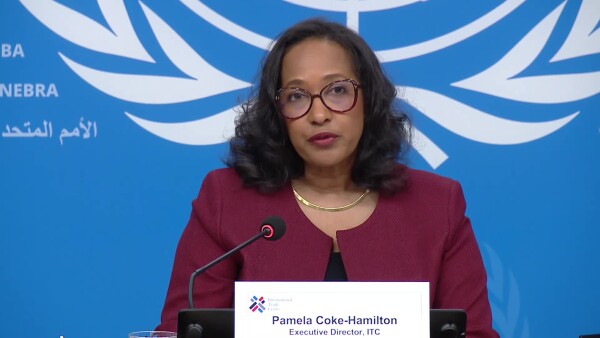
“There will be shifting, I think, in supply chains, there will be a reassessment of global alliances. There will be geopolitical shifts and economic as well,” said Pamela Coke-Hamilton, head of the International Trade Centre (ITC).
Speaking in Geneva after Wednesday’s announcement by the White House of a 90-day pause on “reciprocal tariffs” for most countries with the exception of China, Mrs. Coke-Hamilton noted that exports from Mexico had already been “highly impacted” by earlier seismic changes to US trade policy.
“Countries like Mexico, China and Thailand, but also countries in southern Africa are among the most affected, alongside the US itself,” she said.
While the 90-day pause on the so-called reciprocal tariffs applies to imports from most countries and brings down rates to a still hefty 10 per cent, tariffs on imports from China currently stand at 145 per cent.
China, meanwhile, has raised tariffs against US exports – in effect import taxes on goods – to 125 per cent.
Already, Mexico’s products for export have shifted away from markets such as the US, China, Europe and other Latin American countries to make “modest gains” instead in Canada, Brazil “and to a lesser extent, India”, the ITC chief insisted.
Other countries have followed suit, including Vietnam, whose exports “are redirecting away from the US, Mexico and China”, while “increasing substantially” towards the EU, South Korea and others, said Mrs. Coke-Hamilton, whose UN specialised agency offers assistance to developing countries.
The problem for emerging economies is that they are less well equipped to “pivot” when faced with “instabilities”, the ITC chief explained, since they often lack the manufacturing diversity and ability to add value to raw commodities of more industrialized nations.
Especially vulnerable trading partners of the US include Lesotho, Cambodia, Lao PDR, Madagascar and Myanmar that are “the most exposed”, she continued.
Confirming that the World Trade Organization (WTO) had estimated that commerce between China and the US could drop by up to 80 per cent if the highly unusual situation continues, the ITC Executive Secretary pointed out that they constituted only “three per cent to four per cent of world trade…(so) there's 96 per cent out there that's still trading and that will trade”.
Nonetheless, the impact of the “indeterminate extension of 90 days on and on” has not been good for global commerce and “does not necessarily lend itself to stability”, Mrs. Coke-Hamilton continued.
“Irrespective of whether there is an extension, on and on, the fact that there is no stability, there's no predictability will affect trade and firms and decisions that are being made in real time.”
She added: “This wouldn't be the first time that there have been tremors in the world economic system. We've seen it over the last 50 years in different dispensations. This one is probably a little more harsh, a little more tremulous.”
STORY: Tariff uncertainty and potential - ITC
TRT: 03’11”
SOURCE: UNTV CH
RESTRICTIONS: NONE
LANGUAGE: ENGLISH / NATS
ASPECT RATIO: 16:9
DATELINE: 11 APRIL 2025 GENEVA, SWITZERLAND
Speakers:
- Pamela Coke-Hamilton, Executive Director, International Trade Centre, ITC
SHOTLIST
- Exterior medium shot: Palais des Nations, Flag Alley
- Wide, Press room podium speakers, photographer.
- SOUNDBITE (English) – Pamela Coke-Hamilton, Executive Director, ITC: “You would have seen that the US on Wednesday announced a 90-day pause on the so-called reciprocal tariffs on imports from most countries, bringing down rates to 10 per cent while raising tariffs on imports from China to 145 per cent. China, in the meantime, has raised tariffs on imported US goods to 84 per cent.”
- Medium, podium speakers.
- SOUNDBITE (English) – Pamela Coke-Hamilton, Executive Director, ITC: “This wouldn't be the first time that there have been tremors in the world economic system. We've seen it over the last 50 years in different dispensations. This one is probably a little more harsh, a little more tremulous.”
- Wide, podium speakers, Press room, TV camera, control booths, TV screens.
- SOUNDBITE (English) – Pamela Coke-Hamilton, Executive Director, ITC: “So there will be shifting, I think, in supply chains, there will be a reassessment of global, alliances. There will be geopolitical shifts and economic as well.”
- Wide, podium speakers, Press room.
- SOUNDBITE (English) – Pamela Coke-Hamilton, Executive Director, ITC: “Countries like Mexico, China and Thailand, but also countries in southern Africa are among the most affected, alongside the United States itself.”
- Wide, Press room, journalists, participants.
- SOUNDBITE (English) – Pamela Coke-Hamilton, Executive Director, ITC: “Global trade could shrink by three per cent, with significant long-term shifts in trade patterns and economic integration. For example, exports from Mexico, which have been highly impacted, are shifting from markets such as the US, China, Europe and even other Latin American countries, with modest gains instead in Canada and Brazil and to a lesser extent, India.”
- Wide, Press room, journalists, TV screens.
- SOUNDBITE (English) – Pamela Coke-Hamilton, Executive Director, ITC: “Similarly, Vietnamese exports are redirecting away from the US, Mexico and China, while increasing substantially towards minor markets the EU, Korea and others.”
- Wide, journalists, photographer, TV screens.
- SOUNDBITE (English) – Pamela Coke-Hamilton, Executive Director, ITC: “Least Developed Countries including Lesotho, Cambodia, Lao PDR, Madagascar and Myanmar are most exposed to instabilities in the global trading system and least equipped to pivot as needed.”
- Medium-wide, Press room.
- SOUNDBITE (English) – Pamela Coke-Hamilton, Executive Director, ITC: “China and the US constitute about three per cent to four per cent of world trade. So therefore, if you look at it in, in big numbers, there's 96 per cent out there that's still trading and that will trade.”
- Medium, photographer.
- SOUNDBITE (English) – Pamela Coke-Hamilton, Executive Director, ITC: “The indeterminate extension of 90 days on and on does not necessarily lend itself to stability. So, irrespective of whether there is an extension on and on, the fact that there is no stability, there's no predictability will affect trade and firms and decisions that are being made in real time.”
- Medium-wide, Press room.
- Wide, podium speakers, photographer, journalists.
- Wide, podium speakers, photographer.
- Wide, TV cameras, control booths.
Similar Stories

2
17
1
2
Edited News , Press Conferences | OCHA , WMO
Two UN agencies teamed up on Wednesday to issue an appeal for immediate assistance to help communities already being impacted by the strongest El Niño on record.

3
16
2
2
B-roll , Conferences , Edited News | UNITED NATIONS , UNOG
Sixth Consultative Meeting on Enhancing Coordination of Peace Initiatives and Efforts for Sudan

1
1
1
Edited News | UNICEF , WHO , UNHCR
Yemen war continues to force families from homes amid hunger and disease
More than 250,000 people have now fled renewed fighting in Yemen, the UN said on Tuesday, citing particular concern for those sheltering in the southwestern city of Taiz and the wider governorate, where access is “essentially blocked”.

1
1
1
Edited News | UNICEF
A little over one year since a ceasefire agreement was announced between Hamas fighters and Israel, more than 340 children have been reported killed and hundreds more injured, the UN Children’s Fund, UNICEF, said on Friday.

1
1
1
Edited News | UNICEF , IFRC
Six weeks after Nepal’s deadly flooding disaster, communities are still struggling to rebuild their lives, but they will need sustained help as global warming increases the risk of another Himalayan catastrophe, the UN Children’s Fund (UNICEF) said on Friday.

1
1
1
Edited News | WHO
In suspected Russia plague death, testing and monitoring underway – WHO
The death of a lab worker in Russia’s Siberia region has sparked concerns about plague being the cause, the UN World Health Organization (WHO) said on Tuesday, adding that it was following the situation closely.

1
1
Edited News | OHCHR , UNOG
UN Human Rights Chief Volker Türk on Friday provided and oral update to the 63rd session of the Human rights Council on Ukraine.

1
1
1
Edited News | OHCHR , UNOG
UN Human Rights Chief Volker Türk on Friday provided and oral update to the 63rd session of the Human rights Council on the human rights situation in Haiti.

1
1
1
Edited News | WHO
Repeated delays in bringing lifesaving medicines, prosthetics and more from Israel into Gaza risk having devastating consequences on Palestinians who urgently need them in the wartorn enclave, the UN World Health Organization (WHO) said on Friday. “A truck full of non-priority supplies or the right supplies arriving too late, doesn't save lives. That's the question that actually matters," said Dr Reinhilde Van De Weerdt, WHO Representative in the OPT.

1
1
1
Edited News | WHO
DRC: Early access to care and oxygen decisive for Ebola patients’ survival – WHO
In the Democratic Republic of the Congo (DRC), health workers fighting the country’s largest-ever Ebola outbreak are struggling to overcome critical challenges to patient care, the UN World Health Organization (WHO) warned on Tuesday.

1
1
1
Edited News | OCHA , UN
Civilians in Iran are continuing to feel the consequences of months of conflict and military escalation, the UN’s top official in the country has said, as loss of life, damage to civilian infrastructure and mounting economic pressures leave many facing continued uncertainty.

1
1
1
Edited News | WHO , UNICEF
Aid agencies in Yemen highlighted the growing hunger emergency sparked by renewed fighting between Houthi opposition forces and Government troops, after mobile health clinics reported that hundreds of children displaced by the violence are suffering from the most deadly form of malnutrition.