

The United Nations Office at Geneva
Multimedia Newsroom
Press Conferences | UNDP , UNCTAD , HRC , UNHCR , WHO
UN Geneva Press Briefing - 18 June 2024
UN GENEVA PRESS BRIEFING
18 June 2024
Public support for refugees
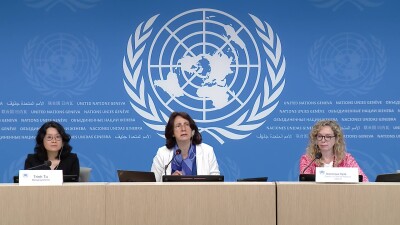
Trinh Tu, Managing Director of Public Affairs at Ipsos, said that Ipsos had been conducting a global annual survey on attitudes towards refugees since 2017. It was the largest survey to date, covering over 50 countries and more than 30,000 citizens. Differences among countries were quite significant, said Ms. Tu, who explained that the survey had been conducted online.
Dominique Hyde, Director of External Relations at the United Nations Refugee Agency (UNHCR), said that the survey (the embargo on which would be lifted at 12 noon today) showed overall support for refugees, but the picture was complex. There was global support and compassion for refugees and their right to seek asylum. The survey, conducted in 52 countries, showed that the vast majority agreed that those fleeing war and persecution were entitled to seek safety from those different threats. Unfortunately, refugees had also become a pawn in internal political games, but most people were quite reasonable and practical, and aware that under different circumstances they could be the ones seeking safety. Ms. Hyde provided several examples from around the world of citizens organizing to support refugees in their countries. At least half of the surveyed people thought that refugees should be given access to education, as well as healthcare; reunification of families was also largely supported. Countries with generous refugee policies, such as Uganda and Kenya, showed a more positive attitude towards refugees and their impact on host communities. Kenya hosted over 600,000 refugees and asylum seekers, she reminded; when there was daily interaction, it helped combat ignorance and negative attitudes.
Ms. Hyde acknowledged that the results were not all positive: for example, the support for refugees had declined in major host countries and some Western countries. Skepticism was coupled with the worry over the refugees’ ability to integrate, and there were also concerns over the impact of the refugees on national security. Refugees and people on the move were often politicized and represented as a threat. Media were generally perceived as trusted sources of information, but there had recently been an increasing trend to target refugees on social media. It was hoped that more people would stand up and change the misinformation and disinformation narratives, which would help fight xenophobia. On the World Refugee Day, later this week, the UNHCR would celebrate refugees’ strength and contribution to host societies. Ms. Hyde stressed that it was heartwarming that many people were taking action to support refugees through their own individual and community actions. Almost 40 percent of people surveyed believed that the aid provided to countries hosting refugees was insufficient; more support was needed especially to low- and middle-income countries, which were hosting most refugees.
Alessandra Vellucci, for the United Nations Information Service (UNIS), said that today was the International Day for Countering Hate Speech; 19 June would be the International Day for the Elimination of Sexual Violence in Conflict, and 20 June - the World Refugee Day. The Secretary-General’s messages on these occasions had been shared.
Responding to questions, Ms. Tu, for Ipsos, said that the data around the world varied, but one element that was present across different countries was compassion towards refugees. There were tensions and doubts as well, nonetheless, such as on the question of closing borders. The report included both global and country averages. Twenty-two new countries had been included in this year’s survey. The trend had overall become more positive after the invasion of Ukraine in 2022, explained Ms. Tu; this had been the case in both Global North and other regions of the world. On another question, Ms. Hyde, for the UNHCR, said that the anti-refugee narrative in certain countries, including France and some other European countries, was often fed with misinformation and disinformation. Uganda was one of the most generous refugee-hosting countries, she said, which had long had a welcoming policy towards displaced people from neighbouring countries.
Also answering questions, Ms. Hyde explained that UNHCR’s communications through social media was part of its broader communications efforts; it was just one of the platforms where the organization was actively combating hate speech, misinformation, and disinformation. Ms. Vellucci said that the United Nations was using all available platforms to promote UN values and to help create an environment free of hate speech. Principles of information integrity were in preparation by the United Nations to serve as guidelines for national policies, Ms. Vellucci stressed, and would soon be made public. Ms. Tu said that social media was a major channel of communication which could not be ignored. People generally understood that they could not trust everything they saw on social media, but many still depended on those platform as the leading source of information. On another question, she explained that in European countries, there was now more concern than in 2017 about refugees’ integration and contribution to the local societies.
Human Rights Council
Pascal Sim, for the United Nations Human Rights Council (HRC), said that this morning the Human Rights Council had opened its 56th regular session. Volker Türk, United Nations High Commissioner for Human Rights, had presented its Global Update. The Council was now holding an interactive dialogue with the High Commissioner on his report on Myanmar, after which there would be an interactive dialogue on the report of the Special Rapporteur on the situation of human rights in Afghanistan. Later in the day, the Council would hear for the first time from the Independent International Fact-Finding Mission for Sudan, which would present an oral update. The following day, the Council would hear from the United Nations Independent International Commission of Inquiry on the Occupied Palestinian Territory, including East Jerusalem, which would also hold a press conference on 19 June at 1:30 pm. On 20 June, the morning meeting would start at 9 am for an informal discussion on climate change and food security, which would feature heads of several UN agencies, informed Mr. Sim.
Responding to a different question, Tarik Jašarević, for the World Health Organization (WHO), said that unsafe abortion was a major and preventable cause of maternal mortality. Lack of access to safe, timely and affordable abortion was considered a serious public health issue in a world where some 73 million induced abortions took place every year. WHO was thus strongly advocating for safe abortion. There should be no legal obstacles to having access to safe abortion, he stressed.
Announcements
Catherine Huissoud, for the United Nations Trade and Development (UNCTAD), informed that UN Trade and Development would launch on 20 June at 10:30 am its annual World Investment Report entitled Investment Facilitation and Digital Government. The report would show that global flows of investment had stagnated in 2023, while new funding into sectors relevant to the Sustainable Development Goals had fallen. Foreign investment had remained subdued amid the global economic slowdown and rising geopolitical tensions. Insufficient funding had hampered efforts to achieve the 2030 Agenda, urging policy action to keep up sustainable finance. Ms. Huissoud added that business facilitation and digital government solutions could facilitate a transparent and streamlined environment to address the root causes of low investment. Press kit would be available on 19 June, she informed.
Sarah Bel, for the United Nations Development Programme (UNDP), said that on 20 June, UNDP would publish the second iteration of The Peoples’ Climate Vote 2024. The survey had been conducted with Oxford University and GeoPoll. This was the world's largest public opinion survey on climate change: more than 75,000 people speaking 87 different languages across 77 countries had been asked 15 questions on climate change for the survey. The results offered a country-by-country snapshot of where the world’s citizens stand on climate change. The embargo would be in place until 6 am on 20 June.
Alessandra Vellucci, for the United Nations Information Service (UNIS), said that there would be no meetings of human rights treaty bodies until 1 July, when the Human Rights Committee would open its 141st session.
***
Similar Stories
1
1
1
Press Conferences | UPU
Release of the State of the Postal Sector Report 2026
1
1
1
Press Conferences | IOM , ITU , UNECE , UNICEF , WHO , WMO
UNICEF: Ebola, DRC - children orphans or separating them from parents and caregivers; IOM: Humanitarian needs in Djibouti amid arrivals from Yemen and increased migrant movements; WHO: Darfur, scale of health needs far exceeds available resources; WMO co-sponsored Global Heat Forum, Bangkok, monthly Global Seasonal Climate Update; UNECE: UN Forum of Mayors; ITU Plenipotentiary Conference 2026; WHO: child and adolescent obesity guidelines and new global roadmap to tackle pregnancy hypertension, a leading cause of maternal mortality
1
1
1
Press Conferences | OCHA , UN WOMEN , UNHCR , WFP , WHO , WTO , UNEP
OCHA – $160M CERF allocation to 12 underfunded crises; UNHCR – 5.8M refugee children remain out of school amid funding cuts; UN Women – Middle East escalation and food security among women/girls; WHO – Gaza supplies and overall situation; WFP – Yemen food insecurity and impact on global hunger ; UNEP - First International Conference of the Global Framework on Chemicals in Geneva | 16-20 November 2026
1
1
1
Press Conferences | UNHCR , WHO
Yemen's health system nears collapse amid conflict, causing rising casualties and medicine shortages.
1
1
1
Press Conferences | HRC
Update by the Expert Mechanism to Advance Racial Justice and Equality in Law Enforcement
1
1
1
Press Conferences | WIPO , WHO , UNICEF , UNHCR , IOM , WFP , FAO
WIPO Global Innovation Index 2026 launch and press conference, WHO Composition of influenza vaccines for the 2027 Southern Hemisphere flu season, UNICEF Yemen hunger and malnutrition; UNHCR Sudan displacement into Chad; IOM Ebola and population movements in DRC; WFP emergency food assistance in Nepal; and FAO food loss and waste.
2
1
2
Press Conferences | UNCTAD
Gaza reconstruction needs reach $71.5 billion as Palestinian economy and public finances face severe strain. Latest UNCTAD report documents the loss of decades of development gains, economic collapse in Gaza and tightening economic constraints in the West Bank.
The report identifies three immediate priorities: transferring withheld Palestinian revenues, safeguarding the banking system and aligning reconstruction support with the documented scale of damage and economic losses.
1
1
1
Press Conferences | HRC
Press conference on the situation of human rights in Nicaragua by the UN Group of Human Rights Experts
1
1
1
Press Conferences | ITU , UNHCR , WHO , WMO
YEMEN - UNHCR: Escalating conflict in Yemen could fuel more displacement, refugee movement
CLIMATE - WHO / WMO: Health and Climate impact of El Niño
1
1
1
Press Conferences | HRC , OHCHR
Mariana Katzarova discusses human rights in Russia as a UN Special Rapporteur.
1
1
1
Press Conferences | IOM , OHCHR , UN WOMEN , UNFPA , UNHCR , UNOPS , WHO
UN Geneva briefing: Yemen crisis worsens, urgent aid needed across multiple sectors.
1
1
1
Press Conferences | HRC
Press conference on the latest report of the Independent International Fact-Finding Mission on the Bolivarian Republic of Venezuela to the UN Human Rights Council