

The United Nations Office at Geneva
Multimedia Newsroom
UN Rights Chief calls for an end to “carnage in Gaza”
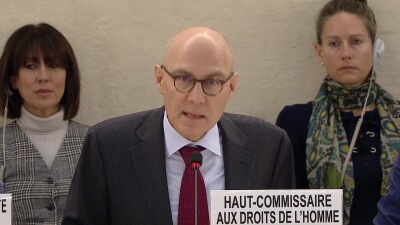
After almost five months of constant Israeli bombardment and mass displacement in the Palestinian enclave which has left more than 30,000 dead, the UN rights chief Volker Türk told the Human Rights Council on Thursday that the “carnage in Gaza” has to stop.
“The war in Gaza must end. Clear violations of international human rights and humanitarian laws, including war crimes and possibly other crimes under international law, have been committed by all parties,” Mr. Türk said. “It is time, well past time, for peace, investigation and accountability.”
In his report to the 47 Member States forum, Mr. Türk underscored that the attacks on Israeli civilians on 7 and 8 October were “shocking, profoundly traumatizing and totally unjustifiable”. He described the torture and sexual violence reportedly inflicted by Hamas and other Palestinian armed groups as “appalling and entirely wrong.”
Also wrong, the High Commissioner said, is the brutality of the Israeli response with “the unprecedented level of killing and maiming of civilians in Gaza.” It is estimated that one out of every 20 inhabitants of Gaza have been killed or wounded.
“Thousands of tons of munitions have been dropped by Israel on Gaza, including repeated use of explosive weapons with wide area effects,” said Mr. Türk. “These weapons send out massive blast wave of high pressure that may rupture internal organs as well as fragmentation projectiles and heat so intense that it causes deep burns - and they have been used in densely populated residential neighborhoods.”
The report by the Human Rights Office noted that between 8 and 21 October 2023, Israel imposed a complete ban on all supply of aid, food, fuel and electricity to Gaza. Since then, Israel has continued to hinder humanitarian assistance.
“All people in Gaza are at imminent risk of famine. Almost all are drinking salty and contaminated water,” said the UN High Commissioner. “Healthcare across the territory is barely functioning. Just imagine what this means for the wounded, and for people suffering infectious disease outbreaks. In northern Gaza, where the operational space for humanitarian work is now almost zero, many are already believed to be starving.”
Mr. Türk issued a stark warning, that the prospect of an Israel ground assault on Rafah would take the nightmare being inflicted on people in Gaza to a new dimension. Over 1,5 million people are sheltering in Rafah, despite continuing bombardment it has become Gaza’s humanitarian aid hub. He said that he believed such an operation would be inconsistent with the binding provisional measures issued by the International Court of Justice to prevent genocide against Palestinians in Gaza.
The High Commissioner reminded the Council that the goal is to achieve a safer, more peaceful future for all. “We must hold on to the promise that peace is achievable in the occupied Palestinian territory and Israel,” he said. “For that to work, the occupation must end. Israeli leaders must accept the right of Palestinians to live in an independent state and all Palestinian factions must accept the right of Israel to exist in peace and security.”
Israel’s Permanent Representative to the UN in Geneva, Meirav Eilon Shahar, insisted on her countries right to defend itself. There was “no choice,” she said. “We must go after Hamas or they will continue to come after us,” the Ambassador stated, “ as Hamas rained down rockets on us, even as our hostages remain in captivity, even as Hamas continues to carry out heinous terrorist attacks, Israel is absolutely committed to conducting itself in accordance with IHL (International Humanitarian Law).”
Sitting with two freed Israeli hostages - Aviva Siegel and Raz Ben Ami - who held hands to support one another during the debate, the Israeli ambassador asked the Council: “If Israel withdraws from Gaza tomorrow, do you think Hamas would lay down its arms? Do you think Hamas will commit to not rebuilding its tunnel, and restoring its terrorist arsenal and instead commit to justice and peace? You think, if Israel stops this war today, Hamas will return all our hostages tomorrow? Mister High Commissioner, the answer is simply no!”
Palestinian representative Ibrahim’s Khraishi earned spontaneous applause after his statement: “It is enough! The world is witnessing this crime and this genocide. Everyone says or tries to believe this false claim as she (the Israeli Ambassador) just mentioned that they respect the law.”
Ambassador Khraishi noted that “unfortunately nobody remembers or condemns the killing of children, women and the elderly.” Some 12,000 children and 8,000 women were among the victims from the conflict, Mr. Khraishi said.
He also reminded the Council that it should ”take into consideration the fact that things have not started on 7th October. 75 years of Nakba, 56 years of occupation, 17 years of siege. No one remembers that there were more than 19,000 Palestinian civilian martyrs from (the year) 2000 to October 7th (2023). We did not hear any condemnation from anyone. There is a moral, humanitarian and racial fall.”
-ends-
STORY: UN High Commissioner for Human Rights on OPT
TRT: 4:44”
SOURCE: UNTV CH
RESTRICTIONS: NONE
LANGUAGE: ENGLISH / NATS
ASPECT RATIO: 16:9
DATELINE: 29 February 2024 GENEVA, SWITZERLAND
SHOTLIST
- Exterior medium shot: UN flag alley at the United Nations Office in Geneva
- Wide shot: Human Rights Room with ceiling and delegates
- SOUNDBITE (English) – Volker Türk, UN High Commissioner for Human Rights: “The war in Gaza must end. Clear violations of international human rights and humanitarian laws, including war crimes and possibly other crimes under international law, have been committed by all parties. It is time, well past time, for peace, investigation and accountability.”
- Medium shot: Photographers and huge screen showing speakers at the podium
- SOUNDBITE (English) – Volker Türk, UN High Commissioner for Human Rights: “Thousands of tons of munitions have been dropped by Israel on Gaza, including repeated use of explosive weapons with wide area effects. These weapons send out massive blast wave of high pressure that may rupture internal organs as well as fragmentation projectiles and heat so intense that it causes deep burns - and they have been used in densely populated residential neighborhoods.”
- Close up: Delegate of Israel
- SOUNDBITE (English) – Volker Türk, UN High Commissioner for Human Rights: “All people in Gaza are at imminent risk of famine. Almost all are drinking salty and contaminated water. Healthcare across the territory is barely functioning. Just imagine what this means for the wounded, and for people suffering infectious disease outbreaks. In northern Gaza, where the operational space for humanitarian work is now almost zero, many are already believed to be starving.”
- Close up: Delegate of State of Palestine
- SOUNDBITE (English) – Volker Türk, UN High Commissioner for Human Rights: “And yet we must hold on to the promise that peace is achievable in the occupied Palestinian territory and Israel. For that to work, the occupation must end. Israeli leaders must accept the right of Palestinians to live in an independent state and all Palestinian factions must accept the right of Israel to exist in peace and security.”
- Medium shot: Delegate of Israel
- SOUNDBITE (English) – Meirav Eilon Shahar, Permanent Representative of Israel to the United Nations in Geneva: “We have no choice we must go after Hamas or they will continue to come after us. But let me be clear. Even as Hamas rained down rockets on us, even as our hostages remain in captivity, even as Hamas continues to carry out heinous terrorist attacks, Israel is absolutely committed to conducting itself in accordance with IHL (International Humanitarian Law).”
- Medium shot: Photographers taking pictures
- SOUNDBITE (English) – Meirav Eilon Shahar, Permanent Representative of Israel to the United Nations in Geneva: “If Israel withdraws from Gaza tomorrow, do you think Hamas would lay down its arms? Do you think Hamas will commit to not rebuilding its tunnel, and restoring its terrorist arsenal and instead commit to justice and peace? You think, if Israel stops this war today, Hamas will return all our hostages tomorrow? Mister High Commissioner, the answer is simply no!”
- Wide shot, photographer taking pictures, delegates in the room
- SOUNDBITE (Arabic) Ibrahim Khraishi, Permanent Representative to the United Nations Office in Geneva, State of Palestine:
“It is enough! The world is witnessing this crime and this genocide. Everyone says or tries to believe this false claim as she (the Israeli Ambassador) just mentioned that they respect the law. But unfortunately, some also condemn what happened on October 7th in the strongest terms, but nobody remembers or condemns the killing of children, women, and the elderly.” - Close up: Cameras filming
- SOUNDBITE (Arabic) – Ibrahim Khraishi, Permanent Representative of the State of Palestine to the United Nations Office in Geneva: “You should take into consideration the fact, that things have not started on 7th October. 75 years of Nakba, 56 years of occupation, 17 years of siege. No one remembers that there were more than 19 000 Palestinian civilian martyrs from 2000 to October 7th. We did not hear any condemnation from anyone. There is a moral, humanitarian and racial fall.”
- Wide shot, speakers at the podium, big screen on the side showing delegates
- Close up: Delegates of the United States of America listening
- Close up: Delegate of Iran
Similar Stories

1
1
1
Edited News | UNICEF
A little over one year since a ceasefire agreement was announced between Hamas fighters and Israel, more than 340 children have been reported killed and hundreds more injured, the UN Children’s Fund, UNICEF, said on Friday.

1
1
1
Edited News | UNICEF , IFRC
Six weeks after Nepal’s deadly flooding disaster, communities are still struggling to rebuild their lives, but they will need sustained help as global warming increases the risk of another Himalayan catastrophe, the UN Children’s Fund (UNICEF) said on Friday.

1
1
1
Edited News | WHO
In suspected Russia plague death, testing and monitoring underway – WHO
The death of a lab worker in Russia’s Siberia region has sparked concerns about plague being the cause, the UN World Health Organization (WHO) said on Tuesday, adding that it was following the situation closely.

1
1
Edited News | OHCHR , UNOG
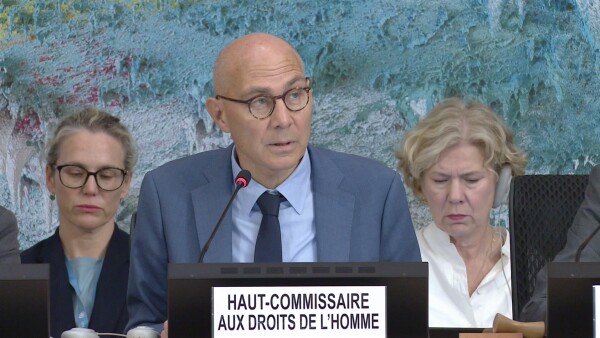
UN Human Rights Chief Volker Türk on Friday provided and oral update to the 63rd session of the Human rights Council on Ukraine.
2
1
2
Statements , Conferences | HRC , OHCHR
Interactive dialogue with the High Commissioner for Human Rights, Volker Türk on the oral update on Ukraine.

1
1
1
Edited News | OHCHR , UNOG
UN Human Rights Chief Volker Türk on Friday provided and oral update to the 63rd session of the Human rights Council on the human rights situation in Haiti.

1
1
1
Edited News | WHO
Repeated delays in bringing lifesaving medicines, prosthetics and more from Israel into Gaza risk having devastating consequences on Palestinians who urgently need them in the wartorn enclave, the UN World Health Organization (WHO) said on Friday. “A truck full of non-priority supplies or the right supplies arriving too late, doesn't save lives. That's the question that actually matters," said Dr Reinhilde Van De Weerdt, WHO Representative in the OPT.

1
1
1
Edited News | WHO
DRC: Early access to care and oxygen decisive for Ebola patients’ survival – WHO
In the Democratic Republic of the Congo (DRC), health workers fighting the country’s largest-ever Ebola outbreak are struggling to overcome critical challenges to patient care, the UN World Health Organization (WHO) warned on Tuesday.

1
1
1
Edited News | OCHA , UN
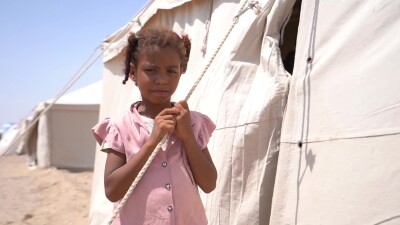
Civilians in Iran are continuing to feel the consequences of months of conflict and military escalation, the UN’s top official in the country has said, as loss of life, damage to civilian infrastructure and mounting economic pressures leave many facing continued uncertainty.
1
1
1
Edited News | WHO , UNICEF
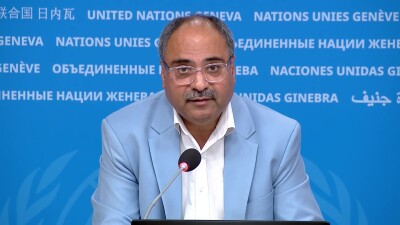
Aid agencies in Yemen highlighted the growing hunger emergency sparked by renewed fighting between Houthi opposition forces and Government troops, after mobile health clinics reported that hundreds of children displaced by the violence are suffering from the most deadly form of malnutrition.
1
1
1
Edited News | UNHCR
Displacement on the rise in Yemen as fighting continues - UNHCR
As hostilities worsen in Yemen, more people have been fleeing their homes, further intensifying the humanitarian crisis within the region, the UN Refugee Agency (UNHCR) warned on Tuesday.
1
1
1
Statements , Conferences | HRC , OHCHR
Interactive dialogue on the oral update of the Independent International Commission of Inquiry on Ukraine at the 63rd regular session of the Human Rights Council