

The United Nations Office at Geneva
Multimedia Newsroom
Press Conferences | ITU , OHCHR , UNHCR , UNICEF , UNITED NATIONS , UNOG
Bi-weekly press briefing - 29 August 2023
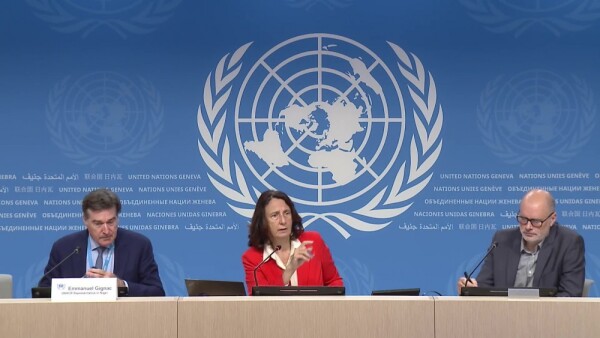
Alessandra Vellucci of the United Nations Information Service (UNIS) in Geneva, chaired the hybrid briefing, attended by the spokespersons and representatives of the United Nations Children’s Fund, the United Nations High Commissioner for Refugees, the Office of the High Commissioner for Human Rights and the International Telecommunication Union.
PRESS BRIEFING BY THE UNITED NATIONS INFORMATION SERVICE
29 August 2023
Impact of the war on Ukrainian children’s education
Regina de Dominicis, Regional Director for Europe and Central Asia for the United Nations Children’s Fund (UNICEF) said that last week, teachers preparing for the school year were among the casualties of an attack on a civilian area in the Ukrainian city of Romny. On the same day, a kindergarten in Kherson city was hit in another attack. These senseless and reckless attacks left many of Ukraine’s children deeply distressed and without a safe space to learn. Just one in three schoolchildren in Ukraine were learning in person fulltime. Three-quarters of children of preschool age in frontline areas were not attending kindergarten. As a result, children in Ukraine were showing signs of widespread learning loss, including a deterioration in learning outcomes of the Ukrainian language, reading and mathematics.
Later this week, Ukraine’s school age children would return to school, which would mark the fourth consecutive year of disrupted schooling. Ms. de Dominicis had been in Ukraine last week, meeting teachers and children who bore the mental scars of war. Up to 57 per cent of teachers reported a deterioration in students’ Ukrainian language abilities, up to 45 per cent reported a reduction in mathematics skills, and up to 52 per cent reported a reduction in foreign language abilities. In response, UNICEF was supporting children’s mental health through counselling and psychosocial support, catch up classes, providing learning materials including those on mine safety, training teachers, and continuing to rehabilitate school shelters. For the millions of children who had fled Ukraine, more than half were not enrolled in national education systems in their host countries.
Responding to questions Ms. de Dominicis said the schools were getting ready for the new academic year. When it came to yesterday’s school attack, data was still being verified and an assessment would be provided. UNICEF had registered more than 1300 schools which had been destroyed, in an assessment carried out in partnership with the Ukrainian Ministry of Education. UNICEF was engaged in providing support, both in Ukraine and in other countries, to ensure children could enrol in a new education system, address language barriers, and help parents adjust to sending their children to school in a new country.
Ms. de Dominicis said UNICEF called on all parties to the conflict to ensure infrastructure such as hospitals and schools were not a target. Children faced language difficulties when attending school in countries outside Ukraine, including Poland, the Czech Republic and Moldova. Previously families were using online systems but as the war persisted, they realised an in-person teacher was needed. Children were very resilient and up until the age of five could learn many languages, so it was hoped they would be able to adapt to school in a new language. Parents of refugee children were sometimes reluctant to bring them back into the school system, due to fears for their safety and past traumas. In some countries, like Moldova, which had a small education system, the system was already overwhelmed.
Responding to further questions, Ms. de Dominicis said the numbers she had provided were on the Ukrainian side. There was no access to schools in non government-controlled areas. UNICEF continued to engage with all parties, and family reunification and the best interests of the child continued to be the goal. Ms. de Dominicis had visited a few schools in Ukraine including kindergartens, and they were very well organised. She had been amazed at the resilience of the children and their ability to play despite the conflict occurring.
UNHCR fears an escalating protection crisis in Niger
Emmanuel Gignac, the United Nations High Commissioner for Refugees (UNHCR) Representative in Niger, said he had been in Niger before the coup on 26 July, which had taken everyone by surprise. UNHCR were concerned about the situation because it was a political crisis which was already starting to have humanitarian implications. Attacks by non-state armed groups, which existed before the coup, were also concerning and it was too early to say whether they had increased. The attacks on 26 July had led to further displacement of internally displaced people. Niger received refugees from Mali who were arriving in dangerous areas. The sanctions imposed by the ECOWAS were another concern, with no existing mechanism for exceptions for humanitarian relief. A letter had been written by the UN Emergency Relief Coordinator, to seek exceptions from the sanctions when it came to humanitarian aid. There had been an increase in food and commodity prices, and it was expected this would continue. This lack of access could lead to protection risks, including sexual violence, trafficking, and exploitation.
UNHCR had observed a 50 percent increase in protection risks, and had observed an additional 20,000 internally displaced people, with 2500 refugees primarily from Mali, who were entering the country seeking asylum. Until now, Niger had been a hub for refugees and was on the migration route to North Africa. UNHCR had updated their contingency plans for the country. It was evident that there would be negative effects if the ECOWAS sanctions were not lifted, and sufficient humanitarian aid could not be brought in. UNHCR had established an Emergency Transit Mechanism which allowed asylum seekers to be evacuated. This was not expected to stop. It was expected that a flight scheduled for September would take off as planned, or at a slightly later stage. There were needs in Niger and donors needed to be ready to disperse larger amounts if the situation continued to deteriorate.
Responding to questions, Mr. Gignac said there was currently no special appeal for Niger, as the humanitarian crisis had not yet erupted. The immediate issue was food and access to medicine. It was difficult to say what would happen. UNHCR were calling for the lifting of sanctions and exceptions for humanitarian aid. The organization was limited in their ability to move around the country. Jet fuel was limited and UNHCR were looking at ways to bring this into the country. The shortage of electricity was also an issue. Mr. Gignac said UNHCR were primarily looking at displacement figures, which were difficult to predict. It was expected that the refugee flow would continue as before. The sanctions needed to be lifted to ensure that cash flow transfers and food could be provided, in the event the situation did deteriorate.
Matthew Saltmarsh, for the Office of the High Commissioner for Human Rights (OHCHR), said there were 700,000 forcibly displaced people in the country, half of them being refugees and asylum seekers and half of them internally displaced. There had not been significant movement across borders in Niger in recent weeks, but there had been internal displacement.
Mr. Gignac said the two main non-state actors in Niger were the Islamic state established on the Mali side, and an Al-Qaeda affiliated group on the right side of the riverbank. Criminal gangs in the Mali region enacted similar damage and acts of violence.
Responding to further questions, Mr. Gignac said that only the French ambassador had been targeted. There was an uncertain atmosphere and people were worried. Niger was hosting the largest number of refugees from Nigeria, and it was possible that some might choose to return. Currently there had not been movements of people leaving Niger. Mr. Gignac said the evacuation of expatriates did not have an impact on UN staff, apart from on morale. He did not think there was an anti- Western feeling.
Online Scam Operations and Trafficking into Forced Criminality in Southeast Asia
Jeremy Laurence, for the Office of the High Commissioner for Human Rights (OHCHR), said hundreds of thousands of people were being forcibly engaged by organised criminal gangs into online criminality in Southeast Asia, from romance-investment scams and crypto fraud to illegal gambling, according to a new OHCHR report. Victims faced a range of violations and abuses, and many had been subjected to torture and cruel, inhuman and degrading treatment or punishment, arbitrary detention, sexual violence, forced labour, and other human rights abuses. Credible sources indicated that at least 120,000 people across Myanmar could be held in situations where they were forced to carry out online scams, with estimates in Cambodia at around 100,000 people. The scam centres generated revenue amounting to billions of US dollars each year.
Most people trafficked into the online scam operations were men and most were not citizens of the countries in which the trafficking occurred. Many of the victims were well-educated, sometimes coming from professional jobs or with degrees, computer-literate, and multi-lingual. Victims came from across the ASEAN region, mainland China, Hong Kong and Taiwan, South Asia, and further afield from Africa and Latin America. While some countries in Southeast Asia had put in place relevant legal and policy frameworks, in some cases they fell short of international standards. Victims of trafficking were being erroneously identified as criminals or as immigration offenders and, rather than being protected, were subjected to criminal prosecution or immigration penalties.
The full statement is available here.
Pia Oberoi, Senior Advisor on Migration and Human Rights- Asia Pacific, for the Office of the High Commissioner for Human Rights (OHCHR), speaking from Bangkok, said the Office had identified a changing profile of victims, who were educated and multi-lingual young men, as well as the changing profile of the countries where the trafficking was taking place. This was unfolding in countries where regulation was weak, including Myanmar, Lao, and Cambodia. Regulation was also challenging in the digital sphere, including on social media and apps, where victims were often recruited. Even if victims were able to escape, many were penalised for immigration offenses, or prosecuted for crimes they were forced to commit. Many were left destitute and unable to return to their home countries. High Commissioner Volker Türk called for a holistic rights-based regional strategy which would place protection of victims at the centre of the response and strengthen human rights and accountability in the region.
Responding to questions, Ms. Oberoi said the response called for a holistic approach and a 360-degree vision on why people were being fraudulently recruited, and the concerns they faced. There was a lack of awareness among frontline officials, that young men could be victims of trafficking. OHCHR stood ready to support those who were affected and would work with private sector hosts of the platforms where the recruitment was taking place.
Ms. Oberoi said this phenomenon initially occurred in the context of COVID-19, where there were robust lockdowns which caused an implosion in the gambling towns located on the countries’ borders. Criminal actors were looking to diversify their operations as many of their sources of income had been reduced. This meant middle class, educated young people, who were out of jobs due to the lockdowns and economic instability in the region, were faced with aggressive, sophisticated recruitment, enticing them to these countries. It was difficult to imagine, but according to information received, the number provided by OHCHR were under-estimated. Raids would rescue thousands of people a time. There had been long standing concerns of fraudulent behaviour in the region, and this meant that red flags were not initially raised. This spoke to the sophistication of the fraudulent activity, and the reach and spread of the criminal actors.
Ms. Oberoi said there were several legal frameworks, including the ASEAN Trafficking Convention, which had been put in place. The concern was in the implementation of these frameworks, as forced criminality was not recognised as a violation and instead victims of trafficking were being prosecuted for immigration penalties. The government needed to enforce criminality laws as part of their response. There was a high degree of corruption and collusion among governments and law enforcement officials, which was one of the obstacles to a rights-based response. There had been many media reports including on the pig butchering scheme, which was a romance scheme. A lot of the advancements were taking place on WhatsApp using sophisticated scripts. Victims were being coerced and faced physical and mental abuse and threats against their family members.
Responding to further questions, Ms. Oberoi said these were criminal organisations based in the countries where the scamming was taking place. Over the last month there had been responses by law enforcement to try and address this. These criminal actors were very mobile and could move countries easily, which was concerning. It was heartening to see that leaders in ASEAN had issued a joint declaration on this issue. OHCHR was only able to say that the amount in revenue was as high as billions of dollars. On average, a victim would be scammed out of 160,000 dollars. Another concern was that people were not reporting the incidents, due to the stigma of being scammed. Instead, victims were trying to recoup their losses privately.
Treated Water in Fukushima
Responding to questions, Jeremy Laurence, for the Office of the High Commissioner for Human Rights (OHCHR), said OHCHR was following the matter of treated water being released in Japan, and the Special Rapporteurs had already addressed the issue. Alessandra Vellucci, of the United Nations Information Service (UNIS), referred journalists to a 25 August press release by the International Atomic Energy Agency, which had provided real time data on the release of the water.
Ethiopia’s deteriorating human rights situation
Marta Hurtado, for the Office of the High Commissioner for Human Rights (OHCHR), said OHCHR were concerned about the deteriorating human rights situation in some regions of Ethiopia. In the Amhara region, following a flare-up in clashes between the Ethiopian military and the regional Fano militia, and the declaration of a state of emergency on 4 August, the situation had worsened considerably. At least 183 people had been killed in clashes since July, according to information gathered by the UN Human Rights Office.
The wide-ranging state of emergency gave the authorities broad powers nationwide, to arrest suspects without a court order, impose curfews and ban public gatherings. Reportedly
more than 1,000 people had been arrested across Ethiopia under the law. Since early August, mass house searches had reportedly been taking place, and at least three Ethiopian journalists had been detained. OHCHR called on the authorities to stop mass arrests, ensure that any deprivation of liberty was judicially reviewed, and to release those arbitrarily detained. The Office had also received allegations that at least 250 ethnic Tigrayans were detained in the disputed area of Western Tigray, reportedly in joint operations by the Amhara police, local authorities and local militia, including armed youth from Wolkait.
The full statement can be viewed here.
Responding to questions, Ms. Hurtado said the situation was very complicated. After the decision of the Government in April to integrate all the regional forces into one
original police, clashes began with the Amhara military and flared up in July through to August. The government then decided to impose the state of emergency, which was enacted to deal with the situation in the Amhara region but could be applied throughout the country. The enactment of the state of emergency meant the clashes got worse. Then the Amhara militias moved to occupy more rural areas and the government currently controlled most of the big towns and cities in the region. Another issue concerned Western Tigray, a zone which had been disputed by ethnic Tigrayans and ethnic Amharas. Since the war in Tigray, the Amhara special forces controlled the region. The Amhara militia were forcibly moving ethnic Tigrayans from Western Tigray to areas controlled by Tigran forces.
Decision of banning clothes in French schools
Marta Hurtado, for the Office of the High Commissioner for Human Rights (OHCHR), said the Office was aware of the announcement on the ban of wearing the abaya in schools in France, but was not in a position to comment in detail, given that it was not clear what exactly was planned nor how it would be implemented. However, on this topic, it was worth recalling that according to international human rights standards, limitations on manifestations of religion or belief, including choice of clothing, were only permitted in very limited circumstances – including public safety, public order, and public health or morals. In addition, under international human rights law, measures adopted in the name of public order must be appropriate, necessary, and proportionate. A further point was that achieving gender equality required understanding the barriers that prevented women and girls from making free choices, and creating an environment which supported their own decision-making, including but not limited to the choice of dress.
Announcements
Alessandra Vellucci of the United Nations Information Service (UNIS), said the Committee on the Rights of Persons with Disabilities would reviewing the report of Germany this afternoon, which would continue tomorrow at 10am. The closing of the Committee on the Elimination of Racial Discrimination would take place on Friday at 4.pm where the Committee would issue findings on Italy, Croatia, Uruguay, Namibia, Senegal, and Turkmenistan. A press conference would take place on Thursday at 1:30pm with the Vice Chairperson of the Committee.
Ms. Vellucci said a Ciné-Onu session was taking place on Thursday 31 August, the International Day for People of African Descent, which would show the film Descendent, on the search for and discovery of The Clotilda, the last known ship arrived in the United States, illegally carrying 110 kidnapped Africans. This event was open to the public and all were welcome at the Geneva movie theatre Cinerama Empire.
Ms. Vellucci said that today the international community commemorated the International Day Against Nuclear Tests. The Secretary-General had said legally binding prohibition on nuclear tests was a fundamental step towards a world free from nuclear weapons. The full message could be found here.
SDG Digital and the UN General Assembly High-Level Week
David Hirsch for the International Telecommunication Unit (ITU), said on 17 September, ITU, UNDP and partners, with the support of the Boston Consulting Group, would convene the SDG Digital at the United Nations Headquarters in New York. SDG Digital was part of the SDG Action Weekend planned for by United Nations Headquarters, ahead of the SDG Summit. The deadline to request media accreditation was 1 September. SDG Digital would explore the connections between digital technologies and the 2030 Agenda for Sustainable Development, with emphasis on how tech could support the SDGs. United Nations Headquarters credentialed reporters did not require additional accreditation.
Alessandra Vellucci said there was a new webpage dedicated to the UN General Assembly high-level week and there were several key events described on the webpage which could be find here.
Similar Stories
1
1
1
Press Conferences | IOM , ITU , UNECE , UNICEF , WHO , WMO
UNICEF: Ebola, DRC - children orphans or separating them from parents and caregivers; IOM: Humanitarian needs in Djibouti amid arrivals from Yemen and increased migrant movements; WHO: Darfur, scale of health needs far exceeds available resources; WMO co-sponsored Global Heat Forum, Bangkok, monthly Global Seasonal Climate Update; UNECE: UN Forum of Mayors; ITU Plenipotentiary Conference 2026; WHO: child and adolescent obesity guidelines and new global roadmap to tackle pregnancy hypertension, a leading cause of maternal mortality
1
1
1
Press Conferences | OCHA , UN WOMEN , UNHCR , WFP , WHO , WTO , UNEP
OCHA – $160M CERF allocation to 12 underfunded crises; UNHCR – 5.8M refugee children remain out of school amid funding cuts; UN Women – Middle East escalation and food security among women/girls; WHO – Gaza supplies and overall situation; WFP – Yemen food insecurity and impact on global hunger ; UNEP - First International Conference of the Global Framework on Chemicals in Geneva | 16-20 November 2026
1
1
1
Press Conferences | UNHCR , WHO
Yemen's health system nears collapse amid conflict, causing rising casualties and medicine shortages.
1
1
1
Press Conferences | HRC
Update by the Expert Mechanism to Advance Racial Justice and Equality in Law Enforcement
1
1
1
Press Conferences | WIPO , WHO , UNICEF , UNHCR , IOM , WFP , FAO
WIPO Global Innovation Index 2026 launch and press conference, WHO Composition of influenza vaccines for the 2027 Southern Hemisphere flu season, UNICEF Yemen hunger and malnutrition; UNHCR Sudan displacement into Chad; IOM Ebola and population movements in DRC; WFP emergency food assistance in Nepal; and FAO food loss and waste.
2
1
2
Press Conferences | UNCTAD
Gaza reconstruction needs reach $71.5 billion as Palestinian economy and public finances face severe strain. Latest UNCTAD report documents the loss of decades of development gains, economic collapse in Gaza and tightening economic constraints in the West Bank.
The report identifies three immediate priorities: transferring withheld Palestinian revenues, safeguarding the banking system and aligning reconstruction support with the documented scale of damage and economic losses.
1
1
1
Press Conferences | HRC
Press conference on the situation of human rights in Nicaragua by the UN Group of Human Rights Experts
1
1
1
Press Conferences | ITU , UNHCR , WHO , WMO
YEMEN - UNHCR: Escalating conflict in Yemen could fuel more displacement, refugee movement
CLIMATE - WHO / WMO: Health and Climate impact of El Niño
1
1
1
Press Conferences | HRC , OHCHR
Mariana Katzarova discusses human rights in Russia as a UN Special Rapporteur.
1
1
1
Press Conferences | IOM , OHCHR , UN WOMEN , UNFPA , UNHCR , UNOPS , WHO
UN Geneva briefing: Yemen crisis worsens, urgent aid needed across multiple sectors.
1
1
1
Press Conferences | HRC
Press conference on the latest report of the Independent International Fact-Finding Mission on the Bolivarian Republic of Venezuela to the UN Human Rights Council
1
1
1
Press Conferences | OHCHR
Victims Still Waiting: A Global Briefing on Transitional Justice Around the World