

The United Nations Office at Geneva
Multimedia Newsroom
Press Conferences | UNHCR , OCHA , WHO , UNCTAD , ILO
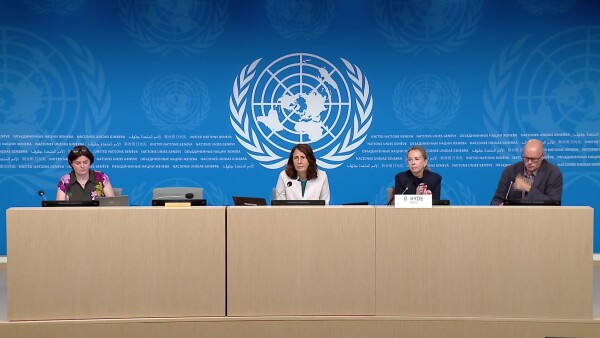
UNOG Bi-weekly press briefing 21 April 2020
Alessandra Vellucci, Director of the United Nations Information Service (UNIS), chaired the virtual briefing, which was attended by the spokespersons and representatives for the United Nations Refugee Agency (UNHCR), the International Labour Organization (ILO), the United Nations Conference for Trade and Development (UNCTAD), the Office for the Coordination of Humanitarian Affairs (OCHA), and the World Health Organization (WHO).
The topics addressed were: COVID-19; floods in the Democratic Republic of the Congo; and the World Immunization Week.
COVID-19
Responding to questions, Fadéla Chaib, for the World Health Organization (WHO), said that the WHO was combatting both the pandemics and the “infodemics” at the same time. All available evidence suggested that the virus had animal origin; it most probably had its ecological reservoir in bats, but it was still not clear how it might have moved from bats to humans. Several working groups were currently looking for a source of the virus, which was still not confirmed with absolute certainty. The collective focus should be on facts, not fear, stressed Ms. Chaib, who also emphasized the connection between animal health and human health; some 70 percent of all human diseases had animal origin, she explained. There was no proof whatsoever that the virus had originated in a lab, as some media outlets were claiming.
In response to another question, Ms. Chaib said that on 12 January 2020, China had shared the sequencing of the virus with the WHO and the international scientific community, which was available on the web. There was an open platform on which countries could share data and information about the virus. WHO always asked all countries to openly and without delay share the information they had about the virus.
Ms. Chaib stressed that Dr. Tedros and the WHO were fully engaged on combating the virus and saving lives, and were working ceaselessly to coordinate and provide the best possible response to the pandemic. Focus ought to remain on science and take into consideration only scientific evidence. International solidarity and the mobilization of all resources were necessary.
Ms. Chaib confirmed that the United States, with 11 percent of the total funding for the WHO for the ongoing biennium, was the largest single donor of the Organization. The WHO budget for this biennium was currently funded at 81 percent. For the last biennium, some 23 percent of the budget had gone for emergency situations and preparedness, she said. A fact sheet on WHO financial issues had been prepared at the request of the journalists and will be shared with them soon.
COVID-19: funding of the Global Humanitarian Response Plan
Jens Laerke, for the Office for the Coordination of Humanitarian Affairs (OCHA), informed about the open letter sent out by the humanitarian agencies to the international donor community asking for urgent support for the global emergency supply system. The letter asked support for an initial USD 350 million to enable the World Food Programme to rapidly scale up its logistics common services with transport hubs, vessels and aircrafts for cargo, health workers and other essential staff. The letter also stressed that the USD 2 billion Global Humanitarian Response Plan was currently 30 percent funded; some USD 600 million were currently in the bank. A lot more was expected to be in the pipeline. Mr. Laerke also said that over USD 90 million of that funding was for the World Food Programme’s emergency logistics system. Responding to a question, Mr. Laerke said that donors understood that supporting the global response was both the right thing to do and the smart thing to do, because the virus anywhere was a threat to the whole world.
COVID-19: annual monsoon response in Bangladesh
Andrej Mahecic, for the United Nations Refugee Agency (UNHCR), warned of life-threatening consequences if annual monsoon preparations could not be completed on time in both Bangladesh and Myanmar amid the global outbreak of COVID-19. The coming of the monsoon rains risked worsening the already difficult situation of refugees in Bangladesh and internally displaced people in Myanmar. In Bangladesh, so far there were no confirmed cases of COVID-19 infection among the Rohingya refugee population. Despite that, both host communities and refugees in Cox’s Bazar, with a population density one and a half times higher than New York City, were considered to be among the most at risk globally in this pandemic.
To address the risks of a potential outbreak of coronavirus in the camps, the Government of Bangladesh, together with the UNHCR and partners, had ensured the inclusion of Rohingya refugees in its national response. UNHCR and partners had launched construction of isolation and treatment facilities, with the goal of ensuring the availability of 1,900 beds to serve both refugees and host communities in the District in the coming weeks.
Full briefing note can be found here.
COVID-19: impact on specific economic factors
Rosalind Yarde, for the International Labour Organization (ILO) reminded about a virtual press briefing with five experts, which would take place at 2 pm today, on the ILO’s preliminary assessment of the impact of COVID-19 on specific economic sectors. ILO had carried out a number of analyses on the impact of COVID-19 pandemics on tourism, car, agriculture and food industry, health sector, education, retail and other industries, threatening the livelihoods of millions of workers. The report featured recommendations on how to lessen such impact.
COVID-19: impact statistics
Catherine Huissoud, for the United Nations Conference on Trade and Development (UNCTAD), said that 36 international agencies had responded positively to UNCTAD’s call to their statistics offices, and at the end of April, UNCTAD would publish a report on the impacts of COVID-19 across the different fields in which those agencies were active.
COVID-19 among UN staff in Geneva
Alessandra Vellucci, for the United Nations Information Service (UNIS), informed that as of 20 April, there were 14 confirmed COVID-19 cases among the staff of the UN Secretariat in Geneva.
Floods in the Democratic Republic of the Congo
Andrej Mahecic, for the United Nations Refugee Agency (UNHCR), stated that the UNHCR was working with local authorities and partners to immediately assist some 80,000 people affected by heavy floods in the South Kivu province of the Democratic Republic of Congo. Significant rainfall in South Kivu’s Uvira town and its surroundings between previous Thursday and Saturday, had led to heavy floods hitting densely populated areas of the town and surrounding villages hosting displaced people, including refugees. Floodwaters had damaged more than 15,000 homes. The developing situation would compound the fears of the residents who are bracing to face another enemy on the horizon – the coronavirus pandemic. Initial reports suggested that more than 25 people had died because of the floods and more than 40 had been injured, with fears of many others swept away by the flood waters.
Full statement can be read here.
World Immunization Week
Fadéla Chaib, for the World health Organization (WHO), said that the WHO would publish a press release on 22 April on the subject on the 2020 World Immunization Week, which would last from 24 to 30 April. Vaccines saved lives, and at the times of the COVID-19 pandemic, it was important that regular immunization services did not stop so that the progress would not be lost. In 2018, some 20 million children had been missing on their vaccinations. Responding to a question, Ms. Chaib said that Latin America was among the most active regions when it came to immunization. The challenge with access to immunizations due to COVID-19 was world-wide.
Geneva announcements
Catherine Huissoud, for the United Nations Conference on Trade and Development (UNCTAD), informed about a press briefing on 22 April at 10:30 a.m. on the upcoming eWeek, which would be the first-ever online version of the UNCTAD eCommerce Week (UNCTAD eWeek), and it would take place from 27 April to 1 May, with 14 eventsreplacing the 80 sessions originally planned. The online webinars would cover some of the hotly debated issues, including how to navigate a digital economy, ecommerce and the digital divide in a post COVID-19 world. The programme is available here.
Ms. Huissoud also spoke about a new analysis on debt, with a press conference with Richard Kozul-Wright, Director of the Division on Globalization and Development Strategies, on 23 April at 2 p.m., under embargo until 5 pm GMT on 23 April. The previous week the rich countries had talked a lot on international solidarity but had delivered little in the way of tangible support for developing countries. UNCTAD’s new report was looking at what was on the table for debt, and suggested a series of bold measures as an urgent priority.
Alessandra Vellucci, for the United Nations Information Service (UNIS), informed that on Friday, 24 April there would be a virtual conversation on multilateralism at the time of COVID-19, from 10:30 to 12:30, which would include several prominent speakers, including the UN Under Secretary-General for the UN75 anniversary and the heads of the United Nations Office at Geneva, the International Labour Organization, the International Telecommunication Union, the International Parliamentary Union, the European Organization for Nuclear Research and the European Broadcasting Union. The event was organized jointly with the Graduate Institute, the University of Geneva and Foraus, and could be watched live at webtv.un.org.
Ms. Vellucci also informed about the first UN75 Update Report, which presented preliminary findings, based on data collected between 1 January and 24 March 2020. Data from 186 countries indicated overwhelming public support for international cooperation. Collected through hundreds of conversations and an online survey, the data was part of the United Nations’ 75th anniversary initiative (#UN75). More information can be found here and the full report is here.
Responding to a question, Fadéla Chaib, for the World Health Organization (WHO), said that the WHO was very keen to hold its governing body meetings planned for this spring, and was currently discussing with the Member States on how to conduct the next World Health Assembly. Concrete questions, such as the exact format and the duration, were now under discussion; it was likely that the WHA would take place in virtual format.
Similar Stories
1
1
1
Press Conferences | CITES
Wildlife trade and conservation policy discussions at the 81st meeting of the CITES Standing Committee (SC81)
1
1
1
Press Conferences | UNHCR , UNCTAD , WMO , OCHA , UNICEF , WHO
UNHCR Hungary’s 1956 Refugee Crisis: 70 Years On, UNCTAD World Investment Forum 2026, Doha, WMO Greenhouse Gas Bulletin and Climate Update for COP31, OCHA Afghanistan: Malnutrition, Girls’ Education and Recovery, UNICEF Yemen: Child Malnutrition and Unsafe Water in Taiz, WHO Inequalities in Noncommunicable Diseases and Risk Factors
1
1
1
Press Conferences | UNHCR
End of UNHCR's 77th Annual Executive Committee (ExCom) meeting week
1
1
1
Press Conferences | UNICEF , IOM , UNHCR
UN Special Assistant to the Personal Envoy Office (SUDAN): Peace Initiatives and Efforts in Sudan; UNICEF: Dire situation of children in Gaza; IOM: Damaged Homes and Energy Attacks Risk Displacing Ukrainians for this winter; UNHCR: update on EXCOM week
1
1
1
Press Conferences | IOM , UNDRR
UN stresses importance of household preparedness for disaster risk reduction.
1
1
1
Statements , Press Conferences | OHCHR
1
1
1
Press Conferences | UNHCR , UNICEF , IFRC , OHCHR , UN WOMEN , IOM , OCHA , WHO
UNHCR – ExCom Meeting, UNICEF – Nepal Recovery, IFRC – Flash Floods, WHO – Mental Health, IOM – South Sudan Floods, OCHA – DRC Humanitarian aid, UNHCR – Sahel Displacement, UNICEF – Yemen Update, IOM – Gaza Shelter, UN Women – Gaza Women, OHCHR – Arrests and detentions of Syrians by Israeli force
2
1
2
Press Conferences | UNCTAD
Presentation of the Trade and Developement Report 2026
Embargoed until 9 October 2026 at 11 a.m. (Geneva Time)
UNCTAD: UNCTAD’s flagship report finds that governments increasingly use industrial, trade, financial and technology policies to pursue economic and national security objectives. Market access and the ability to move into higher-value activities now depend more heavily on technology, finance and geopolitics.
1
1
1
Press Conferences | UPU
Release of the State of the Postal Sector Report 2026
1
1
1
Press Conferences | IOM , ITU , UNECE , UNICEF , WHO , WMO
UNICEF: Ebola, DRC - children orphans or separating them from parents and caregivers; IOM: Humanitarian needs in Djibouti amid arrivals from Yemen and increased migrant movements; WHO: Darfur, scale of health needs far exceeds available resources; WMO co-sponsored Global Heat Forum, Bangkok, monthly Global Seasonal Climate Update; UNECE: UN Forum of Mayors; ITU Plenipotentiary Conference 2026; WHO: child and adolescent obesity guidelines and new global roadmap to tackle pregnancy hypertension, a leading cause of maternal mortality
1
1
1
Press Conferences | OCHA , UN WOMEN , UNHCR , WFP , WHO , WTO , UNEP
OCHA – $160M CERF allocation to 12 underfunded crises; UNHCR – 5.8M refugee children remain out of school amid funding cuts; UN Women – Middle East escalation and food security among women/girls; WHO – Gaza supplies and overall situation; WFP – Yemen food insecurity and impact on global hunger ; UNEP - First International Conference of the Global Framework on Chemicals in Geneva | 16-20 November 2026
1
1
1
Press Conferences | UNHCR , WHO
Yemen's health system nears collapse amid conflict, causing rising casualties and medicine shortages.