

The United Nations Office at Geneva
Multimedia Newsroom
UNHCR calls to states to keep borders open to Sudanese, suspend negative asylum decisions; concerns over rising numbers of children killed
The UN Refugee Agency (UNHCR) on Friday urged States to keep borders open to people fleeing ongoing hostilities in Sudan and to suspend "negative asylum decisions" for Sudanese nationals outside the country who cannot return because of the conflict.
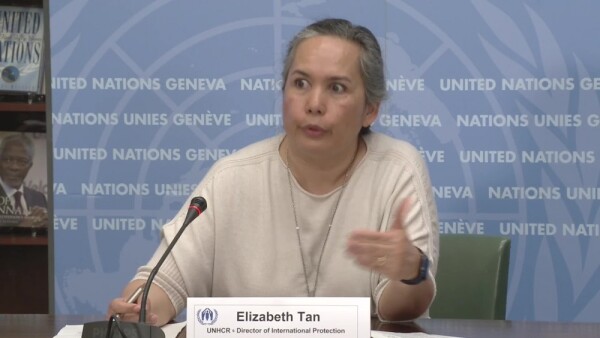
“Our first request in that advisory is that all countries allow civilians fleeing Sudan on a nondiscriminatory manner to access their territory”, said Elizabeth Tan, Director of International Protection of the UN Refugee Agency (UNHCR), speaking to media at the United Nations in Geneva. “So, this applies to Sudanese nationals, to foreign nationals, including refugees who are being hosted in Sudan, stateless persons, as well as those who do not have a passport or any other form of identification.”
In past three weeks since the beginning of the hostilities, UNHCR and humanitarian partners have been reporting a shocking array of human rights violation, including indiscriminate attacks against civilians and sexual violence. Widespread criminality and looting of civilian infrastructure, including hospitals and humanitarian premises, have forced many Sudanese to flee and seek safety outside Sudan.
“There are Sudanese who are outside of Sudan and who now require protection,” said UNHCR’s Ms. Tan. “They should not be sent back to Sudan if they have ongoing asylum claims. We are requesting that negative decisions be put on hold. And those who have received a negative asylum result that they not be forcibly returned to Sudan for the time being, given the situation there.”
Large numbers of civilians have been forced to flee the fighting, including people who were already internally displace because of previous conflict in Sudan, and refugees from other countries who had sought safety in Sudan.
“There were 1.1 million refugees hosted in Sudan, and those individuals require protection in Sudan,” stressed UNHCR’s director of protection. “So, some of them, as I've mentioned, have fled, but some of them are also moving to other countries. And we're requesting that governments support them and enter them into the asylum systems in neighboring countries in order to ensure their safety.”
UNHCR remains particularly concerned about the situation of the newly displaced in Darfur.
“We have heard reports about IDP (internally displaced people) camps being burned to the ground, so we know that people are being displaced. The IDPs in Darfur are being displaced again,” said Ms. Tan. “Our ability to provide assistance in Darfur is severely constrained. I mentioned that in the east of the country and in the Sudanese refugee camps, we're able to provide some assistance because that part of the country is still relatively stable- In Darfur it's a different situation and so the humanitarian situation is likely to deteriorate.”
The UN Child’s Agency (UNICEF) also released disturbing numbers of children killed and injured in Sudan. The data reports from the conflict hotspots of Khartoum and the Darfurs.
“From the start of fighting 15 April until 21 of April, let's call that 11 days, including those two days, the reports we have received are 190 children killed and 1,700 injured," said UNICEF spokesperson James Elder. “Now, when you break that down over those 11 days, that means that every single hour you have seven boys or girls have been killed or injured.”
Mr. Elder added that “these are only children getting to health facilities. I think this is underlining the enormity of how violent this is and how much it's impacting children. This is before we look at the eight million plus who needed humanitarian assistance and now have great, great destruction on their health systems and on their water systems.”
UNICEF stressed that particularly places where children must be safe such as homes, schools and hospitals have consistently come under attack.
While condemning the attacks on humanitarian workers and humanitarian facilities as well as the looting of vehicles and supplies, UNICEF stressed that such attacks undermine the capacity to reach children across the country with lifesaving health, nutrition, water and sanitation services.
Quoting the Sudanese Ministry of Health, Dr Margaret Harris, Spokesperson for the World Health Organization (WHO), said that “4,926 people were wounded and 551 people have been killed” but that real numbers of casualties are most likely numbers much higher.
According to WHO’s Dr Harris, 25 per cent of people die because they didn’t get help for their bleeding injuries.
In the third week of brutal fighting in Sudan, health care services are rapidly falling apart in the nation’s capital, Khartoum. Very few hospitals are fully operating and the biggest majority, over 60 %, are not anymore functioning properly.
“In attacks on health care, 28 attacks leading to eight deaths and 18 injuries. The kinds of attacks include looting, obstruction of access to health care, violent attacks using weapons and forced occupation of facilities,” reported Dr Harris.
Yesterday, UNCHR and 134 partners announced funding requirements of $445 million for the regional interagency refugee’s response plan in five countries to assist an estimated 860,000 Sudanese, refugees of other nationalists and refugees’ returnees leaving the country.
-ends-
STORY: Sudan Update – UNHCR-UNICEF-WHO
TRT: 03’51”
SOURCE: UNTV CH
LANGUAGE: ENGLISH/NATS
ASPECT RATIO: 16:9
RELEASE DATE: 5 May 2023
GENEVA, SWITZERLAND
SHOTLIST
- Exterior wide shot: UN flag alley UN Geneva.
- Medium shot, journalists in in conference room, Palais des Nations, Geneva
- SOUNDBITE (ENGLISH) : Elizabeth Tan, Director of International Protection (UNHCR): “Our first request in that advisory is that all countries allow civilians fleeing Sudan on a nondiscriminatory manner to access their territory. So this applies to Sudanese nationals, to foreign nationals, including refugees who are being hosted in Sudan, stateless persons, as well as those who do not have a passport or any other form of identification.”
- Medium shot, journalists with laptops in the press room
- SOUNDBITE (ENGLISH) : Elizabeth Tan, Director of International Protection (UNHCR): “There are Sudanese who are outside of Sudan and who now require protection. They should not be sent back to Sudan if they have ongoing asylum claims. We are requesting that negative decisions be put on hold. And those who have received a negative asylum result that they not be forcibly returned to Sudan for the time being, given the situation there.”
- Close up, Ms. Tan speaking from podium
- SOUNDBITE (ENGLISH) : Elizabeth Tan, Director of International Protection (UNHCR): “There were 1.1 million refugees hosted in Sudan, and those individuals require protection in Sudan. So some of them, as I've mentioned, have fled, but some of them are also moving to other countries. And we're requesting that governments support them and enter them into the asylum systems in neighboring countries in order to ensure their safety.”
- Wide shot, journalists working on laptops in press briefing room
- SOUNDBITE (ENGLISH) : Elizabeth Tan, Director of International Protection (UNHCR): “We have heard reports about IDP camps being burned to the ground, so we know that people are being displaced. The IDPs in Darfur are being displaced again. Our ability to provide assistance in Darfur is severely constrained. I mentioned that in the east of the country and in the Sudanese refugee camps, we're able to provide some assistance because that part of the country is still relatively stable- In Darfur it's a different situation and so the humanitarian situation is likely to deteriorate.”
- Wide shot, podium with speakers
- SOUNDBITE (ENGLISH) : James Elder, Spokesperson for UNICEF: “From the start of fighting 15th of April until the 21st of April, let's call that 11 days, including those two days. The reports we have received are 190 children killed and 1700 injured. Now, when you break that down over those 11 days, that means that every single hour you have seven boys or girls have been killed or injured. Again, these are only children getting to health facilities. I think this is underlining the enormity of how violent this is and how much it's impacting children. This is before we look at the 8 million plus who needed humanitarian assistance and now have great, great destruction on their health systems and on their water systems.”
- Medium shot, Ms. Tan filmed from behind with journalists and cameras in press briefing room
- SOUNDBITE (ENGLISH): Margaret Harris, Spokesperson for the World Health Organization (WHO): “From the Ministry of Health: 4926 people wounded and 551 people have been killed. »
- Wide shot, journalists from behind with speakers at the podium
- SOUNDBITE (ENGLISH): Margaret Harris, Spokesperson for the World Health Organization (WHO): “In attacks on health care, 28 attacks leading to eight deaths and 18 injuries. The kinds of attacks include looting, obstruction of access to health care, violent attacks using weapons and forced occupation of facilities.”
- Wide shot, press briefing room with journalists
- Close up, camera with view finder and monitor in background
- Wide shot, press briefing room with journalists
Similar Stories

1
1
1
Edited News | OCHA , UNICEF , WFP
Aid agencies warned on Friday of the fast-developing humanitarian emergency inside Taiz City in Yemen, which has been encircled by de facto Houthi forces fighting government troops along the country’s west coast.

2
17
1
2
Edited News , Press Conferences , Images | OCHA , WMO
Two UN agencies teamed up on Wednesday to issue an appeal for immediate assistance to help communities already being impacted by the strongest El Niño on record.

3
16
2
2
Edited News , B-roll , Conferences , Images | UNITED NATIONS , UNOG
Sixth Consultative Meeting on Enhancing Coordination of Peace Initiatives and Efforts for Sudan

1
1
1
Edited News | UNICEF , WHO , UNHCR
Yemen war continues to force families from homes amid hunger and disease
More than 250,000 people have now fled renewed fighting in Yemen, the UN said on Tuesday, citing particular concern for those sheltering in the southwestern city of Taiz and the wider governorate, where access is “essentially blocked”.

1
1
1
Edited News | UNICEF
A little over one year since a ceasefire agreement was announced between Hamas fighters and Israel, more than 340 children have been reported killed and hundreds more injured, the UN Children’s Fund, UNICEF, said on Friday.

1
1
1
Edited News | UNICEF , IFRC
Six weeks after Nepal’s deadly flooding disaster, communities are still struggling to rebuild their lives, but they will need sustained help as global warming increases the risk of another Himalayan catastrophe, the UN Children’s Fund (UNICEF) said on Friday.

1
1
1
Edited News | WHO
In suspected Russia plague death, testing and monitoring underway – WHO
The death of a lab worker in Russia’s Siberia region has sparked concerns about plague being the cause, the UN World Health Organization (WHO) said on Tuesday, adding that it was following the situation closely.

1
1
Edited News | OHCHR , UNOG
UN Human Rights Chief Volker Türk on Friday provided and oral update to the 63rd session of the Human rights Council on Ukraine.

1
1
1
Edited News | OHCHR , UNOG
UN Human Rights Chief Volker Türk on Friday provided and oral update to the 63rd session of the Human rights Council on the human rights situation in Haiti.

1
1
1
Edited News | WHO
Repeated delays in bringing lifesaving medicines, prosthetics and more from Israel into Gaza risk having devastating consequences on Palestinians who urgently need them in the wartorn enclave, the UN World Health Organization (WHO) said on Friday. “A truck full of non-priority supplies or the right supplies arriving too late, doesn't save lives. That's the question that actually matters," said Dr Reinhilde Van De Weerdt, WHO Representative in the OPT.

1
1
1
Edited News | WHO
DRC: Early access to care and oxygen decisive for Ebola patients’ survival – WHO
In the Democratic Republic of the Congo (DRC), health workers fighting the country’s largest-ever Ebola outbreak are struggling to overcome critical challenges to patient care, the UN World Health Organization (WHO) warned on Tuesday.

1
1
1
Edited News | OCHA , UN
Civilians in Iran are continuing to feel the consequences of months of conflict and military escalation, the UN’s top official in the country has said, as loss of life, damage to civilian infrastructure and mounting economic pressures leave many facing continued uncertainty.