

The United Nations Office at Geneva
Multimedia Newsroom
Headline:
“An abject failure to regulate the risks that surveillance technologies pose for every human being on the planet”, UN Special Rapporteur on Terrorism
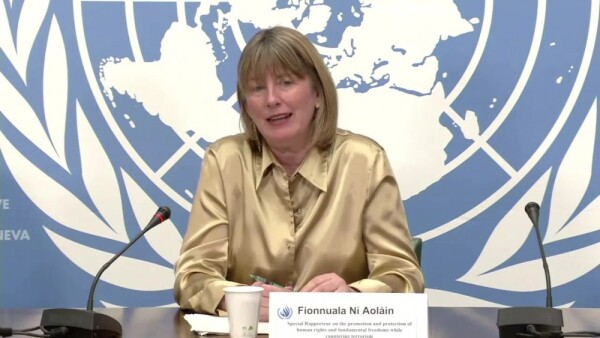
In a report to the ongoing session of the UN Human Rights Council in Geneva, the UN Special Rapporteur on the promotion and protection of human rights while countering terrorism, Fionnuala Ní Aoláin, warned of an alarming misuse of high-risk technologies in the global fight against terrorism.
This includes drones, biometrics, artificial intelligence (AI) and spyware, which is being ramped up in the ongoing fight against terrorism, without due regard for the rule of law, governance and human rights, she said.
“One of the biggest challenges we see in the increased use of drones for surveillance is that it is ordinary people whose data is being collected, ordinary people who have no right to the information that’s been collected on them and no or little regulation of the use of that data by the State,” said Ms. Ní Aoláin when speaking on Wednesday to media at the United Nations in Geneva.
The Special Rapporteur pointed out that States and private actors are using counter-terrorism and security rhetoric to justify and accelerate the deployment and transfer of new high-risk surveillance technologies without regulation. Exceptional justifications for the use of surveillance technology often turn into mundane regular use, Ms Ní Aoláin said.
“Counter-terrorism are security kind of fears or rationales that are often used as the legal and policy basis to adopt them, meaning States say ‘we have this threat, we need this technology’," Ms. Ní Aoláin said. “Now, when that happens the pattern we see is that States say ‘But we are only going to use this technology in a very limited way to counter this specific kind of threat’. But what we are seeing happening in practice is that that exceptional rationale does last very long.”
The Special Rapporteur added that “this slippage from exceptional use justified by counter-terrorism to regular use for all kinds of purposes – some of them quite nefarious - speaks to the real challenges that we are facing in regulating these technologies and ensuring that they don’t pose risks to the protection of human rights.”
The Human Rights Council-appointed independent expert expressed concern about the growing domestication of the use of drones in several countries, the widespread misuse of spyware technology against civil society groups, dissidents and journalists, and the increasing adoption of biometric data collection.
“There is consistently in the adaption of these new technologies either no or very little human rights, or at best a kind of performative note to human rights”, she said. “But very little mainstreaming of human rights protection into what are essentially high-risk technologies. And the result of that, I think, has been an abject failure to – in a way - regulate the risks that these technologies pose for every human being on the planet.”
The UN expert expressed concern about the growing domestication of the use of drones in several countries. “What we are seeing is that drone technology is proliferating at remarkable speed. In many countries you can pick one up at a store and build it in your backyard”, she said. “The result of that in the context where there is no global regulation of drone technology is a massive gap in human rights protection when such technologies are deployed.”
The expert presented in her report also a new and innovative approach to spyware regulation, focusing on ensuring that minimum human rights standards are applied by both governments and companies in the development but also in the use of high-risk surveillance technologies.
One of Ms. Ní Aoláin recommendations are that “if you are going to collect data, counter terrorism data at national level, you have to have in correspondence national legislation that protects data of the persons whose data is being collected, used, transferred and stored.” She added that “all of us have a right to that as a fundamental human right. It seems to me that in a digital age, we don’t have those rights, we actually loose an enormous space of protection.”
-ends-
STORY: Special Rapporteur on Terrorism – Report launch
TRT: 3 min 02s
SOURCE: UNTV CH
RESTRICTIONS: NONE
LANGUAGE: ENGLISH/NATS
ASPECT RATIO: 16:9
DATELINE: 15 March 2023 GENEVA, SWITZERLAND
SHOTLIST
- Medium shot, UN Geneva flag alley.
- Wide shot, press room with speaker at podium
- SOUNDBITE (ENGLISH) - Fionnuala Ní Aoláin, Special Rapporteur on the promotion and protection of human rights and fundamental freedoms while countering terrorism: “One of the biggest challenges we see in the increased use of drones for surveillance is that it is ordinary people whose data is being collected, ordinary people who have no right to the information that’s been collected on them and no or little regulation of the use of that data by the state”.
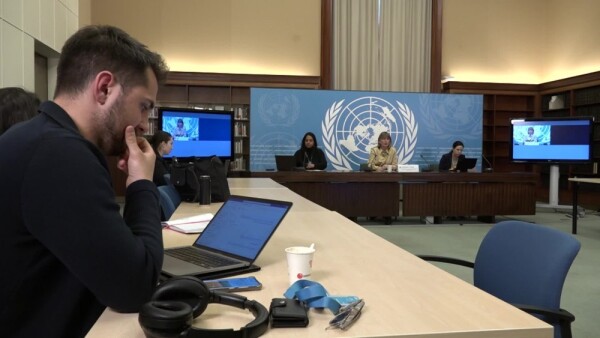
- Medium shot, journalists in front of screen with speakers
- SOUNDBITE (ENGLISH) - Fionnuala Ní Aoláin, Special Rapporteur on the promotion and protection of human rights and fundamental freedoms while countering terrorism: “Counter-terrorism are security kind of fears or rationales that are often used as the legal and policy basis to adopt them, meaning states say ‘we have this threat, we need this technology’. Now, when that happens the pattern we see is that States say but we are only going to use this technology in a very limited way to counter this specific kind of threat. But what we are seeing happening in practice is that that exceptional rationale does last very long”.
- Medium shot, journalists
- SOUNDBITE (ENGLISH) - Fionnuala Ní Aoláin, Special Rapporteur on the promotion and protection of human rights and fundamental freedoms while countering terrorism: “This slippage from exceptional use justified by counter-terrorism to regular use for all kinds of purposes – some of them quite nefarious - speaks to the real challenges that we are facing in regulating these technologies and ensuring that they don’t pose risks to the protection of human rights”.
- Medium shot, panel with speaker
- SOUNDBITE (ENGLISH) - Fionnuala Ní Aoláin, Special Rapporteur on the promotion and protection of human rights and fundamental freedoms while countering terrorism: “There is consistently in the adaption of these new technologies either no or very little human rights, or at best a kind of performative note to human rights. But very little mainstreaming of human rights protection into what are essentially high-risk technologies. And the result of that, I think, has been an abject failure to – in a way - regulate the risks that these technologies pose for every human being on the planet”.
- Mediun shot, journalist writing
- SOUNDBITE (ENGLISH) - Fionnuala Ní Aoláin, Special Rapporteur on the promotion and protection of human rights and fundamental freedoms while countering terrorism: “What we are seeing is that drone technology is proliferating at remarkable speed. In many countries you can pick one up at a store and build it in your backyard. The result of that in the context where there is no global regulation of drone technology is a massive gap in human rights protection when such technologies are deployed”.
- Medium shot, journalists with speaker at the podium
- SOUNDBITE (ENGLISH) - Fionnuala Ní Aoláin, Special Rapporteur on the promotion and protection of human rights and fundamental freedoms while countering terrorism: “If you are going to collect data, counter terrorism data at national level, you have to have in correspondence national legislation that protects data of the persons whose data is being collected, used, transferred and stored. All of us have a right to that as a fundamental human right. It seems to me that in a digital age, we don’t have those rights, we actually loose an enormous space of protection”.
- Medium shot, speaker at podium
- Medium shot, journalists
- Close up, hands typing
Similar Stories
1
1
1
Press Conferences | UNHCR
End of UNHCR's 77th Annual Executive Committee (ExCom) meeting week

1
1
1
Edited News | UNICEF
A little over one year since a ceasefire agreement was announced between Hamas fighters and Israel, more than 340 children have been reported killed and hundreds more injured, the UN Children’s Fund, UNICEF, said on Friday.
1
1
1
Press Conferences | UNICEF , IOM , UNHCR
UN Special Assistant to the Personal Envoy Office (SUDAN): Peace Initiatives and Efforts in Sudan; UNICEF: Dire situation of children in Gaza; IOM: Damaged Homes and Energy Attacks Risk Displacing Ukrainians for this winter; UNHCR: update on EXCOM week
1
1
1
Press Conferences | IOM , UNDRR
UN stresses importance of household preparedness for disaster risk reduction.

1
1
1
Edited News | UNICEF , IFRC
Six weeks after Nepal’s deadly flooding disaster, communities are still struggling to rebuild their lives, but they will need sustained help as global warming increases the risk of another Himalayan catastrophe, the UN Children’s Fund (UNICEF) said on Friday.
1
1
1
Statements , Press Conferences | OHCHR
1
1
1
Press Conferences | UNHCR , UNICEF , IFRC , OHCHR , UN WOMEN , IOM , OCHA , WHO
UNHCR – ExCom Meeting, UNICEF – Nepal Recovery, IFRC – Flash Floods, WHO – Mental Health, IOM – South Sudan Floods, OCHA – DRC Humanitarian aid, UNHCR – Sahel Displacement, UNICEF – Yemen Update, IOM – Gaza Shelter, UN Women – Gaza Women, OHCHR – Arrests and detentions of Syrians by Israeli force
2
1
2
Press Conferences | UNCTAD
Presentation of the Trade and Developement Report 2026
Embargoed until 9 October 2026 at 11 a.m. (Geneva Time)
UNCTAD: UNCTAD’s flagship report finds that governments increasingly use industrial, trade, financial and technology policies to pursue economic and national security objectives. Market access and the ability to move into higher-value activities now depend more heavily on technology, finance and geopolitics.
1
1
1
Press Conferences | UPU
Release of the State of the Postal Sector Report 2026

1
1
1
Edited News | WHO
In suspected Russia plague death, testing and monitoring underway – WHO
The death of a lab worker in Russia’s Siberia region has sparked concerns about plague being the cause, the UN World Health Organization (WHO) said on Tuesday, adding that it was following the situation closely.
1
1
1
Press Conferences | IOM , ITU , UNECE , UNICEF , WHO , WMO
UNICEF: Ebola, DRC - children orphans or separating them from parents and caregivers; IOM: Humanitarian needs in Djibouti amid arrivals from Yemen and increased migrant movements; WHO: Darfur, scale of health needs far exceeds available resources; WMO co-sponsored Global Heat Forum, Bangkok, monthly Global Seasonal Climate Update; UNECE: UN Forum of Mayors; ITU Plenipotentiary Conference 2026; WHO: child and adolescent obesity guidelines and new global roadmap to tackle pregnancy hypertension, a leading cause of maternal mortality

1
1
Edited News | OHCHR , UNOG
UN Human Rights Chief Volker Türk on Friday provided and oral update to the 63rd session of the Human rights Council on Ukraine.