

The United Nations Office at Geneva
Multimedia Newsroom
Press Conferences | OCHA , OHCHR , UNHCR , UNICEF , WHO
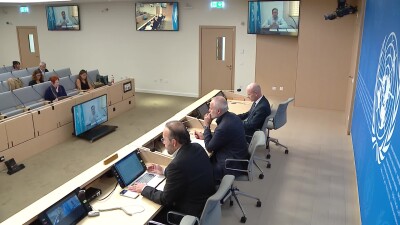
Bi-Weekly Press Briefing 28 February 2023
PRESS BRIEFING BY THE UNITED NATIONS INFORMATION SERVICE
28 February 2023
Human Rights Council
Rolando Gomez, for the Human Rights Council (HRC), informed that the 52nd session had started on 27 February, hearing from the Secretary-General, the Human Rights High Commissioner, and the President of the General Assembly. The high-level segment was continuing for another two days. This morning, the Council was discussing the death penalty. Mr. Gomez reminded that at the end of 2022, a record 125 Member States had voted in the General Assembly for abolition of the death penalty. At 4 pm today, there would be a panel discussion on the 35th anniversary on the Declaration of the Right to Development.
More details on the ongoing 52nd session can be found here.
Urgent assistance needed in the Horn of Africa
Olga Sarrado, for the United Nations Refugee Agency (UNHCR), stated that, as the Horn of Africa entered its sixth consecutive rainy season with no rain, displacement continued to climb, and millions from Somalia, Ethiopia and Kenya struggled to survive amid scarce water sources, hunger, insecurity, and conflict.
With no immediate end in sight to one of the longest and most severe droughts on record, UNHCR was appealing for USD 137 million to provide life-saving aid to 3.3 million refugees and internally displaced people who had been forced to flee their homes in search of safety and assistance, as well as affected local host communities. While famine had so far been averted in Somalia, mostly due to a stepped-up humanitarian response, people continued to battle life-threatening food and water shortages resulting from massive losses of harvests, livestock, and income. According to UNHCR data, over 1.7 million people had been internally displaced in Ethiopia and Somalia due to the drought, most of them last year. More than 180,000 refugees from Somalia and South Sudan had also crossed into drought-affected areas of Kenya and Ethiopia.
Full statement is available here.
Responding to questions, Ms. Sarrado stated that the UNHCR expected to reach 3.3 million refugees, internally displaced people, and local communities in Somalia, Kenya, and Ethiopia. Over 8 million Somalis were expected to experience high levels of food insecurity in the first quarter this year.
Arbitrary deprivation of nationality by Nicaragua
Replying to a question, Olga Sarrado, for the United Nations Refugee Agency (UNHCR), stated that UNHCR was seriously concerned by the arbitrary deprivation of the Nicaraguan nationality of over 300 people. Full UNHCR statement is available here.
Humanitarian and funding needs in Yemen
Alessandra Vellucci, for the United Nations Information Service (UNIS), said that more than 21 million people in Yemen needed protection and assistance, and the pledging conference hosted by the UN Secretary-General, and the governments of Switzerland and Sweden in Geneva the previous day had raised around USD 1.2 billion.
Sami Fakhouri, Head of the Delegation of the International Federation of Red Cross and Red Crescent Societies (IFRC) in Yemen, speaking from Sanaa, stressed that the collective commitments of the international community remained especially important for the people of Yemen. However, at the pledging event in Geneva the previous day, the commitments covered less than a quarter of the humanitarian funding ask. Yemen still lay the tragic claim to be one of the world’s largest humanitarian crises and aid operations, where two out of three people needed humanitarian assistance.
IFRC remained committed to Yemen, which was one of its largest operations. The Yemen Red Crescent remained one of the largest local humanitarian organisations, still operating as one entity serving vulnerable people throughout the country. Mr. Fakhouri said that he was hopeful that a peace settlement would be the result of the ongoing negotiations between the parties, as the country and its people were beyond tired of the conflict. He thanked all humanitarian workers in Yemen for their unwavering daily work despite all the challenges and the difficult operating environment. Mr. Fakhouri, who had been the IFRC Head of Delegation in Yemen for over 18 months, said he was amazed by the generosity of its people, despite the dire conditions in which they were living.
Answering questions, Mr. Fakhouri said that regrettably Yemen was now on the downside of funding, after eight years of the crisis. Media could help by keeping Yemen in the news to fight the donor fatigue. IFRC was not scaling back on its services this year, he explained.
World Wildlife Day
David Whitbourn, for the Convention on International Trade in Endangered Species of Wild Fauna and Flora (CITES), said that 3 March would mark the World Wildlife Day (WWD) and the 50th anniversary of CITES. He reminded that 3 March had been made the World Wildlife Day by the General Assembly in 2013. CITES had been working for 50 years now to make sure that there was sustainability in global trade.
The theme this year was partnerships for conservation and sustainability. On this occasion, CITES was sharing several stories showcasing successful partnerships from around the world. The focus for this year’s WWD would be a live event at the National Geographic Society’s Grosvenor Auditorium in Washington, DC on 3 March. There would be an invited audience of 400 and an opportunity to watch the event via the livestream on the WWD YouTube channel.
Announcements
James Elder, for the United Nations Children’s Fund (UNICEF), said that a joint UNICEF-ILO report on the levels of social protection for children worldwide, More than a Billion Reasons, would be released on 1 March. The report would be shared at 3 p.m.
On 7 March, UNICEF would release its global report Undernourished and Overlooked, which found that the number of pregnant women and girls suffering from malnutrition was on the increase around the world.
Alessandra Vellucci, on behalf of the Office of the Special Envoy for Syria (OSE), said that the Special Envoy would brief the Security Council at 4 p.m. Geneva time today. The transcript would be shared afterwards.
Responding to questions, Margaret Harris, for the World Health Organization (WHO), said that the Intergovernmental Negotiating Body was now discussing the zero draft of the pandemic treaty, after which detailed drafting of individual chapters would commence. Media would be informed if there were press opportunities at the end of the week. There would be no regular press conference by Dr. Tedros this week, she informed. He would hold a press conference in Türkiye this afternoon.
Dr Harris also said that today at 1:30 p.m., the World Health Organization (WHO) would hold a press conference on prevention and response to sexual misconduct: update on support for victims, survivors and their families. Speakers would be Dr. Gaya Gamhewage, Director, Prevention of and Response to Sexual Misconduct at the WHO, and Dr. Eugene Kongnyuy, UNFPA Representative to the Democratic Republic of Congo.
Alessandra Vellucci reminded journalists that today at 12 p.m. noon, the World Intellectual Property Organization (WIPO) would release 2022 global data for international intellectual property filings, including patents, trademarks, and designs. The speaker in this virtual press conference would be Carsten Fink, Chief Economist.
Also today at 3:15 p.m., Csaba Kőrösi, President of the 77th session of the UN General Assembly, would hold a briefing on the 2023 UN Water Conference and other issues.
On 2 March at 2 p.m., there would be a launch of the First Report of the Group of Human Rights Experts on Nicaragua. Speakers would be Jan Simon, Chair of the Group of Human Rights Experts on Nicaragua; Alexandro Álvarez and Ángela María Buitrago, members of the Group of Human Rights Experts on Nicaragua
On 3 March at 9:15 a.m. CET, the Interparliamentary Union (IPU) would launch the IPU’s annual Women in Parliament report. Speakers would be Martin Chungong, IPU Secretary General, and Zeina Hillal, IPU Manager, Gender Partnership Programme and Youth Participation Programme.
On 7 March at 1:30 p.m., there would be launch of the UN Commission on Human Rights in South Sudan’s latest report. Speakers would be Andrew Clapham and Barney Afako, Expert Members of the Commission.
The Committee on Economic, Social and Cultural Rights would close its 73rd session on 3 March at 5:30 p.m. and issue its concluding observations on the reports of Panama, China, Portugal, Yemen, Cambodia, and Lithuania.
The Human Rights Committee would begin this afternoon its review of the report of Egypt.
Similar Stories
1
1
1
Press Conferences | UN WOMEN , WFP , WHO
UN WOMEN: Sudan Women and girls one year after the fall of El Fasher; increasing drone attacks across the country; WFP: DRC - Ebola spreads to eighth DRC province as WFP delivers food, builds treatment centres and keeps supplies moving; WHO - Update on Ebola (Bundibugyo Virus Disease)
1
12
1
1
Press Conferences , Images | UNOG
Closing Press Conference following the Sixth Consultative Meeting on Enhancing Coordination of Peace Initiatives and Efforts in Sudan

2
17
1
2
Edited News , Press Conferences , Images | OCHA , WMO
Two UN agencies teamed up on Wednesday to issue an appeal for immediate assistance to help communities already being impacted by the strongest El Niño on record.
1
1
1
Press Conferences | CITES
Wildlife trade and conservation policy discussions at the 81st meeting of the CITES Standing Committee (SC81)
1
1
1
Press Conferences | UNHCR , UNCTAD , WMO , OCHA , UNICEF , WHO
UNHCR Hungary’s 1956 Refugee Crisis: 70 Years On, UNCTAD World Investment Forum 2026, Doha, WMO Greenhouse Gas Bulletin and Climate Update for COP31, OCHA Afghanistan: Malnutrition, Girls’ Education and Recovery, UNICEF Yemen: Child Malnutrition and Unsafe Water in Taiz, WHO Inequalities in Noncommunicable Diseases and Risk Factors

1
1
1
Press Conferences | UNHCR
End of UNHCR's 77th Annual Executive Committee (ExCom) meeting week

1
1
1
Press Conferences | UNICEF , IOM , UNHCR
UN Special Assistant to the Personal Envoy Office (SUDAN): Peace Initiatives and Efforts in Sudan; UNICEF: Dire situation of children in Gaza; IOM: Damaged Homes and Energy Attacks Risk Displacing Ukrainians for this winter; UNHCR: update on EXCOM week

1
1
1
Press Conferences | IOM , UNDRR
UN stresses importance of household preparedness for disaster risk reduction.

1
1
1
Statements , Press Conferences | OHCHR

1
1
1
Press Conferences | UNHCR , UNICEF , IFRC , OHCHR , UN WOMEN , IOM , OCHA , WHO
UNHCR – ExCom Meeting, UNICEF – Nepal Recovery, IFRC – Flash Floods, WHO – Mental Health, IOM – South Sudan Floods, OCHA – DRC Humanitarian aid, UNHCR – Sahel Displacement, UNICEF – Yemen Update, IOM – Gaza Shelter, UN Women – Gaza Women, OHCHR – Arrests and detentions of Syrians by Israeli force

2
1
2
Press Conferences | UNCTAD
Presentation of the Trade and Developement Report 2026
Embargoed until 9 October 2026 at 11 a.m. (Geneva Time)
UNCTAD: UNCTAD’s flagship report finds that governments increasingly use industrial, trade, financial and technology policies to pursue economic and national security objectives. Market access and the ability to move into higher-value activities now depend more heavily on technology, finance and geopolitics.

1
1
1
Press Conferences | UPU
Release of the State of the Postal Sector Report 2026