

The United Nations Office at Geneva
Multimedia Newsroom
Edited News | OHCHR , UNITED NATIONS
UN Special Rapporteur On Myanmar - Human Rights Council 29 June 2022
Myanmar: shocking toll on country’s children must be spur to action, Human Rights Council hears
Myanmar’s military junta are responsible for shocking violence against children caught up in the bloody aftermath of last February’s coup, a top Human Rights Council-appointed investigator said on Wednesday.
Three months since his last update to the UN rights forum in Geneva, Special Rapporteur on the situation of human rights in Myanmar, Thomas Andrews, said that he’d met youngsters who’d fled the country after suffering “irreparable harm”.
Myanmar – whose seat was empty in the Council - “passed several grim milestones since March”, he continued: “more than 2,500 civilians have now been killed in the junta’s bloody campaign against its opponents; over one million people are now internally displaced.”
The number of arbitrarily detained political prisoners now exceeds 11,000, Mr. Andrews said, before warning that the junta “has announced that executions will soon begin of political prisoners who have been put on death row”.
Amid widespread public opposition to Myanmar’s de facto rulers, the independent rights expert described how the military had “trained its guns on growing numbers of villagers and other non-combatants” and “accelerated a brutal campaign of arson and murder in the northwest.
The task of reporting on such abuses amounts has been complicated by internet shutdowns which “which, of course is the intention, the very intention, of the military”, Mr. Andrews said, before describing in detail the abuse meted out to youngsters suspected of having links to opposition fighters.
“At least 382 children have been killed or maimed; more than 1,400 children have been arbitrarily detained…142 children have been tortured since the coup.”
He added: “These children have been beaten, cut and stabbed; they have been burned with cigarettes; they have had their fingernails and teeth pulled out; they have been forced to hold stress positions; they have been subjected to mock executions; they have been sexually assaulted.”
Such crimes and “repeated attacks on civilians” constituted war crimes and crimes against humanity, insisted the Special Rapporteur, who is an independent and unpaid rights expert, appointed by the Human Rights Council for three years, in line with special procedures mandates.
Failure to take action soon risks an even worse humanitarian crisis in Myanmar, where relief work has been seriously hampered because the UN’s 2022 Humanitarian Response Plan for Myanmar is only 10.5 per cent funded. “This has meant that lifesaving programs have had to be suspended,” Mr. Andrews explained.
Some “33,000 children could die of preventable deaths this year alone, merely because they have missed routine immunizations,” the Special Rapporteur added. “Five million children require urgent humanitarian assistance. Experts warn of a looming food crisis and the possibility of a dramatic increase in rates of childhood malnutrition and stunting. Physical and sexual abuse, the trafficking of children and child labour are all on the rise. Girls are particularly vulnerable to forced marriage and sexual exploitation.”
After insisting that the international community’s approach to Myanmar “is not working”, Mr. Andrews urged the Security Council to take action.
“The people of Myanmar continue to wait for the Security Council to even consider a resolution about Myanmar,” he said. “Some Members have failed to impose sanctions on the junta, even when they have done so in response to other crises. Member States who have adopted sanctions have too often failed to strategically coordinate these sanctions. Many have failed to target the junta’s largest sources of revenue and their ability to move funds. ASEAN’s Five-Point Consensus has failed to generate any tangible outcomes.”
ends
STORY: UN Special Rapporteur On Myanmar - Human Rights Council
TRT: 3 mins 21s
SOURCE: UNTV CH
RESTRICTIONS: NONE
LANGUAGE: ENGLISH/NATS
ASPECT RATIO: 16:9
DATELINE: 29 June 2022 GENEVA, SWITZERLAND
SHOTLIST
- Exterior medium shot, flag alley, UN Geneva.
- Wide, 50th Session of the UN Human Rights Council in Geneva, delegates seated.
- SOUNDBITE (ENGLISH): Thomas Andrews, UN Special Rapporteur on the situation of human rights in Myanmar: “In the three months since my last report to you, Myanmar has passed several grim milestones: more than 2,500 civilians have now been killed in the junta’s bloody campaign against its opponents; over one million people are now internally displaced. The number of arbitrarily detained political prisoners now exceeds 11,000. The junta has announced that executions will soon begin of political prisoners who have been put on death row. In the face of widespread public opposition to the junta, the military has trained its guns on growing numbers of villagers and other non-combatants. In northwest Myanmar, the military has accelerated a brutal campaign of arson and murder. Internet shutdowns imposed in the region make it difficult to document atrocities, which, of course is the intention, the very intention, of the military.”
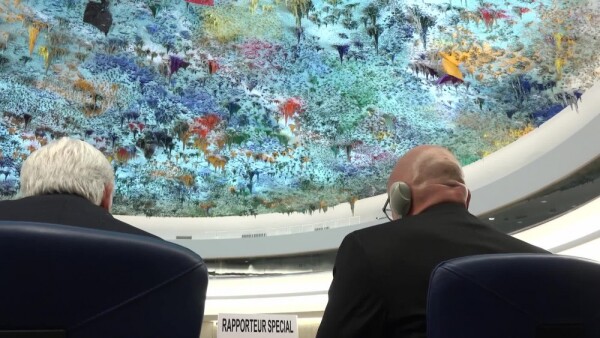
- Medium, Special Rapporteur and Human Rights Council President, rear shot, with spectacular shot of the Council’s multicoloured ceiling above.
- SOUNDBITE (ENGLISH): Thomas Andrews, UN Special Rapporteur on the situation of human rights in Myanmar: “These repeated attacks on civilians - as well as other grave human rights violations - constitute war crimes and crimes against humanity.”
- Medium, empty seats at Myanmar delegation’s place in the Council.
- SOUNDBITE (ENGLISH): Thomas Andrews, UN Special Rapporteur on the situation of human rights in Myanmar: “At least 382 children have been killed or maimed; more than 1,400 children have been arbitrarily detained. I also report that 142 children have been tortured since the coup.”
- Wide, Human Rights Council podium speakers, delegates and ceiling.
- SOUNDBITE (ENGLISH): Thomas Andrews, UN Special Rapporteur on the situation of human rights in Myanmar: “33,000 children could die of preventable deaths this year alone, merely because they have missed routine immunizations. Five million children require urgent humanitarian assistance. Experts warn of a looming food crisis and the possibility of a dramatic increase in rates of childhood malnutrition and stunting. Physical and sexual abuse, the trafficking of children and child labour are all on the rise. Girls are particularly vulnerable to forced marriage and sexual exploitation.”
- Medium shot, TV screen showing image of Mr. Andrews speaking, Council floor to rear.
- SOUNDBITE (ENGLISH): Thomas Andrews, UN Special Rapporteur on the situation of human rights in Myanmar: “The people of Myanmar continue to wait for the Security Council to even consider a resolution about Myanmar. Some Members have failed to impose sanctions on the junta, even when they have done so in response to other crises. Member States who have adopted sanctions have too often failed to strategically coordinate these sanctions. Many have failed to target the junta’s largest sources of revenue and their ability to move funds. ASEAN’s Five-Point Consensus has failed to generate any tangible outcomes.”
- Wide shot: Council floor, delegates seated, gallery and ceiling.
- Close: Mr. Andrews’s head, partly in shot, wearing conference listening device.
- Medium-wide: delegates, masked, from China, Cameroon and Brazil.
- Medium: Myanmar’s empty seat behind nameplate.
- Wide: podium speakers, large screens showing Mr. Andrews speaking.
Similar Stories
1
1
1
Edited News | OCHA , UNICEF , WFP
Aid agencies warned on Friday of the fast-developing humanitarian emergency inside Taiz City in Yemen, which has been encircled by de facto Houthi forces fighting government troops along the country’s west coast.

2
17
1
2
Edited News , Press Conferences , Images | OCHA , WMO
Two UN agencies teamed up on Wednesday to issue an appeal for immediate assistance to help communities already being impacted by the strongest El Niño on record.
3
16
2
2
Edited News , B-roll , Conferences , Images | UNITED NATIONS , UNOG
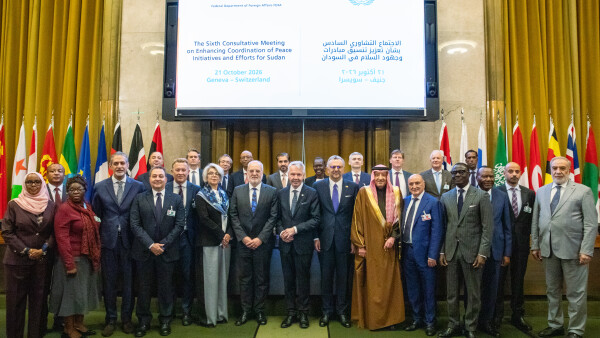
Sixth Consultative Meeting on Enhancing Coordination of Peace Initiatives and Efforts for Sudan

1
1
1
Edited News | UNICEF , WHO , UNHCR
Yemen war continues to force families from homes amid hunger and disease
More than 250,000 people have now fled renewed fighting in Yemen, the UN said on Tuesday, citing particular concern for those sheltering in the southwestern city of Taiz and the wider governorate, where access is “essentially blocked”.

1
1
1
Edited News | UNICEF
A little over one year since a ceasefire agreement was announced between Hamas fighters and Israel, more than 340 children have been reported killed and hundreds more injured, the UN Children’s Fund, UNICEF, said on Friday.

1
1
1
Edited News | UNICEF , IFRC
Six weeks after Nepal’s deadly flooding disaster, communities are still struggling to rebuild their lives, but they will need sustained help as global warming increases the risk of another Himalayan catastrophe, the UN Children’s Fund (UNICEF) said on Friday.

1
1
1
Edited News | WHO
In suspected Russia plague death, testing and monitoring underway – WHO
The death of a lab worker in Russia’s Siberia region has sparked concerns about plague being the cause, the UN World Health Organization (WHO) said on Tuesday, adding that it was following the situation closely.

1
1
Edited News | OHCHR , UNOG
UN Human Rights Chief Volker Türk on Friday provided and oral update to the 63rd session of the Human rights Council on Ukraine.

1
1
1
Edited News | OHCHR , UNOG
UN Human Rights Chief Volker Türk on Friday provided and oral update to the 63rd session of the Human rights Council on the human rights situation in Haiti.

1
1
1
Edited News | WHO
Repeated delays in bringing lifesaving medicines, prosthetics and more from Israel into Gaza risk having devastating consequences on Palestinians who urgently need them in the wartorn enclave, the UN World Health Organization (WHO) said on Friday. “A truck full of non-priority supplies or the right supplies arriving too late, doesn't save lives. That's the question that actually matters," said Dr Reinhilde Van De Weerdt, WHO Representative in the OPT.

1
1
1
Edited News | WHO
DRC: Early access to care and oxygen decisive for Ebola patients’ survival – WHO
In the Democratic Republic of the Congo (DRC), health workers fighting the country’s largest-ever Ebola outbreak are struggling to overcome critical challenges to patient care, the UN World Health Organization (WHO) warned on Tuesday.

1
1
1
Edited News | OCHA , UN
Civilians in Iran are continuing to feel the consequences of months of conflict and military escalation, the UN’s top official in the country has said, as loss of life, damage to civilian infrastructure and mounting economic pressures leave many facing continued uncertainty.