

The United Nations Office at Geneva
Multimedia Newsroom
Edited News | WMO
Mise à jour sur la pollution atmosphérique mondiale - OMM 4 septembre 2025
La pollution de l'air est en hausse, mais pas partout, selon l'agence météorologique de l'ONU
Alors que des milliards de personnes continuent de respirer un air pollué qui cause plus de 4,5 millions de décès prématurés chaque année, les experts climatiques de l'ONU ont souligné vendredi comment les particules de fumée microscopiques provenant des incendies de forêt jouent leur rôle, voyageant à travers le monde.
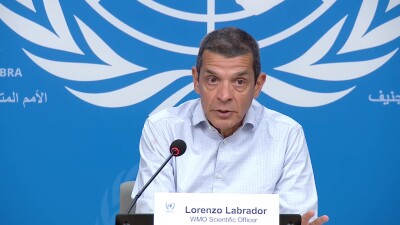
« La qualité de l'air ne respecte aucune frontière, » a déclaré Lorenzo Labrador, Orateur scientifique à l'Organisation météorologique mondiale (OMM). « La fumée et la pollution qui émanent des incendies de forêt lors de cette saison record dans la péninsule ibérique ont déjà été détectées sur l'Europe occidentale [et]… peuvent voyager à travers le reste du continent européen. »
Présentant le dernier Bulletin sur la qualité de l'air et le climat de l'OMM qui analyse les données de différents ensembles de données mondiaux, M. Labrador a annoncé un schéma continu de « dégradation » de la pollution dans le monde.
Il a montré une carte du monde en 2024 indiquant des marqueurs de particules fines connus sous le nom de « PM 2.5 » provenant des incendies de forêt concentrés en taches rouges profondes au Chili, au Brésil et en Équateur, ainsi qu'au Canada, en Afrique centrale et en Sibérie. Les données confirment la tendance à la détérioration de la qualité de l'air mondial déjà notée les années précédentes.
« Nous savons que la saison des incendies de forêt a tendance à être plus forte et plus longue chaque année, en raison du changement climatique, » a expliqué M. Labrador.
La Chine et l'Europe offrent de l'espoir
Dans des nouvelles plus positives, le scientifique de l'OMM a souligné une réduction des émissions dans certaines parties du monde, « notamment dans l'est de la Chine et en Europe, année après année. »
« Lorsque nous voyons que des pays, des régions ou des villes prennent des mesures pour lutter contre la mauvaise qualité de l'air, cela fonctionne, » a déclaré Paolo Laj, Chef de l'Atmosphère mondiale à l'OMM.
Un bon exemple est l'est de la Chine, dans des villes comme Shanghai où des progrès ont été réalisés pour améliorer la qualité de l'air en ouvrant plus de parcs, en plantant plus d'arbres. Et bien qu'il y ait encore beaucoup de trafic de véhicules, beaucoup d'entre eux sont électriques, a noté la porte-parole de l'OMM Clare Nullis.
Malgré ces réussites, très peu de villes dans le monde ont des niveaux de qualité de l'air inférieurs à ceux recommandés par l'Organisation mondiale de la santé (OMS) de l'ONU, a souligné M. Laj de l'OMM. « Cela signifie que, malgré les améliorations récentes, la qualité de l'air reste une préoccupation majeure pour la santé publique. »
Il a expliqué que bien que les principaux polluants tels que le dioxyde de soufre (SO₂) et l'oxyde d'azote (NOₓ) diminuent grâce aux contrôles des émissions, les niveaux d'ozone au sol - le principal ingrédient du smog - n'ont pas diminué. « Cela est en partie une conséquence du réchauffement climatique, car l'ozone est un polluant secondaire formé par des réactions chimiques dans l'atmosphère qui nécessitent la lumière du soleil, » a poursuivi M. Laj.
Couvrant les incendies de forêt, le brouillard hivernal, les émissions des navires et la pollution dans les espaces urbains, le bulletin sur la qualité de l'air de l'OMM souligne le lien étroit entre la qualité de l'air et le changement climatique.
« Le changement climatique et la qualité de l'air ne peuvent être abordés isolément. Ils vont de pair et doivent être traités ensemble pour protéger la santé de notre planète, de nos communautés et de nos économies, » a déclaré la Secrétaire générale adjointe de l'OMM, Ko Barrett.
L'ONU mène des efforts pour lutter contre la pollution de l'air domestique qui est l'une des plus grandes menaces pour la santé publique mondiale et particulièrement nocive pour les enfants.
« La bonne nouvelle est que la technologie de cuisson plus propre est abondante, relativement peu coûteuse et aide déjà à sauver des vies, » a insisté Martina Otto, Chef du Secrétariat de la Coalition pour le Climat et l'Air Pur hébergée par le Programme des Nations Unies pour l'environnement (PNUE). « Le défi maintenant est de mettre cette technologie entre les mains de plus de personnes. »
Fin
HISTOIRE : Mise à jour mondiale sur la pollution de l'air - OMM
DURÉE : 2’46”
SOURCE : UNTV CH
RESTRICTIONS : AUCUNE
LANGUE : ANGLAIS/ SONS NATURELS
FORMAT : 16:9
DATE : 5 SEPTEMBRE 2025 GENÈVE, SUISSE
Orateurs :
- Lorenzo Labrador, Officier scientifique de l'OMM
- Paolo Laj – Chef de l'Atmosphère mondiale – OMM
LISTE DES PLANS
- Plan large extérieur : Palais des Nations, allée des drapeaux.
- Large, salle de presse de l'ONU Genève.
- EXTRAIT SONORE (Anglais) – Lorenzo Labrador, Officier scientifique de l'OMM : « Le problème est que, comme je l'ai dit auparavant, la qualité de l'air ne respecte aucune frontière. Ainsi, la fumée et la pollution issues des incendies de forêt, cette saison record dans la péninsule ibérique, ont déjà été détectées en Europe de l'Ouest, donc les effets ne sont pas seulement limités à la péninsule ibérique, mais peuvent se propager à travers le reste du continent européen. »
- Large, orateurs au podium de la salle de presse de l'ONU Genève.
- EXTRAIT SONORE (Anglais) – Lorenzo Labrador, Officier scientifique de l'OMM : « Nous observons un schéma de dégradation de la qualité de l'air en ce qui concerne les PM 2,5 et nous voyons également qu'il y a une réduction des émissions dans certaines parties du monde, notamment en Chine orientale et en Europe, d'année en année. »
- Large, orateurs au podium de la salle de presse de l'ONU Genève.
- EXTRAIT SONORE (Anglais) – Lorenzo Labrador, Officier scientifique de l'OMM : «Vous avez des sources de PM très fortes à cause des incendies de forêt à la fois dans le bassin amazonien, au Canada et en Sibérie ; nous avons vu cela les années précédentes également. Nous savons que la saison des incendies de forêt a tendance à être plus forte et plus longue chaque année, en raison du changement climatique. Donc, c'est un problème et c'est en partie la raison pour laquelle nous voyons ces schémas concernant les incendies de forêt et la dégradation de la qualité de l'air lors des incendies de forêt. »
- Moyen-large, orateurs au podium de la salle de presse de l'ONU Genève.
- EXTRAIT SONORE (Anglais) – Lorenzo Labrador, Officier scientifique de l'OMM : « La saison actuelle des incendies de forêt dans la péninsule ibérique a été une saison record. Par exemple, les Services de surveillance atmosphérique Copernicus ont souligné que cela a été en termes d'émissions cumulées de CO2 la saison la plus forte depuis qu'ils ont commencé à enregistrer en 2003 ; donc la saison la plus forte en 20 ans. »
- Moyen-large, orateurs au podium de la salle de presse de l'ONU Genève.
- EXTRAIT SONORE (Anglais) – Paolo Laj, Chef de l'Atmosphère mondiale, OMM : « Lorsque nous voyons que des pays, des régions ou des villes prennent des mesures pour lutter contre la mauvaise qualité de l'air, cela fonctionne. Et nous voyons dans de nombreuses zones une amélioration de la qualité de l'air. »
- Moyen, journaliste.
- EXTRAIT SONORE (Anglais) – Lorenzo Labrador, Officier scientifique de l'OMM : « Nous avons une réduction marquée - une amélioration - de la qualité de l'air en raison d'une réduction des polluants dans certains carburants, mais d'un autre côté, nous voyons également que la réduction des aérosols de sulfates - qui est une conséquence de la réduction des émissions de soufre de ces carburants - dévoile également le véritable réchauffement des gaz à effet de serre. »
- Moyen, journaliste.
Similar Stories
1
1
1
Edited News | OCHA , UNICEF , WFP
Aid agencies warned on Friday of the fast-developing humanitarian emergency inside Taiz City in Yemen, which has been encircled by de facto Houthi forces fighting government troops along the country’s west coast.

2
17
1
2
Edited News , Press Conferences , Images | OCHA , WMO
Two UN agencies teamed up on Wednesday to issue an appeal for immediate assistance to help communities already being impacted by the strongest El Niño on record.
3
16
2
2
Edited News , B-roll , Conferences , Images | UNITED NATIONS , UNOG
Sixth Consultative Meeting on Enhancing Coordination of Peace Initiatives and Efforts for Sudan
1
1
1
Edited News | UNICEF , WHO , UNHCR
Yemen war continues to force families from homes amid hunger and disease
More than 250,000 people have now fled renewed fighting in Yemen, the UN said on Tuesday, citing particular concern for those sheltering in the southwestern city of Taiz and the wider governorate, where access is “essentially blocked”.

1
1
1
Edited News | UNICEF
A little over one year since a ceasefire agreement was announced between Hamas fighters and Israel, more than 340 children have been reported killed and hundreds more injured, the UN Children’s Fund, UNICEF, said on Friday.

1
1
1
Edited News | UNICEF , IFRC
Six weeks after Nepal’s deadly flooding disaster, communities are still struggling to rebuild their lives, but they will need sustained help as global warming increases the risk of another Himalayan catastrophe, the UN Children’s Fund (UNICEF) said on Friday.

1
1
1
Edited News | WHO
In suspected Russia plague death, testing and monitoring underway – WHO
The death of a lab worker in Russia’s Siberia region has sparked concerns about plague being the cause, the UN World Health Organization (WHO) said on Tuesday, adding that it was following the situation closely.

1
1
Edited News | OHCHR , UNOG
UN Human Rights Chief Volker Türk on Friday provided and oral update to the 63rd session of the Human rights Council on Ukraine.

1
1
1
Edited News | OHCHR , UNOG
UN Human Rights Chief Volker Türk on Friday provided and oral update to the 63rd session of the Human rights Council on the human rights situation in Haiti.

1
1
1
Edited News | WHO
Repeated delays in bringing lifesaving medicines, prosthetics and more from Israel into Gaza risk having devastating consequences on Palestinians who urgently need them in the wartorn enclave, the UN World Health Organization (WHO) said on Friday. “A truck full of non-priority supplies or the right supplies arriving too late, doesn't save lives. That's the question that actually matters," said Dr Reinhilde Van De Weerdt, WHO Representative in the OPT.

1
1
1
Edited News | WHO
DRC: Early access to care and oxygen decisive for Ebola patients’ survival – WHO
In the Democratic Republic of the Congo (DRC), health workers fighting the country’s largest-ever Ebola outbreak are struggling to overcome critical challenges to patient care, the UN World Health Organization (WHO) warned on Tuesday.

1
1
1
Edited News | OCHA , UN
Civilians in Iran are continuing to feel the consequences of months of conflict and military escalation, the UN’s top official in the country has said, as loss of life, damage to civilian infrastructure and mounting economic pressures leave many facing continued uncertainty.