

The United Nations Office at Geneva
Multimedia Newsroom
Air pollution is on the rise, but not everywhere, says UN weather agency
As billions of people continue to breathe polluted air that causes more than 4.5 million premature deaths every year, UN climate experts on Friday highlighted how damaging microscopic smoke particles from wildfires play their part, travelling half-way across the world.
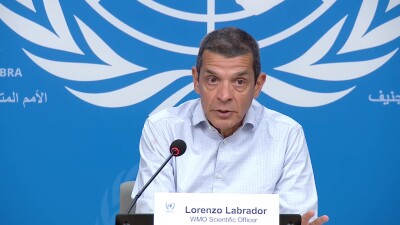
“Air quality respects no boundaries,” said Lorenzo Labrador, Scientific Officer at the World Meteorological Organization (WMO). “The smoke and the pollution that issues from the wildfires in this record-breaking season in the Iberian peninsula has been detected over Western Europe already [and]…can travel basically throughout the rest of the European continent.”
Presenting the latest WMO Air Quality and Climate Bulletin which crunches data from different global datasets, Mr. Labrador announced a continuing pattern of pollution “degradation” worldwide.
He pointed to a map of the world in 2024 showing telltale fine particle markers known as “PM 2.5” from wildfires concentrated in deep red blotches in the Chile, Brazil and Ecuador, along with Canada, central Africa and Siberia. The data confirms the trend for deteriorating global air quality already noted in previous years.
“We know that the wildfire season has the tendency to be stronger and longer every year, as a result of climate change,” Mr. Labrador explained.
China, Europe provide hope
In more positive news, the WMO scientist underscored a reduction in emissions in parts of the world, “particularly eastern China and Europe, year on year”.
“When we see that countries or regions or cities are taking measures to fight against bad air quality, it works,” said Paolo Laj, Chief of Global Atmosphere at WMO.
A good example is eastern China, in cities such as Shanghai where progress has been made in improving air quality by opening more parks, planting more trees. And although there is still heavy vehicle traffic, many of them are electric, WMO spokesperson Clare Nullis noted.
Despite these successes, very few cities worldwide have air quality levels below those recommended by the UN World Health Organization (WHO), stressed WMO’s Mr Laj. “This means that, despite recent improvements, air quality remains a significant public health concern.”
He explained that although main pollutants such as sulphur dioxide (SO₂) and nitrogen oxide (NOₓ) are decreasing as emission controls kick in, ground-level ozone levels – the main ingredient of smog - have not declined. “This is partly a consequence of global warming, as ozone is a secondary pollutant formed through chemical reactions in the atmosphere that require sunlight,” Mr. Laj continued.
Covering wildfires, winter fog, shipping emissions and pollution in urban spaces, the WMO air quality bulletin highlights the close connection between air quality and climate change.
“Climate change and air quality cannot be addressed in isolation. They go hand-in-hand and must be tackled together in order to protect the health of our planet, our communities and our economies,” said WMO Deputy Secretary-General Ko Barrett.
The UN is leading efforts to tackle household air pollution which is one of the world’s greatest public health threats and particularly harmful for children.
“The good news is that cleaner cooking technology is plentiful, relatively inexpensive, and already helping to save lives,” insisted Martina Otto, Head of Secretariat of the Climate and Clean Air Coalition hosted by the UN Environment Programme (UNEP). “The challenge now is to get this technology into the hands of more people.”
Ends
STORY: Global air pollution update - WMO
TRT: 2’46”
SOURCE: UNTV CH
RESTRICTIONS: NONE
LANGUAGE: ENGLISH/ NATS
ASPECT RATIO: 16:9
DATELINE: 5 SEPTEMBER 2025 GENEVA, SWITZERLAND
Speakers:
- Lorenzo Labrador, WMO Scientific Officer
- Paolo Laj – Chief of Global Atmosphere – WMO
SHOTLIST
- Exterior wide shot: Palais des Nations, flag alley.
- Wide, UN Geneva Press room.
- SOUNDBITE (English) – Lorenzo Labrador, WMO Scientific Officer: “The problem is that, as I said before, air quality respects no boundaries. So, the smoke and the pollution that issues from the wildfires in this record-breaking season in the Iberian peninsula has been detected over Western Europe already, so the effects are not only limited to the Iberian peninsula, but can travel basically throughout the rest of the European continent.”
- Wide, UN Geneva Press room podium speakers.
- SOUNDBITE (English) – Lorenzo Labrador, WMO Scientific Officer: “We're seeing a pattern with respect to degradation of air quality insofar as it concerned PM 2.5 and we also see that there is a reduction in emissions in certain parts of the world, particularly eastern China and Europe, year on year.”
- Wide, UN Geneva Press room podium speakers.
- SOUNDBITE (English) – Lorenzo Labrador, WMO Scientific Officer: “You have very strong PM sources as a result of wildfires both in the Amazon basin, in Canada and Siberia; we have seen that in previous years as well. We know that the wildfire season has the tendency to be stronger and longer every year, as a result of climate change. So, that is an issue and that is part of the reason why we see those patterns regarding wildfires and degradation of air quality in wildfires.”
- Medium-wide, UN Geneva Press room podium speakers.
- SOUNDBITE (English) – Lorenzo Labrador, WMO Scientific Officer: “The current wildfire season in the Iberian peninsula has been one for the records. For instance, the Copernicus Atmospheric Monitoring Services has highlighted that this has been in terms of cumulative emissions of CO2 the strongest season that has happened since they started taking records back in 2003; so the strongest season in 20 years.”
- Medium-wide, UN Geneva Press room podium speakers.
- SOUNDBITE (English) – Paolo Laj, Chief of Global Atmosphere, WMO: “When we see that countries or regions or cities are taking measures to fight against bad air quality, it works. And we see that in many areas an improvement of the air quality.”
- Medium, journalist.
- SOUNDBITE (English) – Lorenzo Labrador, WMO Scientific Officer: “We have a marked reduction - improvement - in air quality as a result of a reduction in pollutants in certain fuels, but on the flipside we also see that the reduction in the sulphates aerosols - which is a consequence of the reduction in sulphur emissions from these fuels - also unmasks the real warming of greenhouse gases.”
- Medium, journalist.
Similar Stories
1
1
1
Edited News | OCHA , UNICEF , WFP
Aid agencies warned on Friday of the fast-developing humanitarian emergency inside Taiz City in Yemen, which has been encircled by de facto Houthi forces fighting government troops along the country’s west coast.

2
17
1
2
Edited News , Press Conferences , Images | OCHA , WMO
Two UN agencies teamed up on Wednesday to issue an appeal for immediate assistance to help communities already being impacted by the strongest El Niño on record.
3
16
2
2
Edited News , B-roll , Conferences , Images | UNITED NATIONS , UNOG
Sixth Consultative Meeting on Enhancing Coordination of Peace Initiatives and Efforts for Sudan
1
1
1
Edited News | UNICEF , WHO , UNHCR
Yemen war continues to force families from homes amid hunger and disease
More than 250,000 people have now fled renewed fighting in Yemen, the UN said on Tuesday, citing particular concern for those sheltering in the southwestern city of Taiz and the wider governorate, where access is “essentially blocked”.

1
1
1
Edited News | UNICEF
A little over one year since a ceasefire agreement was announced between Hamas fighters and Israel, more than 340 children have been reported killed and hundreds more injured, the UN Children’s Fund, UNICEF, said on Friday.

1
1
1
Edited News | UNICEF , IFRC
Six weeks after Nepal’s deadly flooding disaster, communities are still struggling to rebuild their lives, but they will need sustained help as global warming increases the risk of another Himalayan catastrophe, the UN Children’s Fund (UNICEF) said on Friday.

1
1
1
Edited News | WHO
In suspected Russia plague death, testing and monitoring underway – WHO
The death of a lab worker in Russia’s Siberia region has sparked concerns about plague being the cause, the UN World Health Organization (WHO) said on Tuesday, adding that it was following the situation closely.

1
1
Edited News | OHCHR , UNOG
UN Human Rights Chief Volker Türk on Friday provided and oral update to the 63rd session of the Human rights Council on Ukraine.

1
1
1
Edited News | OHCHR , UNOG
UN Human Rights Chief Volker Türk on Friday provided and oral update to the 63rd session of the Human rights Council on the human rights situation in Haiti.

1
1
1
Edited News | WHO
Repeated delays in bringing lifesaving medicines, prosthetics and more from Israel into Gaza risk having devastating consequences on Palestinians who urgently need them in the wartorn enclave, the UN World Health Organization (WHO) said on Friday. “A truck full of non-priority supplies or the right supplies arriving too late, doesn't save lives. That's the question that actually matters," said Dr Reinhilde Van De Weerdt, WHO Representative in the OPT.

1
1
1
Edited News | WHO
DRC: Early access to care and oxygen decisive for Ebola patients’ survival – WHO
In the Democratic Republic of the Congo (DRC), health workers fighting the country’s largest-ever Ebola outbreak are struggling to overcome critical challenges to patient care, the UN World Health Organization (WHO) warned on Tuesday.

1
1
1
Edited News | OCHA , UN
Civilians in Iran are continuing to feel the consequences of months of conflict and military escalation, the UN’s top official in the country has said, as loss of life, damage to civilian infrastructure and mounting economic pressures leave many facing continued uncertainty.