

The United Nations Office at Geneva
Multimedia Newsroom
Un panel international mis en place pour aider à protéger les câbles sous-marins
Un panel international a été mis en place pour protéger les câbles de communication sous-marins qui sont cruciaux pour le commerce international et la sécurité, a déclaré vendredi l'Union Internationale des Télécommunications (UIT) des Nations Unies.
La création de l'Organe Consultatif International pour la Résilience des Câbles Sous-marins intervient dans le cadre d'une enquête en cours sur la coupure de deux câbles à fibre optique en mer Baltique, en moins de 24 heures entre le 17 et le 18 novembre.
Pékin a nié toute implication mais a exprimé sa volonté de coopérer avec la Suède dans une enquête, après des rapports indiquant qu'un navire chinois se trouvait à proximité au moment où les deux incidents se sont produits.
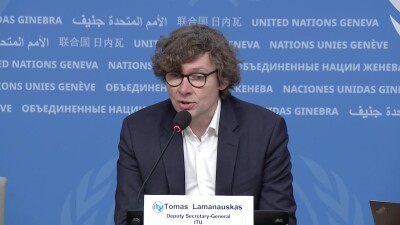
L'organisme international - créé par l'UIT et le Comité International de Protection des Câbles (ICPC) - est "une étape importante dans la protection de l'infrastructure numérique mondiale, assurant sa résilience et qu'elle serve bien notre économie mondiale," a déclaré Tomas Lamanauskas, Secrétaire général adjoint de l'UIT.
Les câbles sous-marins transportent environ 99 pour cent du trafic internet mondial. Cela signifie que "tout ce que nous faisons aujourd'hui dans le monde numérique dépend des câbles sous-marins, de nos e-mails et messages texte aux transactions financières, communications gouvernementales critiques, services de cloud, réseaux sociaux, nos services de streaming vidéo, et ainsi de suite," a déclaré M. Lamanauskas aux journalistes à Genève.
Les dommages aux câbles sous-marins se produisent régulièrement, avec une moyenne de 150 à 200 ruptures survenant chaque année dans le monde et nécessitant environ trois réparations de câbles par semaine, selon l'ICPC.
Il faut généralement quelques semaines pour réparer, mais cela dépend de divers facteurs tels que le type de rupture, la profondeur ou les conditions météorologiques. L'éruption volcanique dans l'océan Pacifique Sud déclenchée par un tsunami en 2022 a déconnecté Tonga pendant plusieurs semaines. Il a fallu près de 18 mois pour réparer complètement les dégâts.
Cela a, à son tour, limité la réponse d'urgence essentielle et le soutien à la gestion et à la récupération des catastrophes dans l'archipel. "Cette infrastructure critique est vulnérable aux perturbations, dues à l'activité humaine accidentelle, aux dangers naturels, à l'infrastructure vieillissante," a expliqué M. Lamanauskas.
Le nouvel organe consultatif visera à améliorer la résilience des câbles en promouvant les meilleures pratiques et principes pour tous les gouvernements et acteurs de l'industrie. Il est chargé d'assurer le déploiement rapide et la réparation rapide des câbles sous-marins, pour réduire le risque de dommages et améliorer la continuité des communications affectées.
Interrogé sur la cause du plus récent incident en mer Baltique, M. Lamanauskas a noté que l'UIT n'attribue pas "les causes des perturbations. Ce que nos partenaires, internationaux ou certains comités internationaux de protection des câbles disent, c'est qu'environ 80 pour cent des perturbations des câbles sont causées par l'activité humaine accidentelle ou les dangers naturels."
Les 40 membres de l'organe consultatif comprennent des ministres gouvernementaux, des chefs d'autorités réglementaires, des dirigeants de l'industrie et des experts seniors dans le domaine des câbles de télécommunication du monde entier. L'organe se réunira au moins deux fois par an. La première réunion virtuelle est prévue le mois prochain, en décembre 2024. La première réunion physique est prévue lors du Sommet sur la Résilience des Câbles Sous-marins, prévu pour fin février 2025 à Abuja, au Nigeria.
Fin
Story: “Résilience des câbles sous-marins – UIT” – 29 novembre 2024 Orateurs: • Tomas Lamanauskas, Secrétaire général adjoint, Union internationale des télécommunications (UIT) TRT: 01’58” SOURCE: UNTV CH LANGUE: ANGLAIS / NATS FORMAT D'IMAGE: 16:9 DATELINE: 29 novembre 2024 - GENÈVE, SUISSE Conférence de presse à Genève SHOTLIST 1. Plan extérieur moyen : allée des drapeaux de l'ONU. 2. Plan large du podium avec les orateurs dans la salle de conférence de presse. 3. EXTRAIT SONORE (Anglais) Tomas Lamanauskas, Secrétaire général adjoint, Union internationale des télécommunications (UIT) : « Nous lançons l'organisme consultatif international pour la résilience des câbles sous-marins, qui est une étape importante dans la protection de notre infrastructure numérique mondiale, en assurant sa résilience et en veillant à ce qu'elle serve bien notre économie mondiale. » 4. Plan moyen de la salle de conférence de presse. 5. EXTRAIT SONORE (Anglais) Tomas Lamanauskas, Secrétaire général adjoint, Union internationale des télécommunications (UIT) : « Les câbles sous-marins transportent environ 99 % du trafic Internet mondial. Cela signifie donc que tout ce que nous faisons aujourd'hui dans le monde numérique dépend des câbles sous-marins, de nos e-mails et messages texte aux transactions financières, communications gouvernementales critiques, services cloud, réseaux sociaux, nos services de streaming vidéo, etc. » 6. Plan large de la salle de conférence de presse et de la salle de contrôle. 7. EXTRAIT SONORE (Anglais) Tomas Lamanauskas, Secrétaire général adjoint, Union internationale des télécommunications (UIT) : « Nous voyons que cette infrastructure critique est vulnérable aux perturbations, dues à une activité humaine accidentelle, à des risques naturels, à une infrastructure vieillissante. Nous identifions généralement environ 150 à 200 pannes qui se produisent chaque année dans le monde, soit environ trois pannes par semaine. » 8. Plan moyen : journalistes dans la salle de conférence de presse. 9. EXTRAIT SONORE (Anglais) Tomas Lamanauskas, Secrétaire général adjoint, Union internationale des télécommunications (UIT) : « Ce n'est pas notre rôle d'enquêter, d'attribuer ou de déterminer les problèmes. Ce que nous faisons pour aider les États membres, c'est de les orienter vers les pratiques qu'ils peuvent utiliser pour cela, à appliquer à cet égard. » 10. Plan rapproché : journaliste écoutant dans la salle de conférence de presse. 11. EXTRAIT SONORE (Anglais) Tomas Lamanauskas, Secrétaire général adjoint, Union internationale des télécommunications (UIT) : « Nous ne faisons pas l'attribution des causes des perturbations. Ce que disent nos partenaires, internationaux ou certains comités internationaux de protection des câbles, c'est qu'environ 80 % des perturbations des câbles sont causées par une activité humaine accidentelle ou des risques naturels. » 12. Plan large de la salle de conférence de presse. 13. Divers plans de la salle de conférence de presse.
Similar Stories

1
1
1
Edited News | UNICEF
A little over one year since a ceasefire agreement was announced between Hamas fighters and Israel, more than 340 children have been reported killed and hundreds more injured, the UN Children’s Fund, UNICEF, said on Friday.

1
1
1
Edited News | UNICEF , IFRC
Six weeks after Nepal’s deadly flooding disaster, communities are still struggling to rebuild their lives, but they will need sustained help as global warming increases the risk of another Himalayan catastrophe, the UN Children’s Fund (UNICEF) said on Friday.

1
1
1
Edited News | WHO
In suspected Russia plague death, testing and monitoring underway – WHO
The death of a lab worker in Russia’s Siberia region has sparked concerns about plague being the cause, the UN World Health Organization (WHO) said on Tuesday, adding that it was following the situation closely.

1
1
Edited News | OHCHR , UNOG
UN Human Rights Chief Volker Türk on Friday provided and oral update to the 63rd session of the Human rights Council on Ukraine.

1
1
1
Edited News | OHCHR , UNOG
UN Human Rights Chief Volker Türk on Friday provided and oral update to the 63rd session of the Human rights Council on the human rights situation in Haiti.

1
1
1
Edited News | WHO
Repeated delays in bringing lifesaving medicines, prosthetics and more from Israel into Gaza risk having devastating consequences on Palestinians who urgently need them in the wartorn enclave, the UN World Health Organization (WHO) said on Friday. “A truck full of non-priority supplies or the right supplies arriving too late, doesn't save lives. That's the question that actually matters," said Dr Reinhilde Van De Weerdt, WHO Representative in the OPT.

1
1
1
Edited News | WHO
DRC: Early access to care and oxygen decisive for Ebola patients’ survival – WHO
In the Democratic Republic of the Congo (DRC), health workers fighting the country’s largest-ever Ebola outbreak are struggling to overcome critical challenges to patient care, the UN World Health Organization (WHO) warned on Tuesday.

1
1
1
Edited News | OCHA , UN
Civilians in Iran are continuing to feel the consequences of months of conflict and military escalation, the UN’s top official in the country has said, as loss of life, damage to civilian infrastructure and mounting economic pressures leave many facing continued uncertainty.
1
1
1
Edited News | WHO , UNICEF
Aid agencies in Yemen highlighted the growing hunger emergency sparked by renewed fighting between Houthi opposition forces and Government troops, after mobile health clinics reported that hundreds of children displaced by the violence are suffering from the most deadly form of malnutrition.
1
1
1
Edited News | UNHCR
Displacement on the rise in Yemen as fighting continues - UNHCR
As hostilities worsen in Yemen, more people have been fleeing their homes, further intensifying the humanitarian crisis within the region, the UN Refugee Agency (UNHCR) warned on Tuesday.
1
1
1
Edited News | IOM , OHCHR , UNFPA , UNOG , UNHCR , WHO
Yemen’s humanitarian crisis growing by the hour amid spike in displacement
Yemenis displaced by renewed fighting have described fleeing for their lives amid shelling and gunfire, aid agencies reported on Friday, while highlighting the dramatic increase in humanitarian needs in the country and in Djibouti, where thousands have sought shelter.
1
1
1
Edited News | OHCHR , UNOG
The UN Human Rights Office issued on Friday a report documenting a shocking pattern of sexual violence amid Russia’s full-scale armed attack on Ukraine.