

The United Nations Office at Geneva
Multimedia Newsroom
UN launches largest single country aid appeal to prevent Afghanistan’s collapse
The UN and partners launched a more than $5 billion funding appeal for Afghanistan on Tuesday, in the hope of shoring up collapsing basic services there, which have left 22 million in need of assistance inside the country and 5.7 million people requiring help beyond its borders.
Speaking in Geneva, UN Emergency Relief Coordinator Martin Griffiths said that $4.4 billion was needed for the Afghanistan Humanitarian Response Plan alone, “to pay direct” to health workers and others, not the de facto authorities.
UN High Commissioner for Refugees Filippo Grandi called for $623 million, to support refugees and host communities in five neighbouring countries, for the Afghanistan Situation Regional Refugee Response Plan.
“Today we are launching an appeal for $4.4 billion for Afghanistan itself for 2022,” said Mr. Griffiths. “This is the largest ever appeal for a single country for humanitarian assistance and it is three times the amount needed, and actually fundraised in 2021.”
The scale of need is already enormous, both UN officials stressed, warning that if insufficient action is taken now to support the Afghanistan and regional response plans, “next year we’ll be asking for $10 billion”.
Mr. Griffiths added: “This is a stop-gap, an absolutely essential stop-gap measure that we are putting in front of the international community today. Without this being funded, there won’t be a future, we need this to be done, otherwise there will be outflow, there will be suffering.”
Rejecting questions that the funding would be used to support the Taliban’s grip on de facto government, Mr. Griffiths insisted that it would go directly into the pockets of “nurses and health officials in the field” so that these services can continue, not as support for State structures.
UN aid agencies describe Afghanistan’s plight as one of the world’s most rapidly growing humanitarian crises.
According to UN humanitarian coordination office OCHA, half the population now faces acute hunger, over nine million people have been displaced and millions of children are out of school.
Asked to describe what might happen if sufficient support was not forthcoming, the UN emergency relief chief replied that he was particularly concerned for one million children now facing severe acute malnutrition. “A million children, it - figures are so hard so grasp when they’re this kind of size - but a million children at risk of that kind of malnutrition if these things don’t happen is a shocking one.”
But humanitarian agencies and their partners who will receive the requested funding directly can only do so much, Mr. Griffiths explained, before reiterating his support for the 22 December UN Security Council resolution that cleared the way for aid to reach Afghans, while preventing funds from falling into the hands of the Taliban.
“Humanitarian agencies inside Afghanistan can only operate if there’s cash in the economy which can be used to pay officials, salaries, costs, fuel and so-forth,” he said. “So, liquidity in its first phase is a humanitarian issue, it’s not just a bigger economic issue.”
He added: “My message is urgent: don’t shut the door on the people of Afghanistan. Humanitarian partners are on the ground, and they are delivering, despite the challenges. Help us scale up and stave off wide-spread hunger, disease, malnutrition and ultimately death by supporting the humanitarian plans we are launching today.”
Highlighting the need to avoid a wider regional crisis emanating from Afghanistan, UN High Commissioner for Refugees Filippo Grandi insisted that what was needed most was “to stabilize the situation inside Afghanistan, including that of displaced people who are displaced inside their country. Also, to prevent a larger refugee crisis, a larger crisis of external displacement.”
Nonetheless, Afghanistan’s immediate neighbours had sheltered vulnerable Afghans for decades, Mr. Grandi explained, as he appealed for $623 million in funding for 40 organizations working in protection, health and nutrition, food security, shelter and non-food items, water and sanitation, livelihoods and resilience, education, and logistics and telecoms.
No-one should forget “that there is a regional dimension to this crisis, represented by the Afghan refugees but also Afghans with many other ‘stay’ arrangements in neighbouring countries in particular,” Mr. Grandi said, “especially in Pakistan and Iran that have hosted Afghans for more than 40 years, but also Central Asian States.”
Since the Taliban takeover last August, women’s and girls’ rights have continued to come under attack, OCHA noted in a statement, “while farmers and herders are struggling amid the worst drought in decades and the economy is in freefall”.
On the issue of protecting fundamental rights, Mr. Griffiths underlined the fact that UN humanitarians were continuing to hold “conversations” with Afghanistan’s de facto authorities at a national and sub-national level, on issues such as aid and education access for all.
Echoing that message, UN refugee chief Mr. Grandi noted that humanitarians on the ground were well aware of the importance of stressing the need to protect the rights of minorities and other vulnerable Afghans.
“Our colleagues are there every day, and that’s what they talk about every day; they certainly talk about access, and delivery and needs, but they also talk about women at work, women in school - girls in school - rights of minorities, but it’s that space that we need to preserve.”
ends
STORY: Afghanistan Appeal – OCHA, UNHCR
TRT: 3’32”
SOURCE: UNTV CH
RESTRICTIONS: NONE
LANGUAGE: ENGLISH
ASPECT RATIO: 16:9
DATELINE: 10 January 2022, GENEVA, SWITZERLAND
SHOTLIST
- Exterior wide shot, United Nations flags flying.
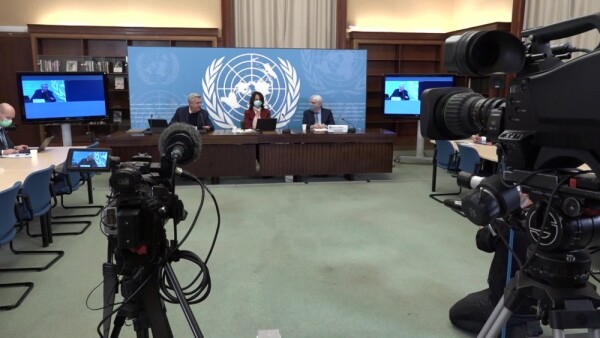
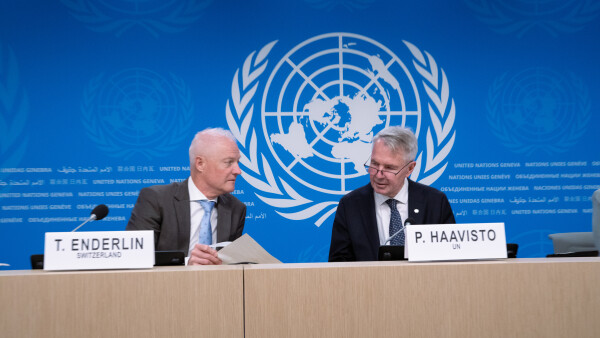
- Medium shot, press conference room, press photographer, masked and crouching, taking picture of podium speakers to rear.
- SOUNDBITE (English): UN Under-Secretary-General for Humanitarian Affairs and Emergency Relief Coordinator, Martin Griffiths: “Today we are launching an appeal for $4.4 billion for Afghanistan itself for 2022. This is the largest ever appeal for a single country for humanitarian assistance and it is three times the amount needed, and actually fundraised in 2021.”
- Medium shot: TV camera operators in profile.
- SOUNDBITE (English): UN Under-Secretary-General for Humanitarian Affairs and Emergency Relief Coordinator, Martin Griffiths: “This is a stop-gap, an absolutely essential stop-gap measure that we are putting in front of the international community today. Without this being funded, there won’t be a future, we need this to be done, otherwise there will be outflow, there will be suffering.”
- Close-up, hand holding a stylus being used to take digital notes on a tablet.
- SOUNDBITE (English): UN Under-Secretary-General for Humanitarian Affairs and Emergency Relief Coordinator, Martin Griffiths: “A million children potentially suffering severe acute malnutrition, a million children, it, figures are so hard so grasp when they’re this kind of size, but a million children at risk of that kind of malnutrition if these things don’t happen is a shocking one.”
- Medium shot, participant seated in front of laptop, masked.
- SOUNDBITE (English): UN Under-Secretary-General for Humanitarian Affairs and Emergency Relief Coordinator, Martin Griffiths: “Humanitarian agencies inside Afghanistan can only operate if there’s cash in the economy which can be used to pay officials, salaries, costs, fuel and so-forth; so, liquidity in its first phase is a humanitarian issue, it’s not just a bigger economic issue.”
- Wide shot, press room, photographer crouching to photograph podium speakers, journalists seated at tables, masked.
- SOUNDBITE (English): UN High Commissioner for Refugees Filippo Grandi: “The key here is to stabilize the situation inside Afghanistan, including that of displaced people who are displaced inside their country. Also, to prevent a larger refugee crisis, a larger crisis of external displacement.”
- Medium shot: photographer kneeling with large telephoto lens, flanked by press conference participants.
- SOUNDBITE (English): UN High Commissioner for Refugees Filippo Grandi: “It is key I think not to forget that there is a regional dimension to this crisis, represented by the Afghan refugees but also Afghans with many other ‘stay’ arrangements in neighbouring countries in particular, especially in Pakistan and Iran that have hosted Afghans for more than 40 years; but also Central Asian States.”
- Close-up: showing a pen being used to scribble notes on notepad.
- SOUNDBITE (English): UN High Commissioner for Refugees Filippo Grandi: “This is why in this segment of this big appeal, of this $5 billion appeal, the segment worth just over $600 million, we’re asking for resources to support the neighbouring countries.”
- Close-up: Filippo Grandi in the TV camera viewfinder and at podium, to rear.
- SOUNDBITE (English): UN High Commissioner for Refugees Filippo Grandi: “Our colleagues are there every day, and that’s what they talk about every day; they certainly talk about access, and delivery and needs, but they also talk about women at work, women in school - girls in school - rights of minorities, but it’s that space that we need to preserve.”
- Medium shot from ground level: TV crews with cameras on tripods, large screen TV showing podium speakers.
- Close-up: Martin Griffiths on TV camera viewfinder and to rear at podium and on big-screen TV, blurred.
- Medium-wide shot: TV cameras in foreground, podium speakers to rear.
Similar Stories
1
1
1
Edited News | OCHA , UNICEF , WFP
Aid agencies warned on Friday of the fast-developing humanitarian emergency inside Taiz City in Yemen, which has been encircled by de facto Houthi forces fighting government troops along the country’s west coast.
1
1
1
Press Conferences | UN WOMEN , WFP , WHO
UN WOMEN: Sudan Women and girls one year after the fall of El Fasher; increasing drone attacks across the country; WFP: DRC - Ebola spreads to eighth DRC province as WFP delivers food, builds treatment centres and keeps supplies moving; WHO - Update on Ebola (Bundibugyo Virus Disease)
1
12
1
1
Press Conferences , Images | UNOG
Closing Press Conference following the Sixth Consultative Meeting on Enhancing Coordination of Peace Initiatives and Efforts in Sudan

2
17
1
2
Edited News , Press Conferences , Images | OCHA , WMO
Two UN agencies teamed up on Wednesday to issue an appeal for immediate assistance to help communities already being impacted by the strongest El Niño on record.

3
16
2
2
Edited News , B-roll , Conferences , Images | UNITED NATIONS , UNOG
Sixth Consultative Meeting on Enhancing Coordination of Peace Initiatives and Efforts for Sudan
1
1
1
Press Conferences | CITES
Wildlife trade and conservation policy discussions at the 81st meeting of the CITES Standing Committee (SC81)

1
1
1
Edited News | UNICEF , WHO , UNHCR
Yemen war continues to force families from homes amid hunger and disease
More than 250,000 people have now fled renewed fighting in Yemen, the UN said on Tuesday, citing particular concern for those sheltering in the southwestern city of Taiz and the wider governorate, where access is “essentially blocked”.
1
1
1
Press Conferences | UNHCR , UNCTAD , WMO , OCHA , UNICEF , WHO
UNHCR Hungary’s 1956 Refugee Crisis: 70 Years On, UNCTAD World Investment Forum 2026, Doha, WMO Greenhouse Gas Bulletin and Climate Update for COP31, OCHA Afghanistan: Malnutrition, Girls’ Education and Recovery, UNICEF Yemen: Child Malnutrition and Unsafe Water in Taiz, WHO Inequalities in Noncommunicable Diseases and Risk Factors

1
1
1
Press Conferences | UNHCR
End of UNHCR's 77th Annual Executive Committee (ExCom) meeting week

1
1
1
Edited News | UNICEF
A little over one year since a ceasefire agreement was announced between Hamas fighters and Israel, more than 340 children have been reported killed and hundreds more injured, the UN Children’s Fund, UNICEF, said on Friday.

1
1
1
Press Conferences | UNICEF , IOM , UNHCR
UN Special Assistant to the Personal Envoy Office (SUDAN): Peace Initiatives and Efforts in Sudan; UNICEF: Dire situation of children in Gaza; IOM: Damaged Homes and Energy Attacks Risk Displacing Ukrainians for this winter; UNHCR: update on EXCOM week

1
1
1
Press Conferences | IOM , UNDRR
UN stresses importance of household preparedness for disaster risk reduction.