

The United Nations Office at Geneva
Multimedia Newsroom
Press Conferences | OHCHR , UNHCR , WHO , UNOG , UNITED NATIONS , FAO
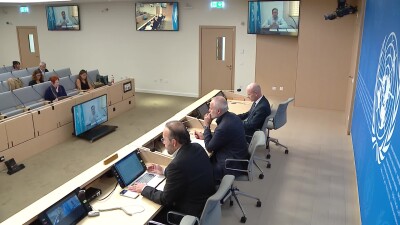
Bi-weekly Press Briefing 24 September 2021
Human Rights Council update
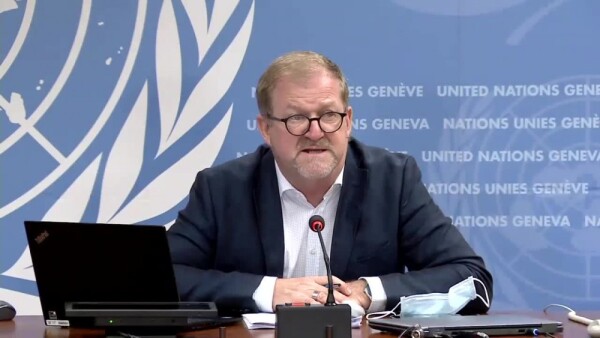
Rolando Gomez, for the Human Rights Council, said that on 28 September, there would be two panel discussions, at 10 a.m. and 3 p.m., on the situation of indigenous persons facing the coronavirus disease (COVID-19) pandemic, with a focus on the right to participate, and on the deepening inequalities as a result of the pandemic. Speakers on the latter panel included the High Commissioner, Joseph Stiglitz and Gordon Brown. The Council would hear from the Expert Mechanism on the Rights of Indigenous Peoples at 12.30 p.m. and from the Special Rapporteur on the rights of indigenous peoples at 5 p.m.
The programme for Wednesday, 29 September, included a panel discussion on the tenth anniversary of the United Nations Declaration on Human Rights Education and Training, from 10 a.m. to noon; the presentation, at noon, of the Secretary-General’s report on reprisals committed between May 2020 and April 2021 against persons who cooperated with the United Nations; and a panel on the promotion and protection of human rights in the context of peaceful protests, from 3 to 5 p.m.
Mr. Gomez recalled that the deadline for the submission of draft recommendations was 29 September; some 30 draft recommendations were expected for the current session.
World Food Forum
Adriano Timossi, for the Food and Agriculture Organization of the United Nations (FAO), said that the first World Food Forum would be held from 1 to 5 October. The Forum was an independent global network of partners, tasked with helping to transform agri-food systems and achieve the Sustainable Development Goals. The flagship event would bring together major youth groups, influencers, companies, academic institutions, non-profit organizations, Governments and the public to drive awareness, foster engagement and mobilize resources. Speakers included Pope Francis, the President of Costa Rica Carlos Alvarado Quesada, Queen Letizia of Spain, food entrepreneurs and philanthropists, as well as young global leaders.
For more details and registration, see http://www.world-food-forum.org/.
International Day of Awareness of Food Loss and Waste
Nancy Aburto, FAO Deputy Director of the Food and Nutrition Division Economic and Social Development Stream, said that a high-level event to mark the second observance of International Day of Awareness of Food Loss and Waste would be held at 4 p.m. on Wednesday, 29 September 2021. The event would highlight how reducing food loss and waste impacted nutritional outcomes.
No country was unaffected by food insecurity, hunger and malnutrition, and diet-related factors accounted for six of the top nine risks for the global burden of disease. The high cost of healthy food had put healthy diets out of reach for some 3 billion people, including in Europe – a trend that had increased considerably during the COVID-19 pandemic. At the same time, an estimated 14 per cent of food produced globally was lost, from post-harvest to retail, and the United Nations Environmental Programme (UNEP) 2021 Food Waste Report documented that an estimated 17 per cent of food available to consumers was wasted. Furthermore, food loss and waste accounted for approximately 10 per cent of global greenhouse gas emissions.
For more information and registration, see http://www.fao.org/international-day-awareness-food-loss-waste/en/.
Replying to questions from journalists, Ms. Aburto said that nutritional outcomes were a function of a multitude of complex factors, including conflict, hygiene and food systems, that affected the availability and accessibility of healthy food. It was also important to recognize the value of food and to empower people to take up healthy diets. It was no longer necessarily true that there was more food loss and waste in higher-income countries. Areas for improvement included shelf life, transportation and packaging to keep food in edible condition and better linking producers with consumers through apps.
World Health Organization updates
Margaret Harris, for the World Health Organization (WHO), said that, although the prevalence of influenza had been very low between February and August 2021, owing chiefly to COVID-19 mitigation efforts, what strains to include in the southern hemisphere vaccine had been decided following the technical consultations in September. A recommendation would be made in February 2022 as to vaccines that would be used for the northern hemisphere 2022–2023 influenza season.
Ms. Harris also said that the Essential Medicines List would be updated that week. An embargoed press release would be issued prior to the update, likely on 29 September.
In response to journalists, Ms. Harris said that the WHO Emergency Use Listing was data-driven and intended to assure States of the safety, efficacy and manufacturing process of vaccines submitted to WHO for inclusion in the list. Nevertheless, States had a sovereign right to choose whether or not to apply the list. She urged the journalists to consult the WHO website for comprehensive information on the election of the next WHO Director General. That afternoon’s press conference by the independent commission on the Democratic Republic of the Congo was being managed by the commission’s communications specialist.
UNCTAD Announcements
Richard Warren, for the United Nations Conference on Trade and Development (UNCTAD), said that UNCTAD15 would be taking place virtually next week, hosted by Barbados. The Secretary-General of the United Nations would be attending in person on Monday, 4 October. Further details would be forthcoming. UNCTAD Secretary General would be participating in the UNHQ noon briefing on Wednesday, 29 September, where she would outline her aspirations and expectations for UNCTAD15. She was eager to speak with the Geneva press upon her return from UNCTAD15.
He also said that UNCTAD would be holding a hybrid press conference on Tuesday, 28 September, at 3.30 p.m., to present its Digital Economy Report 2021 (under embargo until 29 September, at 7 a.m.). The speakers would be Isabelle Durant, UNCTAD Deputy Secretary-General, and Shamika N. Sirimanne, Director of UNCTAD's Division on Technology and Logistics.
Mr. Warren recalled that the embargo on the UNCTAD report on its assistance to the Palestinian people would be lifted at 7 p.m. that day.
Lastly, he said that, following the technical difficulties at the launch of the UNCTAD report on LDCs in the post-COVID world last week, the team of Mr. Paul Akiwumi of the Division on Africa, Least Developed Countries and Special Programmes was available for information requests.
Announcements
Rhéal LeBlanc, for the United Nations Information Service (UNIS), on behalf of the Office of the Special Envoy of the Secretary-General for Syria, said that Mr. Geir Pedersen would be briefing the Security Council at 4 p.m. that day. The briefing would be carried live on UN WebTV and the Special Envoy’s remarks would be circulated shortly after the briefing.
Mr. LeBlanc, for the United Nations Information Service (UNIS), said that the Committee on Economic, Social and Cultural Rights, whose seventieth session would run at the Palais des Nations (Room XXIII) from 27 September to 8 October, would be reviewing the periodic reports of Kuwait on 28–29 October, Azerbaijan on the mornings of 30 September and 1 October, Bosnia and Herzegovina on the afternoons of 30 September and 1 October, Bolivia on 5–6 October and Nicaragua on 7–8 October.
The Committee on Migrant Workers, whose thirty-third session would run from 27 September to 8 October, first at Palais Wilson then at the Palais des Nations, would be reviewing the periodic reports of Rwanda on 27–28 September and Azerbaijan on 4–5 October.
The Department of Economic and Social Affairs would be holding a virtual press conference on Friday, 1 October, at 2.30 p.m., on the United Nations World Data Forum, being held in Bern, Switzerland, from 3-6 October. The speakers would be Stefan Schweinfest, Director of the United Nations Statistics Division, and Gabriella Vukovich, Chair of the United Nations World Data Forum Programme Committee and President of the Hungarian Central Statistical Office.
In connection with the General Assembly, a virtual high-level event on jobs and poverty alleviation, co-organized by the International Labour Organization and hosted by the Secretary-General and the Prime Ministers of Canada and Jamaica, as well as a high-level meeting to commemorate International Day for the Total Elimination of Nuclear Weapons would be held on 28 September and carried live on UN WebTV.
[Correspondents are reminded that tomorrow, 29 September, at 4 p.m. Geneva time, the High-Level Panel on Internal Displacement, co-chaired by Federica Mogherini and Donald Kaberuka, will formally submit its report to the UN Secretary-General. The event will be carried live on UN Web TV. The Panel was established by the UN Secretary-General at the end of 2019 to identify concrete recommendations on how to better prevent, respond to, and achieve solutions to the global internal displacement crisis.]
Similar Stories
1
1
1
Press Conferences | UN WOMEN , WFP , WHO
UN WOMEN: Sudan Women and girls one year after the fall of El Fasher; increasing drone attacks across the country; WFP: DRC - Ebola spreads to eighth DRC province as WFP delivers food, builds treatment centres and keeps supplies moving; WHO - Update on Ebola (Bundibugyo Virus Disease)
1
12
1
1
Press Conferences , Images | UNOG
Closing Press Conference following the Sixth Consultative Meeting on Enhancing Coordination of Peace Initiatives and Efforts in Sudan

2
17
1
2
Edited News , Press Conferences , Images | OCHA , WMO
Two UN agencies teamed up on Wednesday to issue an appeal for immediate assistance to help communities already being impacted by the strongest El Niño on record.
1
1
1
Press Conferences | CITES
Wildlife trade and conservation policy discussions at the 81st meeting of the CITES Standing Committee (SC81)
1
1
1
Press Conferences | UNHCR , UNCTAD , WMO , OCHA , UNICEF , WHO
UNHCR Hungary’s 1956 Refugee Crisis: 70 Years On, UNCTAD World Investment Forum 2026, Doha, WMO Greenhouse Gas Bulletin and Climate Update for COP31, OCHA Afghanistan: Malnutrition, Girls’ Education and Recovery, UNICEF Yemen: Child Malnutrition and Unsafe Water in Taiz, WHO Inequalities in Noncommunicable Diseases and Risk Factors

1
1
1
Press Conferences | UNHCR
End of UNHCR's 77th Annual Executive Committee (ExCom) meeting week

1
1
1
Press Conferences | UNICEF , IOM , UNHCR
UN Special Assistant to the Personal Envoy Office (SUDAN): Peace Initiatives and Efforts in Sudan; UNICEF: Dire situation of children in Gaza; IOM: Damaged Homes and Energy Attacks Risk Displacing Ukrainians for this winter; UNHCR: update on EXCOM week

1
1
1
Press Conferences | IOM , UNDRR
UN stresses importance of household preparedness for disaster risk reduction.

1
1
1
Statements , Press Conferences | OHCHR

1
1
1
Press Conferences | UNHCR , UNICEF , IFRC , OHCHR , UN WOMEN , IOM , OCHA , WHO
UNHCR – ExCom Meeting, UNICEF – Nepal Recovery, IFRC – Flash Floods, WHO – Mental Health, IOM – South Sudan Floods, OCHA – DRC Humanitarian aid, UNHCR – Sahel Displacement, UNICEF – Yemen Update, IOM – Gaza Shelter, UN Women – Gaza Women, OHCHR – Arrests and detentions of Syrians by Israeli force

2
1
2
Press Conferences | UNCTAD
Presentation of the Trade and Developement Report 2026
Embargoed until 9 October 2026 at 11 a.m. (Geneva Time)
UNCTAD: UNCTAD’s flagship report finds that governments increasingly use industrial, trade, financial and technology policies to pursue economic and national security objectives. Market access and the ability to move into higher-value activities now depend more heavily on technology, finance and geopolitics.

1
1
1
Press Conferences | UPU
Release of the State of the Postal Sector Report 2026