

The United Nations Office at Geneva
Multimedia Newsroom
UN GENEVA PRESS BRIEFING
27 February 2026
Situation in South Sudan
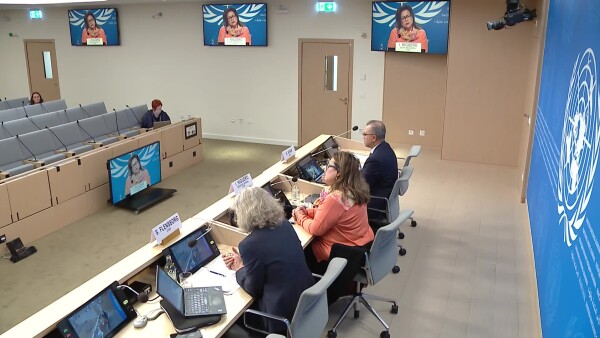
Ugochi Daniels, Deputy Director General for Operations, International Organization for Migration (IOM), speaking from Juba, South Sudan, said she was leaving the country with three impressions: the urgent need for peace and open dialogue, the generosity of host communities and the Government in welcoming refugees and returnees, and the resilience of displaced communities across the country.
At its core, this was a political crisis with profound humanitarian consequences. Without progress on the political track, humanitarian needs would only continue to escalate. Over the past two months alone, over 250,000 people had been displaced, yet this unfolding emergency had received little international attention.
South Sudan remained one of the countries most affected by displacement in the world. Nearly 10 million people required humanitarian assistance, and more than 2.3 million people remained internally displaced. At the same time, the joint border monitoring mechanism run by IOM, the United Nations High Commissioner for Refugees and the Government had tracked over 1.3 million people crossing into South Sudan since the conflict erupted in Sudan, most of them South Sudanese returnees fleeing violence. The regional dimension of the Sudan crisis was significantly compounding humanitarian pressures, stretching already fragile systems and resources.
In Renk, a border town that Ms. Daniels had visited that normally had a population of 80,000, one million people had passed through in less than three years, with hundreds more arriving each day. Transit facilities were operating far beyond capacity. IOM teams were present at the border, providing registration, medical screening, protection and mental health services, as well as onward transportation to ease pressure on host communities. Over the past two years, IOM had directly supported more than 610,000 returnees and refugees affected by the Sudan crisis.
However, humanitarian assistance could not be an open-ended response. From day one, it needed to be accompanied by a clear exit strategy and a long-term vision for development — one that was Government-led and Government-financed, with sustained support from partners.
Bentiu remained the country’s largest displacement site, with over 109,000 people living in fragile conditions, surrounded by floodwaters and increasingly exposed to climate shocks. People with already limited resources were being forced to cope with the growing impacts of climate change on top of conflict and displacement. Yet through flood mitigation efforts undertaken with the Government and the World Bank, land had been reclaimed, allowing families to begin rebuilding flood resilient homes and reconnecting to basic services.
Durable solutions were beginning to take shape, but progress to date remained fragile and needed to be adequately protected. Without security, reliable services, and sustained investment in infrastructure and recovery, South Sudan risked remaining trapped in cycles of protracted displacement and dependency.
Pressures were intensifying — border communities were absorbing unprecedented arrivals; climate shocks were compounding displacement; infrastructure remained weak; and IOM currently faced a 29 million USD funding shortfall for this year alone. This covered critical life-saving assistance, system-wide humanitarian enablers such as displacement data, supplies pipeline, humanitarian hubs, and onward transportation assistance, as well as health and protection activities.
The message from communities was very clear: they wanted peace, stability, and the opportunity to rebuild their lives. South Sudan's leadership needed to meet these expectations, and the international community must not step back at this critical moment. Protecting lives today while investing in durable, development-oriented solutions for tomorrow needed to happen in parallel.
IOM needed to respond to critical needs, but to break the cycle in South Sudan, there needed to be humanitarian assistance with an exit strategy for a long-term transition and development outcomes. Durable solutions promoting development could be provided simultaneously with responses to humanitarian needs. Ms. Daniels said the people had told her that they wanted to end their reliance on international assistance and humanitarian aid.
Responding to questions, Ms. Daniels said accessing Jonglei State was a challenge. She had raised this issue in meetings with senior Government officials and received assurances of improvements in access, but access remained fragile. The Government needed to live up to the commitments and promises it had made regarding access.
There was a funding shortfall for critical life-saving IOM services, including the provision of shelter and non-food items, data generating activities, and health and protection for the most vulnerable people. This was what was at stake if funding gaps in critical areas were not met.
Compounding crises, decades of protracted displacement and the impacts of climate change were exacerbating the situation in South Sudan. This was happening at a time when the capacities and resources of IOM and the UN system were reduced. Ms. Daniels said her visit sought to bring visibility to this situation, and to remind the Government of IOM’s expectations.
What was happening in South Sudan was impacted by the situation in Sudan and the wider region. IOM was very concerned by the situation in Kordofan and what this meant for the near future, and there were also refugees coming into South Sudan from other neighbouring countries. Coping capacities at the border were at the brink, if not exceeding it.
Deaths on Migration Routes in 2025
Mohammedali Abunajela for International Organization for Migration (IOM), sharing the latest data from IOM’s Missing Migrants Project, said at least 7,667 people died or went missing on migration routes in 2025; about 21 lives were lost every day. While this was lower than in 2024, it did not signal that the risks had eased, but that fewer people were attempting some routes. IOM believed that the actual numbers of deaths and people missing were likely higher than what was reported.
Sea crossings remained especially dangerous and record deaths had been recorded in Asia on the eastern route from the Horn of Africa. Early 2026 figures were already rising, highlighting the urgent need for safer migration pathways, stronger search and rescue, and action against smuggling networks that continued to put lives at risk.
In response to questions on the number of migrant deaths in different regions, Julia Black, Global Migration Data Analysis Centre, International Organization for Migration (IOM), said that in the Americas, 409 deaths had been recorded in 2025, which was lower than had been ever recorded before. This was due to less people attempting these journeys.
On the eastern route from the Horn of Africa that went back and forth from Yemen and the Gulf countries, there had been a very significant rise in deaths, with 922 recorded in 2025 compared to 558 in 2024. There had been three or four massive shipwrecks that had claimed almost 200 lives each, and almost all these people were Ethiopian nationals.
In the Mediterranean, IOM was able to verify the deaths of 2,185 people, and another 1,214 on the Atlantic route towards the Spanish Canary Islands. This was a notable decrease compared to 2024, but one factor was that IOM had less access to information in 2025, both due to humanitarian aid cuts and difficulties in getting official information. An additional 1,500 people on sea routes to Europe had been reported missing, but IOM was not able to verify this information.
IOM estimated that the number of families directly affected by death and displacement on migration routes in 2025 was in the hundreds of thousands; it would publish a report on this in April. There had been 36 deaths on the route from France to the United Kingdom compared to 85 in 2024.
Responding to a question on the drivers of irregular migration, Ms. Black said these were very complex. There had been positive progress in countries in West Africa, where new systems were being created within governments that were addressing this issue. The Gambia had a government working group that was dedicated to this issue, and many of the Rabat Process countries had a similar system. These groups were working on international coordination on search and rescue and trying to help families who were searching for missing people in the context of migration.
Announcements
Alessandra Vellucci, Director of the United Nations Information Service (UNIS) in Geneva, said the United Nations Secretary-General António Guterres had issued a statement on cross-border clashes between de facto security forces in Afghanistan and Pakistan security forces, in which he urged the relevant parties to comply with their obligations under international law, including international humanitarian law, and to ensure the protection of civilians. He urged the parties to continue to seek to resolve any difference through diplomacy, while commending mediation efforts by several Member States in recent months.
On Friday, 27 February 2026 at 12 p.m., Richard Bennett, the Special Rapporteur on the situation of human rights in Afghanistan, would hold a press briefing to present his report on women’s and girls’ right to health in Afghanistan, alongside Nazifa Jalali, Director of Dialogue Hub and steering committee member of Human Rights Defenders Plus (HRD+), and Suraya Dalil, former Minister of Public Health of Afghanistan and former Ambassador of Afghanistan to the United Nations Office at Geneva.
On Tuesday, 3 March 2026 at 12 p.m., Alice Jill Edwards, Special Rapporteur on torture and other cruel, inhuman or degrading treatment or punishment, would brief the press on her report on the “Charter of Rights of Victims and Survivors of Torture.”
On Thursday, 5 March 2026 at 11 a.m., Balakrishnan Rajagopal, Special Rapporteur on the right to adequate housing, would conduct a briefing on his report, “Housing in crisis: Urgent call to action on ‘domicide’, resettlement, reconstruction, affordability and climate.”
On Friday, 6 March 2026 at 9:45 a.m., the Inter-Parliamentary Union (IPU) would hold a press briefing at which Martin Chungong, IPU Secretary General, and Mariana Mutzenberg, IPU Gender Programme, would present IPU’s latest report on women in parliament, ahead of International Women’s Day on Sunday, 8 March.
The Human Rights Committee would open its 145th session next Monday, 2 March at 10 a.m. in Palais Wilson (ground floor). During this session, the Committee would review reports submitted by Andorra (2-3 March), Canada (3-4 March), Slovakia (4-5 March), Chad (5-6 March) and Moldova (9-10 March).
The Human Rights Council was continuing its sixty-first session, which would begin its second week on Monday, 2 March. The full schedule of meetings for the session can be viewed here.
In response to a question on the end of the term of Cindy McCain, Executive Director of the World Food Programme (WFP), Ms. Vellucci said that the United Nations Secretary-General had greatly appreciated the work that Cindy McCain had done at the head of the WFP. He said she had done a great job leading and reforming the agency at a time of extreme humanitarian needs and dwindling resources.
TOPICS
- IOM - Mohammedali Abunajela with Ugochi Daniels IOM Deputy Director for Operations (From Juba): Situation in South Sudan
- IOM - Mohammedali Abunajela with Julia Black, Global Migration Data Analysis Centre (From Berlin): Deaths on Migration Routes in 2025
Similar Stories
1
1
1
Press Conferences | WMO , UNHCR , WHO , ILO
WMO: Greenhouse Gas Bulletin; UNHCR: As attacks intensify UNHCR urges support for war ravaged Ukrainians; WHO: Clinical trials in DRC: vaccines and beyond; ILO: New global and regional estimates on domestic work, informality and working conditions
1
1
1
Press Conferences | UN WOMEN , WFP , WHO
UN WOMEN: Sudan Women and girls one year after the fall of El Fasher; increasing drone attacks across the country; WFP: DRC - Ebola spreads to eighth DRC province as WFP delivers food, builds treatment centres and keeps supplies moving; WHO - Update on Ebola (Bundibugyo Virus Disease)
1
12
1
1
Press Conferences , Images | UNOG
Closing Press Conference following the Sixth Consultative Meeting on Enhancing Coordination of Peace Initiatives and Efforts in Sudan

2
17
1
2
Edited News , Press Conferences , Images | OCHA , WMO
Two UN agencies teamed up on Wednesday to issue an appeal for immediate assistance to help communities already being impacted by the strongest El Niño on record.
1
1
1
Press Conferences | CITES
Wildlife trade and conservation policy discussions at the 81st meeting of the CITES Standing Committee (SC81)
1
1
1
Press Conferences | UNHCR , UNCTAD , WMO , OCHA , UNICEF , WHO
UNHCR Hungary’s 1956 Refugee Crisis: 70 Years On, UNCTAD World Investment Forum 2026, Doha, WMO Greenhouse Gas Bulletin and Climate Update for COP31, OCHA Afghanistan: Malnutrition, Girls’ Education and Recovery, UNICEF Yemen: Child Malnutrition and Unsafe Water in Taiz, WHO Inequalities in Noncommunicable Diseases and Risk Factors

1
1
1
Press Conferences | UNHCR
End of UNHCR's 77th Annual Executive Committee (ExCom) meeting week

1
1
1
Press Conferences | UNICEF , IOM , UNHCR
UN Special Assistant to the Personal Envoy Office (SUDAN): Peace Initiatives and Efforts in Sudan; UNICEF: Dire situation of children in Gaza; IOM: Damaged Homes and Energy Attacks Risk Displacing Ukrainians for this winter; UNHCR: update on EXCOM week

1
1
1
Press Conferences | IOM , UNDRR
UN stresses importance of household preparedness for disaster risk reduction.

1
1
1
Statements , Press Conferences | OHCHR

1
1
1
Press Conferences | UNHCR , UNICEF , IFRC , OHCHR , UN WOMEN , IOM , OCHA , WHO
UNHCR – ExCom Meeting, UNICEF – Nepal Recovery, IFRC – Flash Floods, WHO – Mental Health, IOM – South Sudan Floods, OCHA – DRC Humanitarian aid, UNHCR – Sahel Displacement, UNICEF – Yemen Update, IOM – Gaza Shelter, UN Women – Gaza Women, OHCHR – Arrests and detentions of Syrians by Israeli force

2
1
2
Press Conferences | UNCTAD
Presentation of the Trade and Developement Report 2026
Embargoed until 9 October 2026 at 11 a.m. (Geneva Time)
UNCTAD: UNCTAD’s flagship report finds that governments increasingly use industrial, trade, financial and technology policies to pursue economic and national security objectives. Market access and the ability to move into higher-value activities now depend more heavily on technology, finance and geopolitics.