

The United Nations Office at Geneva
Multimedia Newsroom
DR Congo emergency: More civilians uprooted by hostilities amid fears that regional capital Goma could come under attack
Intensifying hostilities in eastern Democratic Republic of the Congo involving the non-state armed group M23 have caused further mass displacement in the mineral-rich region, with fears that the regional capital Goma could come under attack, UN agencies warned on Friday.
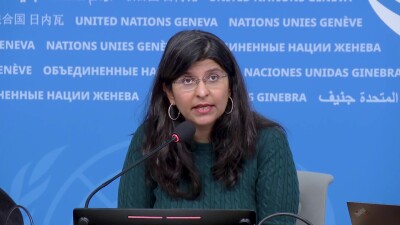
“We are deeply alarmed at the heightened risk of an attack by the M23 armed group on Goma, the capital of North Kivu, in the eastern Democratic Republic of Congo…Any such attack on Goma risks catastrophic impacts on hundreds of thousands of civilians, putting them at heightened exposure to human rights violations and abuses,” said Ravina Shamdasani, spokesperson for the UN human rights office, OHCHR.
“The High Commissioner has flagged many times that sexual violence is a key component - a very horrific component - of this conflict,” Ms. Shamdasani added. “Armed groups abduct, hold captive and subject women and girls to sexual slavery and many of them have been killed after being raped.”
Since the UN peacekeeping Mission, MONUSCO, withdrew from South Kivu in June 2024, peacekeepers have defended key positions in North Kivu, including Goma and Sake, where clashes between the M23, the Congolese Armed Forces and other armed groups have continued.
Hundreds of thousands displaced
Some 400,000 people have been displaced in North and South Kivu since the beginning of this year alone, according to the UN refugee agency, UNHCR.
Highlighting the humanitarian crisis that continues to unfold largely unseen by the outside world, UNHCR spokesperson Matt Saltmarsh reported that “bombs have fallen” on camps for people uprooted by the violence in South and North Kivu.
These attacks include one on 20 January, when explosions at Kitalaga site in South Kivu killed two children. On 21 January, five makeshift shelters were destroyed in Nzuolo, near Goma, while on Wednesday, Bushagara site - also near Goma - was “heavily impacted, causing panic and new waves of forced displacement”, Mr. Saltmarsh told journalists in Geneva.
He noted that heavy bombardments from clashes involving the M23 rebels forced families to flee various displacement sites on the periphery of Goma and try to seek safety within the city…UNHCR staff remain on the ground in Goma, assisting the displaced civilians wherever they can and wherever they get access,” he said. “But as you can understand, the access at the moment is extremely challenging.”
The development came as the UN Secretary-General on Thursday expressed alarm over a renewed offensive by M23 rebels in eastern DRC and the “devastating toll” on civilians.
In a statement issued by his Spokesperson, António Guterres noted the Rwandan-backed rebels’ seizure of Sake, in South Kivu, “which increases the threat” to the regional capital Goma – all of which is “heightening the threat of a regional war”. Rwanda denies any direct involvement with M23 fighters.
“The Secretary-General calls on the M23 to immediately cease its offensive, withdraw from all occupied areas and abide by the 31 July 2024 ceasefire agreement,” the UN chief’s statement continued.
Echoing the Secretary-General’s concerns, OHCHR spokesperson Ms. Shamdasani reiterated UN chief Volker Türk’s appeal “to all States with influence on the parties to impress on them the urgent need for an immediate cessation of hostilities”. M23 is well funded and “as the High Commissioner has said previously, any role played by Rwanda in supporting the M23 in North Kivu – and by any other country supporting armed groups active in the DRC – must end,” she insisted. “The people in the DRC are exhausted by violence, exhausted by conflict, exhausted by the horrors of their daily life. And this must not be allowed to worsen further.”
Stark options for the uprooted
Asked to explain the dangers faced by those sheltering in camps, UNHCR’s Mr. Saltmarsh replied that their “options are stark and extremely limited...What you will receive in terms of aid is extremely limited - that depends very much on whether agencies like UNHCR and our partners in the UN and NGOs are able to access those sites. If they are, we can bring in a minimum of assistance, otherwise, civilians will be in areas that are now occupied by the armed groups. We don't have access to those areas, so it's very difficult to for us to say what conditions are like there.”
South and North Kivu Provinces already host 4.6 million internally displaced people. UNHCR has warned that human rights violations, including looting, injuries, murders, kidnappings and arbitrary arrests of displaced people mistaken for rebels have escalated.
“Hospitals are nearing capacity with injured civilians,” Mr. Saltmarsh said. “Vulnerable women, children, and the elderly are living in overcrowded and precarious conditions with limited access to food, water, and essential services.”
ends
STORY: Eastern DR Congo: Escalating violence – OHCHR, UNHCR
TRT: 02 min 58s
SOURCE: UNTV CH
RESTRICTIONS: NONE
LANGUAGE: ENGLISH / NATS
ASPECT RATIO: 16:9
DATELINE: 24 JANUARY 2025 GENEVA, SWITZERLAND
Spokespersons:
- Ravina Shamdasani, OHCHR
- Matthew Saltmarsh, UNHCR
SHOTLIST
- Exterior wide shot, Palais des Nations flag alley, nations’ flags flying.
- Wide shot, podium with speakers to rear in Press room, Palais des Nations.
- SOUNDBITE (English) — Ravina Shamdasani, OHCHR: “We are deeply alarmed at the heightened risk of an attack by the M23 armed group on Goma, the capital of North Kivu, in the eastern Democratic Republic of Congo.”
- Medium-wide shot, podium speakers, journalists, TV screens showing speakers.
- SOUNDBITE (English) — Ravina Shamdasani, OHCHR: “Some 400,000 people have been displaced in North and South Kivu since the beginning of this year alone. Any such attack on Goma risks catastrophic impacts on hundreds of thousands of civilians, putting them at heightened exposure to human rights violations and abuses.”
- Wide, Press room, TV screens and control booths.
- SOUNDBITE (English) — Matthew Saltmarsh, UNHCR: “The bombardments from these clashes caused families to flee various displacement sites on the periphery of Goma and try to seek safety, within the city and our staff, UNHCR staff, remain on the ground, in Goma, assisting the displaced civilians wherever they can and wherever they get access. But as you can understand, the access at the moment is extremely challenging.”
- Medium, journalist writing, looking to podium, folding arms.
- SOUNDBITE (English) — Ravina Shamdasani, OHCHR: “The High Commissioner appeals to all States with influence on the parties to impress on them the urgent need for an immediate cessation of hostilities. As the High Commissioner has said previously, any role played by Rwanda in supporting the M23 in North Kivu – and by any other country supporting armed groups active in the DRC – must end.”
- Medium, podium speakers.
- SOUNDBITE (English) — Matthew Saltmarsh, UNHCR: “The options are, stark, and they're extremely limited. You can go to a displacement setting, a displacement camp; when you go there, what you will receive in terms of aid is extremely limited - that depends very much on whether agencies like UNHCR and our partners in the UN and NGOs are able to access those sites. If they are, we can bring in a minimum of assistance, otherwise, civilians will be in areas that are now occupied by the armed groups. We don't have access to those areas, so it's very difficult to for us to say what conditions are like there.”
- Medium-wide, podium speakers.
- SOUNDBITE (English) — Ravina Shamdasani, OHCHR: “The High Commissioner has flagged many times that sexual violence is a key component - a very horrific component - of this conflict. Armed groups abduct, hold captive and subject women and girls to sexual slavery and many of them have been killed after being raped.”
- Wide, Press room, journalists, control booths.
- SOUNDBITE (English) — Ravina Shamdasani, OHCHR: “This is a well funded, quite a sophisticated armed group - the M23 - and the High Commissioner has, you know, during his visit to the DRC, I believe in April last year, he had already called on Rwanda and all other States to cease their support of this armed group and to instead work together to bring this conflict to an end.”
- Medium, podium speakers.
- Medium, journalists.
Similar Stories

1
1
1
Edited News | OCHA , UNICEF , WFP
Aid agencies warned on Friday of the fast-developing humanitarian emergency inside Taiz City in Yemen, which has been encircled by de facto Houthi forces fighting government troops along the country’s west coast.

2
17
1
2
Edited News , Press Conferences , Images | OCHA , WMO
Two UN agencies teamed up on Wednesday to issue an appeal for immediate assistance to help communities already being impacted by the strongest El Niño on record.

3
16
2
2
Edited News , B-roll , Conferences , Images | UNITED NATIONS , UNOG
Sixth Consultative Meeting on Enhancing Coordination of Peace Initiatives and Efforts for Sudan

1
1
1
Edited News | UNICEF , WHO , UNHCR
Yemen war continues to force families from homes amid hunger and disease
More than 250,000 people have now fled renewed fighting in Yemen, the UN said on Tuesday, citing particular concern for those sheltering in the southwestern city of Taiz and the wider governorate, where access is “essentially blocked”.

1
1
1
Edited News | UNICEF
A little over one year since a ceasefire agreement was announced between Hamas fighters and Israel, more than 340 children have been reported killed and hundreds more injured, the UN Children’s Fund, UNICEF, said on Friday.

1
1
1
Edited News | UNICEF , IFRC
Six weeks after Nepal’s deadly flooding disaster, communities are still struggling to rebuild their lives, but they will need sustained help as global warming increases the risk of another Himalayan catastrophe, the UN Children’s Fund (UNICEF) said on Friday.

1
1
1
Edited News | WHO
In suspected Russia plague death, testing and monitoring underway – WHO
The death of a lab worker in Russia’s Siberia region has sparked concerns about plague being the cause, the UN World Health Organization (WHO) said on Tuesday, adding that it was following the situation closely.

1
1
Edited News | OHCHR , UNOG
UN Human Rights Chief Volker Türk on Friday provided and oral update to the 63rd session of the Human rights Council on Ukraine.

1
1
1
Edited News | OHCHR , UNOG
UN Human Rights Chief Volker Türk on Friday provided and oral update to the 63rd session of the Human rights Council on the human rights situation in Haiti.

1
1
1
Edited News | WHO
Repeated delays in bringing lifesaving medicines, prosthetics and more from Israel into Gaza risk having devastating consequences on Palestinians who urgently need them in the wartorn enclave, the UN World Health Organization (WHO) said on Friday. “A truck full of non-priority supplies or the right supplies arriving too late, doesn't save lives. That's the question that actually matters," said Dr Reinhilde Van De Weerdt, WHO Representative in the OPT.

1
1
1
Edited News | WHO
DRC: Early access to care and oxygen decisive for Ebola patients’ survival – WHO
In the Democratic Republic of the Congo (DRC), health workers fighting the country’s largest-ever Ebola outbreak are struggling to overcome critical challenges to patient care, the UN World Health Organization (WHO) warned on Tuesday.

1
1
1
Edited News | OCHA , UN
Civilians in Iran are continuing to feel the consequences of months of conflict and military escalation, the UN’s top official in the country has said, as loss of life, damage to civilian infrastructure and mounting economic pressures leave many facing continued uncertainty.