

The United Nations Office at Geneva
Multimedia Newsroom
UN GENEVA PRESS BRIEFING
7 January 2025
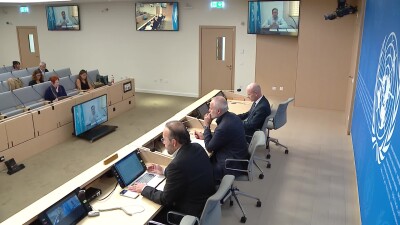
Alessandra Vellucci, Director of the United Nations Information Service in Geneva, chaired a hybrid press briefing, which was attended by spokespersons of the Office of the High Commissioner for Human Rights, the World Health Organization, the International Labour Organization, and the World Meteorological Organization.
Executions in Iran
Elizabeth Throssell, for the Office of the High Commissioner for Human Rights (OHCHR), stated that the OHCHR was deeply troubled by the marked increase in executions in Iran in 2024. At least 901 people had been reportedly executed in 2024, including some 40 in one week alone in December. At least 853 people had been executed in 2023. Most of the executions in 2024 had been for drug-related offences, but dissidents and people connected to the 2022 protests had also been executed.
“We oppose the death penalty under all circumstances,” said the High Commissioner in a statement. “It is incompatible with the fundamental right to life and raises the unacceptable risk of executing innocent people. And, to be clear, it can never be imposed for conduct that is protected under international human rights law.” Some 170 States had either abolished the death penalty or imposed a moratorium on its use, informed Ms. Throssell.
Full statement is available here.
Answering questions from the media, Ms. Throssell explained that there was a lack of transparency around executions in Iran, but the OHCHR had figures from several reputable human rights organizations with which it had been working for years. Most of the executions seemed to have been because of drug offences but there were concerns that some executions concerned people arrested in the context of the demonstrations. However, precise numbers of those executed for political offences were not available, explained Ms. Throssell. At least 31 women were reported to have been executed in 2024, the highest number in a decade; many of them had been convicted of murdering their husbands and had been reportedly victims of domestic violence or forced, child marriage. The method of execution was understood to be by hanging. Iran was a party to a number of international human rights treaties, she reminded, and the OHCHR and the treaty bodies had been consistently calling for the death penalty to be halted or at least for a moratorium to be implemented. It was difficult to determine how free and fair the trials in Iran were because the system was quite opaque. There were also people currently awaiting executions, added Ms. Throssell, which was why it was important to speak out about these situations.
Over 5,500 killed in gang violence in Haiti
Elizabeth Throssell, for the Office of the High Commissioner for Human Rights (OHCHR), stated that at least 5,601 people had been killed in Haiti in 2024 as a result of gang violence, an increase of over 1,000 on the total killings for 2023, according to figures verified by the OHCHR. A further 2,212 people had been injured and 1,494 kidnapped. “These figures alone cannot capture the absolute horrors being perpetrated in Haiti, but they show the unremitting violence to which people are being subjected,” said UN High Commissioner for Human Rights Volker Türk in a statement.
In one of the deadliest and most shocking incidents in 2024, at least 207 people had been killed in early December 2024 in a massacre orchestrated by the leader of the powerful Wharf Jérémie gang in the Cité Soleil area of Port-au-Prince. Many of the victims had been elderly people accused of causing the death of the leader’s son through alleged voodoo practices. To erase evidence, gang members had mutilated and burned most of the bodies, while other bodies had been thrown in the sea. In 2024, OHCHR had also documented 315 lynchings of gang members and people allegedly associated with gangs, on some occasions reportedly facilitated by Haitian police officers. In addition, there had been 281 cases of alleged summary executions involving specialized police units in 2024.
Restoring the rule of law had to be a priority. To this end, the Multinational Security Support mission in Haiti needed the logistical and financial support to successfully implement its mandate. The National Haitian Police, with the support of the international community, also had to strengthen its oversight mechanism to hold accountable police officers reportedly involved in human rights violations. OHCHR noted that the acute insecurity and resulting human rights crisis in the country did not allow for the safe, dignified, and sustainable return of Haitians, and called on all States not to forcibly return anyone to Haiti.
OHCHR’s press release is available here.
Answering questions from the journalists, Ms. Throssell said that there were about 400 Kenyan police officers in Haiti, along with recently deployed Guatemalan and Ecuadorian police officers. They needed adequate financial and logistical support. UN Secretary-General had appealed to UN Member States to provide such support without delay, added Alessandra Vellucci, for the UN Information Service. Ms. Throssell stressed that the crisis in Haiti was complex and long-lasting; this was a deep-seated problem which had to be tackled at multiple levels, including security, political, economic, social and human rights aspects.
Update on respiratory viruses currently circulating in the northern hemisphere
Margaret Harris, for the World Health Organization (WHO), said that, based on what was reported by the Chinese Center for Disease Control and Prevention on 2 January 2025, and shared in meetings between the WHO and Chinese authorities, there had been a rise of common respiratory infections in the country. The pathogens causing these infections were known ones and included seasonal influenza virus, RSV (respiratory syncytial virus), hMPV (human metapneumovirus), and SARS-CoV-2 (the virus that causes COVID-19). The seasonal influenza was by far the most common and increasing; the test positivity rate was over 30 percent. China’s reported levels of respiratory infections were along usual and expected rates, said Ms. Harris. There had been no emergency declarations and no emergency responses triggered.
WHO’s global influenza surveillance system had observed a rise in influenza across the northern hemisphere, where it was currently winter, so this was expected. Regarding human metapneumovirus (HMPV) , she stressed that this was not a new virus, as it had first been identified in 2001. It was one of the many viruses that caused the common cold and usually did not cause a serious illness in humans. In some cases, it could lead to a more serious disease in those with weak immunity, such as newborns, very old persons or people undergoing a cancer treatment. Simple measures could prevent spread: if they had symptoms, people should stay at home; wearing a mask in crowded space would be recommended; covering one’s face when coughing and sneezing was a sensible thing to do; regular handwashing would help; and getting the vaccines recommended by one’s doctor.
Responding to questions from the media, Ms. Harris explained that the Chinese Center for Disease Control and Prevention had shared its data with the WHO, and its latest report had been published on 2 January. Pregnant women were a vulnerable category and should discuss possible vaccinations with their doctors. Regarding COVID-19, Ms. Harris stressed that the primary concern remained investigating the origins of the virus. The case mortality rate for HMPV was very low, she responded to another question. WHO was aware of reports that a man over 65 with an underlying illness had died of H5N1 (bird flu). The United States was doing a comprehensive surveillance on animals, while the risk assessment for the general population remained low, she explained. The risk was always there, which was why working together with animal health organizations and experts was critical. Whenever there were seasonal influenza and animal influenza circulating at the same time, it was extremely important to keep the global surveillance system fully running. Data sharing was as critical as ever.
Answering further questions, Ms. Harris said that most people had by now been exposed to COVID-19 one way or another, and our immune systems were much better prepared than before. The newborns, the very elderly, or the immunocompromised people were still vulnerable, though, stressed Ms. Harris. WHO was still monitoring the situation around the world and was not seeing much sicker populations or overwhelmed hospitals.
Venezuela
Responding to a question on the upcoming presidential inauguration in Venezuela and possible demonstrations, Margaret Harris, for the World Health Organization (WHO), said that the WHO had guidance for mass gatherings and trauma management, shared through its country office.
Elizabeth Throssell, for the Office of the High Commissioner for Human Rights (OHCHR), said that it was not up to the OHCHR to establish the validity of election results. She stated that there had been arbitrary detentions following the 2024 presidential election, and the OHCHR urged for the release of all those detained. She emphasized the right to peaceful assembly, association and freedom of expression.
Syria
Answering questions from the media, Elizabeth Throssell, for the Office of the High Commissioner for Human Rights (OHCHR), said that the OHCHR had had initial contacts with the new authorities in Syria. The Office had been monitoring the situation in Syria for many years and had its contacts with the Syrian civil society. OHCHR had deployed a small team of four staff to Syria to start engaging on human rights issues on the ground. She stressed that all parties ought to abide by their obligations under international human rights law, including respect and protection of minorities, and avoid any behavior driven by desire for revenge. Human rights had to be central for a just transition. Women and different ethnic and religious minorities had to be given an opportunity to enjoy full human rights.
Alessandra Vellucci, for the United Nations Information Service, informed that the UN Special Envoy for Syria would brief the Security Council on 8 January at 4 pm Geneva time. The briefing would be open, and the Special Envoy’s remarks would be circulated afterwards.
Ms. Vellucci informed that the Independent Institution on Missing Persons in the Syrian Arab Republic had a new staff in charge of media relations, Nermine Abdelhamid (nermine.abdelhamid@un.org)
Announcements
Alessandra Vellucci, for the United Nations Information Service (UNIS), stated that the Human Rights Council would convene at 10 am on 8 January to select by lot of the UPR “troikas”, the sets of three States which would act as rapporteurs in the Universal Periodic Review process. From 3 pm the same day, the Council would hold an interactive dialogue on the oral update by the High Commissioner on the findings of the OHCHR report on human rights in Ukraine. Deputy High Commissioner Nada al-Nashif was to present the report, published on 31 December 2024. More information is available here.
Zeina Awad, for the International Labour Organization (ILO), informed that the ILO would publish its World Employment and Social Outlook (WESO) 2025 update on 16 January at a closed breakfast with the ILO Director-General with accredited journalists who needed to register. This report would provide a detailed analysis of the state of global labour markets, including key trends and challenges. It would explore issues such as the slowdown in labour market recovery, the persistence of youth unemployment, and the widening global jobs gap. Embargoed copies of the report, the press release, and other materials could be made available to accredited media on request. The embargo would end on 16 January at 11:30 am.
Clare Nullis, for the World Meteorological Organization (WMO), informed that on 10 January the WMO would be issuing a press release on global temperatures in 2024, which was expected to be the warmest year on record. The consolidated global figure to be presented would be based on six different data sets from around the world. The exact timing of the press release was to be determined, but it was likely to be in late afternoon on 10 January. Ms. Nullis said that 2025 was the International Year for the Preservation of Glaciers; on 21 January an event would be held at the WMO to formally launch the initiative.
Ms. Vellucci informed that the Committee on the Rights of the Child would open on 13 January at 10 am its 98th session, during which it would review the reports of Slovakia, Eritrea, Honduras, St Kitts and Nevis, Peru, Gambia, and Ecuador.
She also said that on 8 January, UNIS would be sending to the press corps embargoed World Economic and Social Prospects Report, under embargo till 6:30 pm on 9 January. Published by the UN Department of Economic and Social Affairs, WESP 2025 would present global and regional outlooks, highlighting that despite falling inflation, improving labour market conditions, and stabilizing prospects for growth at the global level, considerable uncertainties remain, and divergences across countries and regions call for urgent attention.
Finally, Ms. Vellucci informed that the Bar des Délégués/Salon Suisse at the Palais des Nations would reopen the following week.
***
The webcast for this briefing is available here.
The audio for this briefing is available here.
Similar Stories
1
1
1
Press Conferences | UN WOMEN , WFP , WHO
UN WOMEN: Sudan Women and girls one year after the fall of El Fasher; increasing drone attacks across the country; WFP: DRC - Ebola spreads to eighth DRC province as WFP delivers food, builds treatment centres and keeps supplies moving; WHO - Update on Ebola (Bundibugyo Virus Disease)
1
12
1
1
Press Conferences , Images | UNOG
Closing Press Conference following the Sixth Consultative Meeting on Enhancing Coordination of Peace Initiatives and Efforts in Sudan

2
17
1
2
Edited News , Press Conferences , Images | OCHA , WMO
Two UN agencies teamed up on Wednesday to issue an appeal for immediate assistance to help communities already being impacted by the strongest El Niño on record.
1
1
1
Press Conferences | CITES
Wildlife trade and conservation policy discussions at the 81st meeting of the CITES Standing Committee (SC81)
1
1
1
Press Conferences | UNHCR , UNCTAD , WMO , OCHA , UNICEF , WHO
UNHCR Hungary’s 1956 Refugee Crisis: 70 Years On, UNCTAD World Investment Forum 2026, Doha, WMO Greenhouse Gas Bulletin and Climate Update for COP31, OCHA Afghanistan: Malnutrition, Girls’ Education and Recovery, UNICEF Yemen: Child Malnutrition and Unsafe Water in Taiz, WHO Inequalities in Noncommunicable Diseases and Risk Factors

1
1
1
Press Conferences | UNHCR
End of UNHCR's 77th Annual Executive Committee (ExCom) meeting week

1
1
1
Press Conferences | UNICEF , IOM , UNHCR
UN Special Assistant to the Personal Envoy Office (SUDAN): Peace Initiatives and Efforts in Sudan; UNICEF: Dire situation of children in Gaza; IOM: Damaged Homes and Energy Attacks Risk Displacing Ukrainians for this winter; UNHCR: update on EXCOM week

1
1
1
Press Conferences | IOM , UNDRR
UN stresses importance of household preparedness for disaster risk reduction.

1
1
1
Statements , Press Conferences | OHCHR

1
1
1
Press Conferences | UNHCR , UNICEF , IFRC , OHCHR , UN WOMEN , IOM , OCHA , WHO
UNHCR – ExCom Meeting, UNICEF – Nepal Recovery, IFRC – Flash Floods, WHO – Mental Health, IOM – South Sudan Floods, OCHA – DRC Humanitarian aid, UNHCR – Sahel Displacement, UNICEF – Yemen Update, IOM – Gaza Shelter, UN Women – Gaza Women, OHCHR – Arrests and detentions of Syrians by Israeli force

2
1
2
Press Conferences | UNCTAD
Presentation of the Trade and Developement Report 2026
Embargoed until 9 October 2026 at 11 a.m. (Geneva Time)
UNCTAD: UNCTAD’s flagship report finds that governments increasingly use industrial, trade, financial and technology policies to pursue economic and national security objectives. Market access and the ability to move into higher-value activities now depend more heavily on technology, finance and geopolitics.

1
1
1
Press Conferences | UPU
Release of the State of the Postal Sector Report 2026