

The United Nations Office at Geneva
Multimedia Newsroom
Syria: needs continue to grow amid highly uncertain situation, say aid teams
The historic power shift in Syria and the still volatile situation two days after the fall of Bashar al-Assad’s regime have increased humanitarian needs in a country where nearly 17 million people, including millions of internally displaced, already depended on humanitarian aid before the recent events, UN aid teams said on Tuesday.
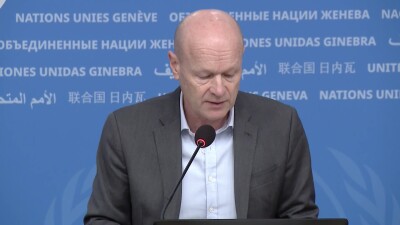
Since 28 November, “more than one million people – mostly women and children – have been displaced across Idlib, Aleppo, Hama and Homs. Some have reportedly been gone returning home in recent days,” said Jens Laerke, spokesperson for the UN Office for the Coordination of Humanitarian Affairs (OCHA) to journalists in Geneva on Tuesday.
The OCHA spokesperson also noted that humanitarian operations in affected areas including Homs, Hama, and Damascus have recommenced. “As of yesterday, all humanitarian organizations in Idlib and northern Aleppo have resumed operations”, Mr. Laerke said, adding that the three border crossings from Türkiye used by the UN to deliver assistance into Syria have remained open.
UN agencies and partners are providing basic assistance in the northwest, including to those newly displaced; food, health and nutrition services have been provided, as well as support for access to clean water in Aleppo. But health facilities are reportedly overwhelmed, with major hospitals operating at limited capacity owing to shortages of staff, medicine and supplies. Humanitarian partners continue to provide trauma care, maintain blood banks and administer vaccinations.
“Money is, as always, an issue. Our $4 billion appeal for this year is currently less than a third funded”, Mr. Laerke emphasized.
According to the UN refugee agency (UNHCR), seven million Syrians have been displaced internally, and more than five million have fled to neighbouring countries and beyond, uprooted by almost 14 years of war. That represents half of the country's pre-war population of 23 million.
For those forced to flee, “they are considering how safe Syria is to return to, and how far their rights will be respected before they can make an informed, voluntary decision to return home. They must be given the space to do so without any pressure”, insisted Shabia Mantoo from the UN refugee agency. She reiterated that all refugees have the fundamental right to return to their country of origin at a time of their choosing, and overturns must be voluntary, dignified and safe.
Asked about the decisions by host countries in Europe to suspend decisions on Syrian asylum claims after the fall of Bashar al-Assad, Ms. Mantoo reiterated that “any Syrian or anyone seeking international protection must be able to access asylum procedures and have their application examined fully and individually on its merits”.
On 27 November, a coalition of opposition forces, led by the armed Hayat Tahrir al-Sham (HTS), launched an offensive from its stronghold of Idlib, seizing dozens of localities and the strategic cities of Aleppo, Hama and Homs, before reaching the capital, Damascus.
The Syrian conflict was sparked after the suppression of a popular uprising that escalated into civil war in 2011.
Ends
Story: “Syria humanitarian update – OCHA, UNHCR” – 10 December 2024
Speakers are:
- Jens Laerke, spokesperson for the UN Office for the Coordination of Humanitarian Affairs (OCHA)
- Shabia Mantoo, spokesperson for the UN Refugee Agency (UNHCR)
TRT: 02’22”
SOURCE: UNTV CH
LANGUAGE: ENGLISH / NATS
ASPECT RATIO: 16:9
DATELINE: 10 December 2024 - GENEVA, SWITZERLAND
Geneva Press briefing
SHOTLIST
- Exterior medium shot: UN flag alley.
- Wide shot of the press conference room.
- SOUNDBITE (English) Jens Laerke, spokesperson for the UN Office for the Coordination of Humanitarian Affairs (OCHA): “Before the recent events, nearly 17 million people, including millions of internally displaced people, already required humanitarian assistance. Since 28 November more than one million people – mostly women and children – have been displaced across Idlib, Aleppo, Hama and Homs. Some have reportedly been gone returning home in recent days.”
- Wide shot of the press conference room.
- SOUNDBITE (English) Jens Laerke, spokesperson for the UN Office for the Coordination of Humanitarian Affairs (OCHA): “As of yesterday, all humanitarian organizations in Idlib and northern Aleppo have resumed operations. The three border crossings from Türkiye used by the UN to deliver assistance into Syria remain open and we are providing assistance in the north-west including to those who have been newly displaced.
- Medium shot: journalists in the press conference room.
- SOUNDBITE (English) Jens Laerke, spokesperson for the UN Office for the Coordination of Humanitarian Affairs (OCHA): “The humanitarian needs are growing and a scaled-up response is urgently required. Money is, as always, an issue. Our $4 billion appeal for this year is currently less than a third funded.”
- Medium shot of the press conference room.
- SOUNDBITE (English) Shabia Mantoo, spokesperson for the UN Refugee Agency (UNHCR): “Millions of Syrian refugees who remain outside are trying to understand what the rapidly changing situation means for them. They are considering how safe Syria is to return to and how far their rights will be respected before they can make an informed, voluntary decision to return home. They must be given the space to do so without any pressure.”
- Medium rear shot of the speaker on the podium in the press conference room.
- SOUNDBITE (English) Shabia Mantoo, spokesperson for the UN Refugee Agency (UNHCR): “We take note of the reporting of the suspension of asylum applications from Syrian nationals. So, just to reiterate that events are rapidly unfolding and the situation is changing. So, the displacement dynamics are continuing. So, what is important is to bear in mind the fluidity of the situation and that any Syrian or anyone seeking international protection must be able to access asylum procedures and have their application examined fully and individually on its merits.”
- Medium shot of screen and journalist in the press room.
- Various shots of journalists in the press conference room.
Similar Stories

2
17
1
2
Edited News , Press Conferences | OCHA , WMO
Two UN agencies teamed up on Wednesday to issue an appeal for immediate assistance to help communities already being impacted by the strongest El Niño on record.

3
16
2
2
B-roll , Conferences , Edited News | UNITED NATIONS , UNOG
Sixth Consultative Meeting on Enhancing Coordination of Peace Initiatives and Efforts for Sudan

1
1
1
Edited News | UNICEF , WHO , UNHCR
Yemen war continues to force families from homes amid hunger and disease
More than 250,000 people have now fled renewed fighting in Yemen, the UN said on Tuesday, citing particular concern for those sheltering in the southwestern city of Taiz and the wider governorate, where access is “essentially blocked”.

1
1
1
Edited News | UNICEF
A little over one year since a ceasefire agreement was announced between Hamas fighters and Israel, more than 340 children have been reported killed and hundreds more injured, the UN Children’s Fund, UNICEF, said on Friday.

1
1
1
Edited News | UNICEF , IFRC
Six weeks after Nepal’s deadly flooding disaster, communities are still struggling to rebuild their lives, but they will need sustained help as global warming increases the risk of another Himalayan catastrophe, the UN Children’s Fund (UNICEF) said on Friday.

1
1
1
Edited News | WHO
In suspected Russia plague death, testing and monitoring underway – WHO
The death of a lab worker in Russia’s Siberia region has sparked concerns about plague being the cause, the UN World Health Organization (WHO) said on Tuesday, adding that it was following the situation closely.

1
1
Edited News | OHCHR , UNOG
UN Human Rights Chief Volker Türk on Friday provided and oral update to the 63rd session of the Human rights Council on Ukraine.

1
1
1
Edited News | OHCHR , UNOG
UN Human Rights Chief Volker Türk on Friday provided and oral update to the 63rd session of the Human rights Council on the human rights situation in Haiti.

1
1
1
Edited News | WHO
Repeated delays in bringing lifesaving medicines, prosthetics and more from Israel into Gaza risk having devastating consequences on Palestinians who urgently need them in the wartorn enclave, the UN World Health Organization (WHO) said on Friday. “A truck full of non-priority supplies or the right supplies arriving too late, doesn't save lives. That's the question that actually matters," said Dr Reinhilde Van De Weerdt, WHO Representative in the OPT.

1
1
1
Edited News | WHO
DRC: Early access to care and oxygen decisive for Ebola patients’ survival – WHO
In the Democratic Republic of the Congo (DRC), health workers fighting the country’s largest-ever Ebola outbreak are struggling to overcome critical challenges to patient care, the UN World Health Organization (WHO) warned on Tuesday.

1
1
1
Edited News | OCHA , UN
Civilians in Iran are continuing to feel the consequences of months of conflict and military escalation, the UN’s top official in the country has said, as loss of life, damage to civilian infrastructure and mounting economic pressures leave many facing continued uncertainty.

1
1
1
Edited News | WHO , UNICEF
Aid agencies in Yemen highlighted the growing hunger emergency sparked by renewed fighting between Houthi opposition forces and Government troops, after mobile health clinics reported that hundreds of children displaced by the violence are suffering from the most deadly form of malnutrition.