

The United Nations Office at Geneva
Multimedia Newsroom
Press Conferences , Edited News | UNRWA
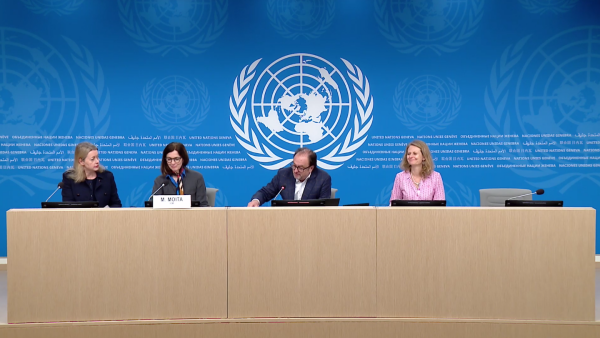
UNRWA Press conference: Update on the situation in the occupied Palestinian territory (OPT) - 18 November 2024
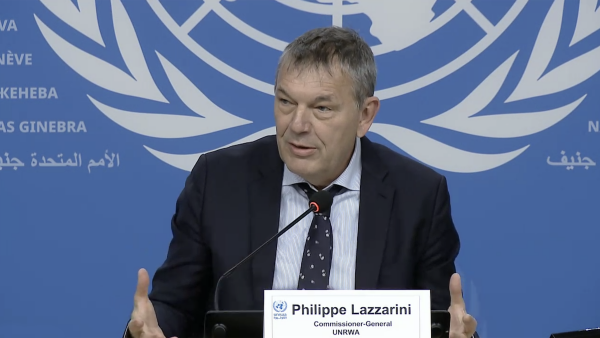
Lazzarini: Annexation of Gaza won’t create lasting peace in Middle East
The head of the UN agency for Palestine refugees, UNRWA, confirmed on Monday that a large convoy of humanitarian aid was looted inside Gaza at the weekend, amid a near-total a breakdown in law and order and harassment of the agency’s staff by Israeli soldiers.
“More than 100 trucks have been looted, primarily [carrying goods for] UNRWA and the WFP, basically, 80-90 per cent of the convoy on that day,” said Philippe Lazzarini, UNRWA Commissioner-General.
“What does it show? Well, we have been warning a long time ago about the total breakdown of civil order; until you know, four or five months ago, we still had local capacity, people who were escorting the convoy. This has completely gone.”
According to UNRWA, the incident happened on Saturday and involved a 109-truck convoy. “The vast majority of the trucks, 97 in total, were lost and drivers were forced at gunpoint to unload aid,” it said in an online post on X.
“The Israeli authorities continue to disregard their legal obligations under international law to ensure the population's basic needs are met and to facilitate the safe delivery of aid,” the UN agency insisted. “Such responsibilities continue when trucks enter the Gaza Strip, until people are reached with essential assistance.”
In addition to ongoing deadly Israeli bombardment – including of a residential building in northern Beit Lahia at the weekend which left dozens dead including children – UNRWA said that critical shortages of flour had forced all eight UN-supported bakeries in Deir al Balah and Khan Younis to operate “at diminished capacity for weeks. Many have been forced to shut down entirely. Without immediate intervention, severe food shortages are set to worsen, further endangering the lives of over two million people who depend on humanitarian aid to survive.”
Speaking in Geneva on the sidelines of a meeting of the Advisory Committee which is tasked with advising and assisting UNRWA in carrying out its mandate, Mr. Lazzarini reiterated his warning – echoed widely by the international community – that Israeli efforts to dismantle the agency would have terrible consequences on Gazans who rely on it for education, healthcare and livelihoods, unless a viable alternative were put in place.
“I keep being asked why is the agency irreplaceable? In fact, it is replaceable by a functioning state…if we do this and we do not have a viable alternative in place, we will create a vacuum. We will also deprive hundreds of thousands of children to the right of education, but by doing this we will also sow the seeds for more extremism, more hate in the future.”
Echoing that message, Antón Leis, Secretary General and Executive Director of the Spanish Agency for International Cooperation and Development and Chair of the Meeting of the Advisory Committee insisted that UNRWA was “irreplaceable and indispensable…for six million Palestine refugees in the Middle East - not just in Gaza - in the entire Middle East”.
Mr. Leis underscored the negative impact of an ongoing disinformation campaign targeting UNRWA and stressed the need to explain the agency’s crucial grassroots work across the Occupied Palestinian Territories.
“It is important also to set the record straight and explain what UNRWA does and what UNRWA does differently from other UN agencies and why - and this is a reality on the ground - why UNRWA is indispensable and irreplaceable.”
Mr. Lazzarini noted that the diplomatic and political campaign against UNRWA was impacting staff on the ground, too: “We had already last week an incident where a female staff member was searched at her home by [an Israel Defense Forces] soldier and when they realized that she's working for UNRWA, basically they told her, ‘How come you work for a terrorist organization?’”
Asked what the election of Donald Trump might change, the UNRWA chief maintained the need to listen to the aspirations of Palestinians. “We keep hearing that promoting a lasting peace is a priority and I do not see how you can promote lasting peace without addressing the question of the Palestinians in the region. So, of course, people are extremely worried that it might go in the direction of an annexation, but annexation wouldn't mean a lasting peace in the region if you haven’t addressed the question of the Palestinians.”
TRT: 04 min 50s
SOURCE: UNTV CH
RESTRICTIONS: NONE
LANGUAGE: ENGLISH / FRENCH / NATS
ASPECT RATIO: 16:9
DATELINE: 18 NOVEMBER 2024 GENEVA, SWITZERLAND
Speakers:
• Philippe Lazzarini, UNRWA Commissioner-General;
• Antón Leis, Secretary General and Executive Director of the Spanish Agency for International Cooperation and Development, Chair of the Meeting of the Advisory Committee, at UN Geneva.
SHOTLIST
-
- Exterior médium-wide: UN Geneva flag alley.
- Wide, UN Geneva Press room.
- SOUNDBITE (English) - Philippe Lazzarini, UNRWA Commissioner-General: “I confirm indeed, that they have been looting, more than 100 trucks have been looted, primarily UNRWA and the WFP. Basically, 80-90 per cent of the convoy on that day. What does it show? Well, we have been warning a long time ago about the total breakdown of civil order; until you know, four or five months ago, we still had local capacity, people who were escorting the convoy. This has completely gone.”
- Medium-wide, Press room, journalists, photographers, TV journalists.
- SOUNDBITE (English) - Philippe Lazzarini, UNRWA Commissioner-General: “You keep hearing that the agency is irreplaceable. I keep being asked why is the agency irreplaceable? In fact, it is replaceable by a functioning state, by a functioning institution and for this we need to invest even more into a political process in order to make sure that this reality would be the reality of tomorrow for the Palestinians.”
- Medium-wide, journalists, TV screens showing Mr. Lazzarini.
- SOUNDBITE (English) - Philippe Lazzarini, UNRWA Commissioner-General: “If we do this and we do not have a viable alternative in place, we will create a vacuum. We will also deprive hundreds of thousands of children to the right of education, but by doing this we will also sow the seeds for more extremism, more hate in the future.”
- Medium, photographer lining up to take pictures.
- SOUNDBITE (English) - Philippe Lazzarini, UNRWA Commissioner-General: (French): « Est-ce qu’il y a aujourd’hui une autre organisation en dehors d’un état qui fonctionne pour ramener des enfants dans un environnement éducatif, la réponse est non, il n’y a personne. La même réponse vous sera donnée pour la santé primaire. »
- Medium, podium speakers, UN insignia.
- SOUNDBITE (English) – Antón Leis, Secretary General and Executive Director of the Spanish Agency for International Cooperation and Development, Chair of the Meeting of the Advisory Committee, at UN Geneva: “Our intention is to provide support for an irreplaceable and indispensable - and I underline those two words, irreplaceable and indispensable - agency for six million Palestine refugees in the Middle East - not just in Gaza - in the entire Middle East. It is indispensable and irreplaceable in the absence of a political solution to the conflict because all these people depend on UNRWA for basic services such as health, education or social services.”
- Medium-wide, journalists, TV screens showing speakers.
- SOUNDBITE (English) – Antón Leis, Secretary General and Executive Director of the Spanish Agency for International Cooperation and Development, Chair of the Meeting of the Advisory Committee, at UN Geneva: “There are discussions also about what is happening on the ground, the difficulties to operate, some of the questions where were alluding to that, and the campaigns of disinformation and misinformation that go around the organization. So, it is important also to set the record straight and explain what UNRWA does and what UNRWA does differently from other UN agencies and why - and this is a reality on the ground - why UNRWA is indispensable and irreplaceable.”
- Medium-wide, journalists, TV cameras.
- SOUNDBITE (English) - Philippe Lazzarini, UNRWA Commissioner-General: “Our staff in the region is deeply, deeply concerned, anxious - very - about what might happen and rightly so. We had already last week an incident where a female staff member was searched at her home by IDF soldier and when they realized that she's working for UNRWA, basically they told her, ‘How come you work for a terrorist organization?’”
- Medium-wide, journalists.
- SOUNDBITE (English) - Philippe Lazzarini, UNRWA Commissioner-General: “We have a new incoming administration in the US; no one, really knows in which direction things will go. We keep hearing that promoting a lasting peace is a priority and I do not see how you can promote lasting peace without addressing the question of the Palestinians in the region. So, of course, people are extremely worried that it might go in the direction of an annexation, but annexation wouldn't mean a lasting peace in the region if you haven’t addressed the question of the Palestinians.”
- Medium, TV journalist taking footage.
- Medium, journalists.
- Medium-wide, journalists, TV cameras and video journalists.
Similar Stories

1
1
1
Edited News | OCHA , UNICEF , WFP
Aid agencies warned on Friday of the fast-developing humanitarian emergency inside Taiz City in Yemen, which has been encircled by de facto Houthi forces fighting government troops along the country’s west coast.
1
1
1
Press Conferences | UN WOMEN , WFP , WHO
UN WOMEN: Sudan Women and girls one year after the fall of El Fasher; increasing drone attacks across the country; WFP: DRC - Ebola spreads to eighth DRC province as WFP delivers food, builds treatment centres and keeps supplies moving; WHO - Update on Ebola (Bundibugyo Virus Disease)
1
12
1
1
Press Conferences , Images | UNOG
Closing Press Conference following the Sixth Consultative Meeting on Enhancing Coordination of Peace Initiatives and Efforts in Sudan

2
17
1
2
Edited News , Press Conferences , Images | OCHA , WMO
Two UN agencies teamed up on Wednesday to issue an appeal for immediate assistance to help communities already being impacted by the strongest El Niño on record.

3
16
2
2
Edited News , B-roll , Conferences , Images | UNITED NATIONS , UNOG
Sixth Consultative Meeting on Enhancing Coordination of Peace Initiatives and Efforts for Sudan
1
1
1
Press Conferences | CITES
Wildlife trade and conservation policy discussions at the 81st meeting of the CITES Standing Committee (SC81)

1
1
1
Edited News | UNICEF , WHO , UNHCR
Yemen war continues to force families from homes amid hunger and disease
More than 250,000 people have now fled renewed fighting in Yemen, the UN said on Tuesday, citing particular concern for those sheltering in the southwestern city of Taiz and the wider governorate, where access is “essentially blocked”.
1
1
1
Press Conferences | UNHCR , UNCTAD , WMO , OCHA , UNICEF , WHO
UNHCR Hungary’s 1956 Refugee Crisis: 70 Years On, UNCTAD World Investment Forum 2026, Doha, WMO Greenhouse Gas Bulletin and Climate Update for COP31, OCHA Afghanistan: Malnutrition, Girls’ Education and Recovery, UNICEF Yemen: Child Malnutrition and Unsafe Water in Taiz, WHO Inequalities in Noncommunicable Diseases and Risk Factors
1
1
1
Press Conferences | UNHCR
End of UNHCR's 77th Annual Executive Committee (ExCom) meeting week

1
1
1
Edited News | UNICEF
A little over one year since a ceasefire agreement was announced between Hamas fighters and Israel, more than 340 children have been reported killed and hundreds more injured, the UN Children’s Fund, UNICEF, said on Friday.
1
1
1
Press Conferences | UNICEF , IOM , UNHCR
UN Special Assistant to the Personal Envoy Office (SUDAN): Peace Initiatives and Efforts in Sudan; UNICEF: Dire situation of children in Gaza; IOM: Damaged Homes and Energy Attacks Risk Displacing Ukrainians for this winter; UNHCR: update on EXCOM week
1
1
1
Press Conferences | IOM , UNDRR
UN stresses importance of household preparedness for disaster risk reduction.