

The United Nations Office at Geneva
Multimedia Newsroom
Everyone has a role in press freedom, insists Narcos star Diego Luna
Mexican actor, producer and director Diego Luna took a break from the big screen on Thursday to highlight the dangers faced by journalists in his country and beyond, condemning murders of reporters everywhere as “a scandal”.
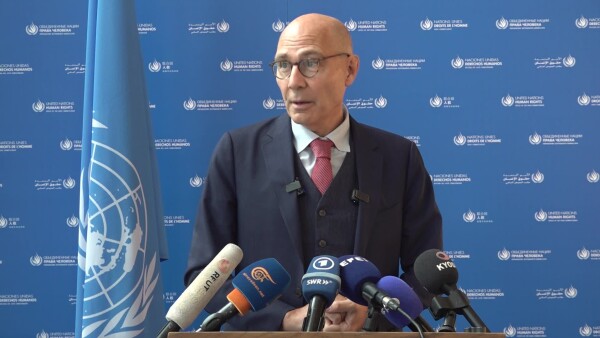
Speaking to journalists at UN Geneva ahead of a screening of his new documentary State Of Silence, Mr. Luna insisted that the issue of their safety was everyone’s responsibility.
“I think it's time for us to come out, us citizens, to come out and protect journalism around the world and protect these voices that are crucial for us to experience freedom, to experience democracy and to live in a healthy world,” he said. “There is no access to truth if there is no free journalism.”
According to UNESCO, the UN Scientific, Educational and Cultural agency that is mandated with keeping track of and promoting journalists’ safety worldwide, in 2022 and 2023, a journalist was killed every four days.
Efforts to encourage governments to do more to protect journalists are also spearheaded by the UN human rights office, OHCHR, which leads the International Day to End Impunity for Crimes Against Journalists. A staggering eight in 10 murders of journalists are not investigated around the world, said OHCHR Human Rights Officer Renaud de Villaine, who highlighted a “persistence” of the killing of journalists today.
“It happens in in conflict situations, like in the Middle East, but also in Ukraine,” he said. But it can also happen in countries not at war such as Mexico, where journalists investigating corruption, drugs, cartels and gangs like those who feature in the documentary “are specifically targeted”.
Since 2017, there have been 69 recorded murders and 32 documented cases of disappearances of journalists in Mexico, Mr. de Villaine noted, before insisting that the crisis belied deeper systemic issues which OHCHR was working hard with the authorities to resolve. “Journalists are not the only ones targeted…the problem is beyond journalism,” he maintained, noting the recent gruesome murder of city mayor Alejandro Arcos in Guerrero state.
Echoing those concerns, Santiago Maza, Director of State Of Silence, explained simply that “violence pays off” against journalists. The theme runs through the documentary which tells the stories of courageous investigative reporters from Mexico who have endured violence and threats on their lives which have forced them into hiding, in the pursuit of their work into subjects including illegal logging and the exploitation of vulnerable communities whose rivers have been diverted.
“The current situation won't change by itself, Mr. Maza insisted. “The fact that there's a new president doesn't mean that there's going to be an improvement in the situation, but it does provide an opportunity to address this properly and to change the hierarchy of what needs to be addressed by the Government.”
The dangers journalists face today include an increasing trend in many countries to criminalize their activities by using the apparatus of government.
“The judicial system in many countries is used and I would say also weaponized by State actors sometimes, but also by non-state actors to target journalists and media outlets,” said Mr. de Villaine. “It explains this criminalization of journalists, it explains why there is still a high rate of journalists being detained around the world - more than 300,” he said, citing the NGO Committee to Protect Journalists.
According to the Reporters Without Borders, Mexico ranks 121st in its World Press Freedom Index and 165th in terms of safety. A staggering 155 journalists have been killed there since 2000 because of organized crime “that is able to target and hit journalists…systemic corruption, plus also the failure of some institutions”, said Thibaut Bruttin, the NGO’s Director General.
“Journalists are not numbers, they are actual people,” he told reporters in Geneva. “It's not one more journalist being killed, it's another story that's gone, it's another life that’s disrupted…Also, journalists don't die, they're killed. Somebody is behind that.”
Explaining his reasons for wanting to get involved in the project as its executive producer, Mr. Luna said that over and above the “scandal” of the high number of journalists killed in Mexico, the wider negative impact on society needed to be addressed.
“It's what that violence generates,” he said. “It's the amount of young people that today are questioning if pursuing the dream of being a journalist or not, it’s the number of people who are scared of giving an interview today.”
He added: “When you silence a journalist, you're not just silencing one voice, you're silencing the voice of thousands of communities that needed that journalist to connect with the outside.”
ends
TRT: 04 min 03s
SOURCE: UNTV CH
RESTRICTIONS: NONE
LANGUAGE: ENGLISH / NATS
ASPECT RATIO: 16:9
DATELINE: 14 NOVEMBER 2024 GENEVA, SWITZERLAND
Speakers:
- Renaud de Villaine, Human Rights Officer, OHCHR
- Diego Luna, Actor and Executive Producer of State Of Silence
- Santiago Maza, Director State Of Silence
- Thibaut Bruttin, Director General, Reporters Without Borders
SHOTLIST
-
- Exterior medium: UN Geneva flag alley.
- Wide, UN Geneva Press room.
- SOUNDBITE (English) – Renaud de Villaine, Human Rights Officer, OHCHR: "The figures are crazy I would say, because still there are eight cases of murders of journalists out of 10 not investigated around the world.”
- Medium-wide, Press room, journalists.
- SOUNDBITE (English) – Diego Luna, Actor and Executive Producer, "State Of Silence”: “I think it's time for us to come out, us citizens, to come out and protect journalism around the world and protect these voices that are crucial for us to experience freedom, to experience democracy and to live in a healthy world. There is no access to truth if there is no free journalism.”
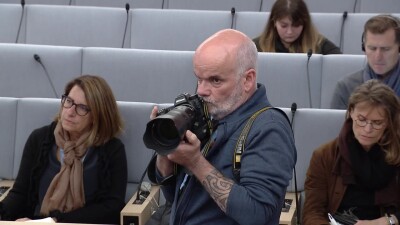
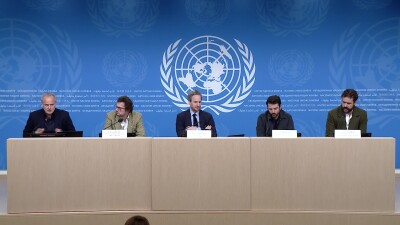
- Medium-wide, podium speakers, photographers, journalists.
- SOUNDBITE (English) – Thibaut Bruttin, Director General of Reporters Without Borders “Journalists are not numbers, they are actual people; it's not one more journalist being killed, it's another story that's gone, it's another live that’s disrupted. And then a lot of gravity thinking of the families of journalists. Also, journalists don't die, they're killed. Somebody is behind that.”
- Medium, journalists, TV screens showing podium speaker.
- SOUNDBITE (English) – Renaud de Villaine, Human Rights Officer, OHCHR: “The judicial system in many countries is used and I would say also weaponized by State actors sometimes, but also by non-state actors to target journalists and media outlets. And it explains this criminalization of journalists, it explains why there is still a high rate of journalists being detained around the world - more than 300 according to the Committee to Protect Journalists, which is another lead organization working to defend journalists around the world.”
- Medium, journalists.
- SOUNDBITE (English) – Thibaut Bruttin, Director General, Reporters Without Borders: “Mexico is a test case for the ability of the international community and the journalists to continue having impact. It is currently ranked 121st in the World Press Freedom Index by RSF and 165th in terms of safety. So, we have 155 journalists killed since 2000.”
- Medium, Diego Luna and Santiago Maza at the podium.
- SOUNDBITE (English) – Santiago Maza, Director of “State of Silence”: “The fact that there's a new president doesn't mean that there's going to be an improvement in the situation, but it does provide an opportunity to address this properly and to change the hierarchy of what needs to be addressed by the Government.”
- Medium-wide, podium speakers.
- SOUNDBITE (English) – Thibaut Bruttin, Director General, Reporters Without Borders: “What we're facing is something that is very specific in a country that is allegedly in peace times. And we have here a vicious circle of organized crimes that is able to target and hit journalists and some issues with systemic corruption, plus also the failure of some of the institutions.”
- Medium, photographers, journalists.
- SOUNDBITE (English) – Diego Luna, Actor and Executive Producer of State Of Silence”: “When you silence a journalist, you're not just silencing one voice, you're silencing the voice of thousands of communities that needed that journalist to connect with the outside.”
- TV journalist using mobile phone.
- SOUNDBITE (English) – Diego Luna, Actor and Executive Producer of State Of Silence”: “The numbers are a scandal already. You know, the numbers you heard here, but it's not just about that, it's what that violence generates. It's the amount of young people that today are questioning if pursuing the dream of being a journalist or not, it’s the number of people who are scared of giving an interview today.”
- Medium, journalists, participants.
- Medium, journalist.
- Medium, photographer, journalists.
Similar Stories
1
12
1
1
Press Conferences , Images | UNOG
Closing Press Conference following the Sixth Consultative Meeting on Enhancing Coordination of Peace Initiatives and Efforts in Sudan

2
17
1
2
Edited News , Press Conferences | OCHA , WMO
Two UN agencies teamed up on Wednesday to issue an appeal for immediate assistance to help communities already being impacted by the strongest El Niño on record.

3
16
2
2
B-roll , Conferences , Edited News | UNITED NATIONS , UNOG
Sixth Consultative Meeting on Enhancing Coordination of Peace Initiatives and Efforts for Sudan
1
1
1
Press Conferences | CITES
Wildlife trade and conservation policy discussions at the 81st meeting of the CITES Standing Committee (SC81)

1
1
1
Edited News | UNICEF , WHO , UNHCR
Yemen war continues to force families from homes amid hunger and disease
More than 250,000 people have now fled renewed fighting in Yemen, the UN said on Tuesday, citing particular concern for those sheltering in the southwestern city of Taiz and the wider governorate, where access is “essentially blocked”.
1
1
1
Press Conferences | UNHCR , UNCTAD , WMO , OCHA , UNICEF , WHO
UNHCR Hungary’s 1956 Refugee Crisis: 70 Years On, UNCTAD World Investment Forum 2026, Doha, WMO Greenhouse Gas Bulletin and Climate Update for COP31, OCHA Afghanistan: Malnutrition, Girls’ Education and Recovery, UNICEF Yemen: Child Malnutrition and Unsafe Water in Taiz, WHO Inequalities in Noncommunicable Diseases and Risk Factors
1
1
1
Press Conferences | UNHCR
End of UNHCR's 77th Annual Executive Committee (ExCom) meeting week

1
1
1
Edited News | UNICEF
A little over one year since a ceasefire agreement was announced between Hamas fighters and Israel, more than 340 children have been reported killed and hundreds more injured, the UN Children’s Fund, UNICEF, said on Friday.
1
1
1
Press Conferences | UNICEF , IOM , UNHCR
UN Special Assistant to the Personal Envoy Office (SUDAN): Peace Initiatives and Efforts in Sudan; UNICEF: Dire situation of children in Gaza; IOM: Damaged Homes and Energy Attacks Risk Displacing Ukrainians for this winter; UNHCR: update on EXCOM week
1
1
1
Press Conferences | IOM , UNDRR
UN stresses importance of household preparedness for disaster risk reduction.

1
1
1
Edited News | UNICEF , IFRC
Six weeks after Nepal’s deadly flooding disaster, communities are still struggling to rebuild their lives, but they will need sustained help as global warming increases the risk of another Himalayan catastrophe, the UN Children’s Fund (UNICEF) said on Friday.
1
1
1
Statements , Press Conferences | OHCHR