

The United Nations Office at Geneva
Multimedia Newsroom
‘Exceptional achievement’: Humanitarians reach over 105,000 with polio vaccine in north Gaza
Despite ongoing attacks and access challenges, humanitarians have managed to inoculate over 105,000 children in north Gaza with the second and final dose of the oral polio vaccine, the UN World Health Organization (WHO) said on Tuesday.
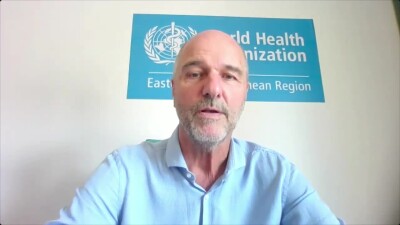
Speaking from Gaza, WHO Representative for the Occupied Palestinian Territory, Dr. Rik Peeperkorn, told journalists that between 2 and 4 November, the campaign reached 88 per cent of 119,000 children under 10. Close to 84,000 children also received vitamin A to boost their immunity.
“This is an exceptional achievement,” he said.
Just three days ago, WHO had warned that reaching the target was “unlikely” due to access constraints. Highlighting the challenges, Dr. Peeperkorn stressed that this time, the humanitarian pause area was “substantially reduced” compared to the first round of the campaign some five weeks ago, encompassing mainly Gaza City and excluding the remaining portions of northern Gaza. Even during the agreed humanitarian pauses, in place from 6am to 4pm over the course of the three-day vaccination drive, there were reports of violent incidents at campaign sites, drawing concern from WHO chief Tedros Adhanom Ghebreyesus.
The campaign had been postponed from 23 October to 2 November due to a lack of humanitarian pauses, intense bombardment and new mass evacuation orders. Over the past few weeks, some 150,000 people have been forced to evacuate from north Gaza to Gaza City, and the decision was made to go ahead with the second round of the campaign and “do our level best”, Dr. Peeperkorn said.
WHO warned that a delay in administering a second dose of the novel oral polio vaccine type 2 within six weeks could compromise immunity and jeopardize efforts to stop the spread of the virus in Gaza and beyond. Eradicated in the enclave 25 years ago, polio reappeared earlier this year as waterborne diseases spread amid dire sanitary conditions linked to the intense Israeli bombardment.
Dr. Peeperkorn also revealed that over 100 critically ill patients are to be medically evacuated outside Gaza on Wednesday by WHO and partners. On the eve of the operation, the UN health agency will bring these patients, who are on the enclave’s health authorities’ priority list, to one location.
“Tonight, they will be gathered at European Gaza Hospital, and tomorrow from six in the morning… they will be brought to Kerem Shalom,” before continuing on to Ramallah airport, Dr. Peeperkorn said. The majority will travel to the United Arab Emirates (UAE) for treatment, while some 13 patients will be headed to Romania.
The group comprises both trauma patients who need urgent treatment for their injuries and people with chronic diseases such as cancer. Since the Rafah crossing with Egypt was closed in May due to Israel’s ground offensive there, only 282 patients have been medically evacuated outside of Gaza – mostly to the UAE.
The WHO official called Wednesday’s planned operation “a very good initiative” but deplored its “ad hoc” character. He reiterated the need for “sustained medical evacuations outside of Gaza”, stressing that up to 14,000 people in the Strip require evacuation, half of them trauma cases. Dr. Peeperkorn also appealed for medical corridors, first and foremost the “traditional referral pathway from Gaza to East Jerusalem and the West Bank” to be restored.
Expanding on the dire health situation in the Strip, Dr. Peeperkorn expressed concern over Al-Awda hospital, which could soon become non-functional. A WHO mission reached the hospital on Sunday and transferred five out of 44 patients and their caregivers to Gaza City’s Al-Shifa hospital. Dr. Peeperkorn stressed that Al-Awda has no fuel and that despite a high number of trauma cases, no surgical operations can take place due to the lack of electricity.
He said that WHO had put in a request “time and again to bring medical, surgical supplies and medications for approximately 1,000 interventions, to deliver 10,000 litres of fuel, deliver food and water… and 50 units of blood.” Dr. Peeperkorn noted that the request was not granted by the Israeli authorities “for unclear reasons”.
The WHO official said that out of three hospitals in north Gaza, the Indonesian Hospital is “not functional” while Kamal Adwan and Al-Awda are only functioning at a minimum level. “There are no functional primary health care centres or medical points in the north of Gaza,” he added.
While some 150,000 people are estimated to have fled the north of the enclave, as many as 75,000 could remain. “It’s vital that these hospitals remain functional,” Dr. Peeperkorn insisted.
-Ends -
STORY: Gaza health update WHO
TRT: 2:34”
SOURCE: UNTV CH
RESTRICTIONS: NONE
LANGUAGE: ENGLISH / NATS
ASPECT RATIO: 16:9
DATELINE: 5 NOVEMBER 2024 GENEVA, SWITZERLAND
1. Exterior wide shot: Palais des Nations, Flag Alley.
2. Wide lateral shot: Speaker at the podium of the press conference from rear; speaker on screens; journalists in the Press room.
3. SOUNDBITE (English) – Dr. Rik Peeperkorn, Representative for the Occupied Palestinian Territory, UN World Health Organization (WHO): “Between 2 and 4 November, so yesterday, over 105,000 children – actually 105,261 under 10 years - have been vaccinated and almost 84,000 provided vitamin A. That’s actually 88 per cent of the target. It’s exceptionally, I think it’s an exceptional achievement.”
4. Wide lateral shot: Speaker on screens; journalists in the Press room.
5. SOUNDBITE (English) – Dr. Rik Peeperkorn, Representative for the Occupied Palestinian Territory, UN World Health Organization (WHO): “We talk over 100 patients, I think it’s even 113 or something like that. And the larger group of patients – so, what’s happening, these patients are prioritized, they’re on the Ministry of Health priority list.”
6. Wide lateral shot: Speaker at the podium of the press conference from rear; speaker on screens; journalists in the Press room.
7. SOUNDBITE (English) – Dr. Rik Peeperkorn, Representative for the Occupied Palestinian Territory, UN World Health Organization (WHO): “Tonight, they will be gathered at European Gaza Hospital, and tomorrow from 6 in the morning, that’s the plan, they will be brought to Kerem Shalom, and then across, then from Kerem Shalom they will go to Ramallah airport, and the majority of the patients will go to the UAE.”
8. Wide lateral shot: Speaker at the podium of the press conference from rear; speaker on screens; journalists in the Press room.
9. SOUNDBITE (English) – Dr. Rik Peeperkorn, Representative for the Occupied Palestinian Territory, UN World Health Organization (WHO): “We put in this request time and again to bring medical, surgical supplies and medications for approximately 1,000 interventions, to deliver 10,000 litres of fuel, deliver food and water, you know, and 50 units of blood. For unclear reasons, we were not facilitated.”
10. Wide shot: Speaker on screens; journalists in the Press room.
11. SOUNDBITE (English) – Dr. Rik Peeperkorn, Representative for the Occupied Palestinian Territory, UN World Health Organization (WHO): “There’s three hospitals in north Gaza: Kamal Adwan, Al-Awda, and Indonesian Hospital. Indonesian Hospital is not functional. And Kamal Adwan and Al-Awda are minimum functional. There are no functional primary health care centres or medical points in the north of Gaza.”
12. Wide shot: Journalists in the Press room; speaker on screens.
13. SOUNDBITE (English) – Dr. Rik Peeperkorn, Representative for the Occupied Palestinian Territory, UN World Health Organization (WHO): “A lot of people, the estimate is 150,000 people, left. But it's - left, were forcibly evacuated and fled. But it is critically, it’s vital that these hospitals remain functional.”
14. Various shots of journalists in the Press room.
Similar Stories

1
1
1
Edited News | OCHA , UNICEF , WFP
Aid agencies warned on Friday of the fast-developing humanitarian emergency inside Taiz City in Yemen, which has been encircled by de facto Houthi forces fighting government troops along the country’s west coast.

2
17
1
2
Edited News , Press Conferences , Images | OCHA , WMO
Two UN agencies teamed up on Wednesday to issue an appeal for immediate assistance to help communities already being impacted by the strongest El Niño on record.

3
16
2
2
Edited News , B-roll , Conferences , Images | UNITED NATIONS , UNOG
Sixth Consultative Meeting on Enhancing Coordination of Peace Initiatives and Efforts for Sudan

1
1
1
Edited News | UNICEF , WHO , UNHCR
Yemen war continues to force families from homes amid hunger and disease
More than 250,000 people have now fled renewed fighting in Yemen, the UN said on Tuesday, citing particular concern for those sheltering in the southwestern city of Taiz and the wider governorate, where access is “essentially blocked”.

1
1
1
Edited News | UNICEF
A little over one year since a ceasefire agreement was announced between Hamas fighters and Israel, more than 340 children have been reported killed and hundreds more injured, the UN Children’s Fund, UNICEF, said on Friday.

1
1
1
Edited News | UNICEF , IFRC
Six weeks after Nepal’s deadly flooding disaster, communities are still struggling to rebuild their lives, but they will need sustained help as global warming increases the risk of another Himalayan catastrophe, the UN Children’s Fund (UNICEF) said on Friday.

1
1
1
Edited News | WHO
In suspected Russia plague death, testing and monitoring underway – WHO
The death of a lab worker in Russia’s Siberia region has sparked concerns about plague being the cause, the UN World Health Organization (WHO) said on Tuesday, adding that it was following the situation closely.

1
1
Edited News | OHCHR , UNOG
UN Human Rights Chief Volker Türk on Friday provided and oral update to the 63rd session of the Human rights Council on Ukraine.

1
1
1
Edited News | OHCHR , UNOG
UN Human Rights Chief Volker Türk on Friday provided and oral update to the 63rd session of the Human rights Council on the human rights situation in Haiti.

1
1
1
Edited News | WHO
Repeated delays in bringing lifesaving medicines, prosthetics and more from Israel into Gaza risk having devastating consequences on Palestinians who urgently need them in the wartorn enclave, the UN World Health Organization (WHO) said on Friday. “A truck full of non-priority supplies or the right supplies arriving too late, doesn't save lives. That's the question that actually matters," said Dr Reinhilde Van De Weerdt, WHO Representative in the OPT.

1
1
1
Edited News | WHO
DRC: Early access to care and oxygen decisive for Ebola patients’ survival – WHO
In the Democratic Republic of the Congo (DRC), health workers fighting the country’s largest-ever Ebola outbreak are struggling to overcome critical challenges to patient care, the UN World Health Organization (WHO) warned on Tuesday.

1
1
1
Edited News | OCHA , UN
Civilians in Iran are continuing to feel the consequences of months of conflict and military escalation, the UN’s top official in the country has said, as loss of life, damage to civilian infrastructure and mounting economic pressures leave many facing continued uncertainty.