

The United Nations Office at Geneva
Multimedia Newsroom
Edited News , Press Conferences | UNOG , IOM
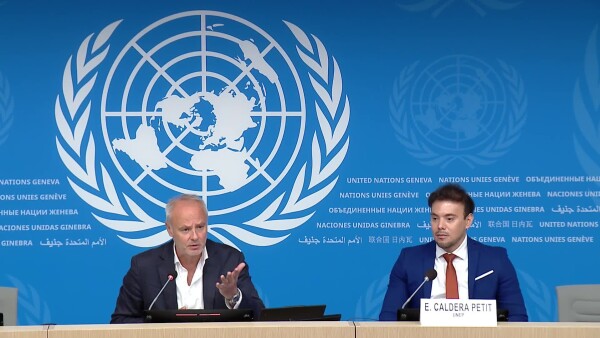
Press conference IOM: The Impact of COVID-19 on Global Mobility
Migrants stranded ‘all over the world’ and at risk from COVID-19
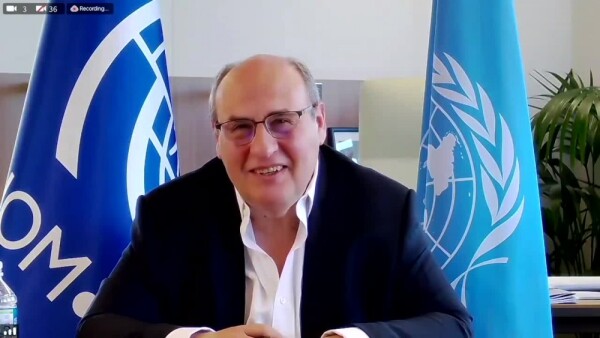
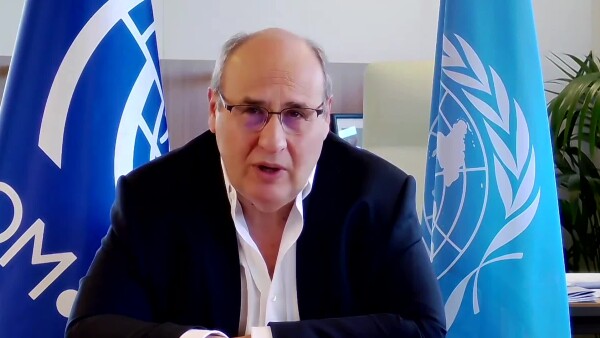
Thousands of migrants have been stranded “all over the world” where they face a heightened risk of COVID-19 infection, the head of UN migration agency, IOM, said on Thursday.
Speaking to journalists via videoconference, António Vitorino said that travel restrictions to try to limit the spread of the pandemic had left them more vulnerable than ever and unable to work to support themselves.
Future measures to prevent health emergencies from spreading globally – such as so-called immunity passports and mobile phone tracking software - also threatened equality for migrants, the IOM Director General cautioned.
“There are thousands of stranded migrants all over the world; in South-East Asia, in East Africa, in Latin America, because of the closing of the borders and with the travel restrictions, lots of migrants who were on the move; some of them wanted to return precisely because of the pandemic.”
He added: “They have been stranded, they are blocked, some in large groups, some in small groups, in the border areas, in very difficult conditions, without access to minimal care, especially health screening. And this is a source of tremendous concern for us, and we have been asking the Governments to allow the humanitarian workers and the health workers to have access to these large groups of stranded migrants.”
In a statement IOM noted its concern for migrants who have been stranded in deserts – either having been deported without due process or abandoned by smugglers - across west, central, and eastern Africa.
To help them, agency staff continue to conduct search and rescue in the desert, provide shelter, health assistance and support to hundreds of stranded migrants every week.
Immediate priorities for migrants include ensuring that they have access to health care and other basic social welfare assistance in their host country, Mr. Vitorino insisted.
Among the agency’s other immediate concerns is preventing the spread of new coronavirus infection in the more than 1,100 camps that it manages across the world.
They include the Cox’s Bazar complex in Bangladesh, home to around one million mainly ethnic Rohingya from Myanmar, the majority having fled persecution that was likened to ethnic cleansing by former top UN rights official Zeid Ra’ad Al Hussein.
So far, no cases of infection have been reported there, the IOM chief said, adding that preventative measures had been communicated to hundreds of thousands of camp residents, while medical capacity has been boosted.
On the situation of migrants in camps on the Greek mainland – IOM does not work on the islands which are home to migrants and refugees crossing the Eastern Mediterranean waters from Turkey - Mr. Vitorino said that some 200 cases of infection had been identified.
He described social distancing measures as “unthinkable” and added that “access to water and sanitation is quite a challenge”.
Turning to Venezuelan migrants, who are believed to number around five million amid a worsening economic crisis in the country, the IOM chief explained that “thousands…have lost their jobs in countries like Ecuador and Colombia and are returning back to Venezuela in large crowds without any health screening and being quarantined when they go back.”
Beyond the immediate health threat of COVID-19 infection, migrants also face growing stigmatization which they need protection from, Mr. Vitorino insisted.
Allowing hate speech and xenophobic narratives to thrive unchallenged also threatens to undermine the public health response to COVID-19, he said, before noting that migrant workers make up a significant percentage of the health sector in many developed countries including the UK, the U.S. and Switzerland.
Populist narratives targeting migrants as carriers of disease could also destabilise national security through social upheaval and countries’ post-COVID economic recovery, the IOM chief continued, by removing critical workers in agriculture and service industries.
Remittances have already seen a 30pc drop during the pandemic, Mr Vitorino said, citing World Bank data, meaning that some $20 billion has not been sent home to families in countries where up to 15 per cent of their gross domestic product comes from pay packets earned abroad.
In a plea for the health of migrants to be given as much attention as that of host populations in all countries, Mr. Vitorino also noted that Governments which did not monitor them, risked having to resume lockdown measures.
He also warned that in future, even more onerous health-related travel restrictions might discriminate disproportionately against migrant workers.
“In lots of countries in the world, we already have a system of screening checks to identify the health of migrants, above all malaria, tuberculosis, AIDS – HIV-AIDS – and now I believe that there will be increased demands in health controls for regular migrants.”
“Dans plusieurs états dans le monde, nous avions déjà un système de ‘screening” – d’identification – des conditions de santé des migrants, surtout la malaria, la ‘tuberculosis’ ou le ‘AIDS’, le HIV-AIDS; et maintenant j’anticipe qu’il y aura des exigences accrues en matière de contrôles sanitaires pour migration régulière.”
Mr. Vitorino added: “It is quite clear that health is the new wealth and that health concerns will be introduced in the mobility systems - not just for migration - but as a whole; where travelling for business or professional reasons, health will be the new gamechanger in town.”
Such health conditions “might leave some countries and some individuals excluded from international mobility”, he added. “And if the current pandemic leads to a two or even three-tier mobility system, then we will have to tried to solve the problem – the problem of the pandemic - but at the same time we have created a new problem of deepening the inequalities.”
Part of IOM’s core work is to voluntarily repatriate migrants in difficulty, including those affected by the pandemic. To do so, the agency seeks funding and works in partnership with Governments which ask for assistance.
“We have requests from a number of countries in the region to help repatriating those migrants to their countries of origin, whether it is Mozambique or Malawi, Zimbabwe, Nigeria,” Mr. Vitorino said. “As you know, IOM works very much on the basis of projects, so we do not have the financial capacity to help countries to repatriate their citizens unless there is funding available to do that.”
SHOTLIST OF THE EDITED STORY
1. Wide shot: exterior, United Nations Geneva, main entrance with UN flag and building in background.
2. SOUNDBITE (EN) António Vitorino, Director General of the International Organization for Migration (IOM): “There are thousands of stranded migrants all over the world; in South-East Asia, in East Africa, in Latin America, because of the closing of the borders and with the travel restrictions, lots of migrants who were on the move; some of them wanted to return precisely because of the pandemic.”
3. Medium shot: UN Geneva and UN flag alley behind gates at UN Geneva, filmed from the Place des Nations. A motorcyclist passes from left to right.
4. SOUNDBITE (EN) António Vitorino, Director General of the International Organization for Migration (IOM): “They have been stranded, they are blocked, some in large groups, some in small groups, in the border areas, in very difficult conditions, without access to minimal care especially health screening and this is a source of tremendous concern for us, and we have been asking the Governments to allow the humanitarian workers and the health workers to have access to these large groups of stranded migrants.”
5. Medium shot: flag alley, UN Geneva.
6. SOUNDBITE (EN) António Vitorino, Director General of the International Organization for Migration (IOM): “Our concern in Latin America is about all the thousands of Venezuelans that have lost their jobs in countries like Ecuador and Colombia, and are returning back to Venezuela in large crowds without any health screening and being quarantined when they go back to Venezuela.”
7. Medium shot: UN Geneva flag alley, with UN flag in background.
8. SOUNDBITE (EN) António Vitorino, Director General of the International Organization for Migration (IOM): “There in the camps social distancing is unthinkable and access to water and sanitation is quite a challenge. We have identified 200 cases of contamination in mainland Greece camps, as you know IOM is not in the islands.”
9. Wide shot, UN flag alley, UN Geneva.
10. SOUNDBITE (EN) António Vitorino, Director General of the International Organization for Migration (IOM): “It is quite clear that health is the new wealth and that health concerns will be introduced in the mobility systems - not just for migration - but as a whole; where travelling for business or professional reasons, health will be the new gamechanger in town.”
11. Medium shot, UN palais building with UN lettering in English and French either side of UN emblem.
12. SOUNDBITE (FR) António Vitorino, Director General of the International Organization for Migration (IOM): “Dans plusieurs états dans le monde, nous avions déjà un système de ‘screening” – d’identification – des conditions de santé des migrants, surtout la malaria, la ‘tuberculosis’ ou le ‘AIDS’, le HIV-AIDS; et maintenant j’anticipe qu’il y aura des exigences accrues en matière de contrôles sanitaires pour migration régulière.”
13. Medium shot, UN flag flying in front of palais building.
14. SOUNDBITE (EN) António Vitorino, Director General of the International Organization for Migration (IOM): “We have requests from a number of countries in the region to help repatriating those migrants to their countries of origin, whether it is Mozambique or Malawi, Zimbabwe, Nigeria. As you know, IOM works very much on the basis of projects, so we do not have the financial capacity to help countries to repatriate their citizens unless there is funding available to do that.
15. Close-up, UN flag alley, UN Geneva.
16. SOUNDBITE (EN) António Vitorino, Director General of the International Organization for Migration (IOM): “We are concerned that countries impose health conditions that effectively might leave some countries and some individuals excluded from international mobility. And if the current pandemic leads to a two or even three-tier mobility system, then we will have to tried to solve the problem – the problem of the pandemic - but at the same time we have created a new problem of deepening the inequalities.”
17. Wide shot, UN flag alley, UN Geneva.
Similar Stories
1
1
1
Press Conferences | IOM , UNDRR
UN stresses importance of household preparedness for disaster risk reduction.

1
1
1
Edited News | UNICEF , IFRC
Six weeks after Nepal’s deadly flooding disaster, communities are still struggling to rebuild their lives, but they will need sustained help as global warming increases the risk of another Himalayan catastrophe, the UN Children’s Fund (UNICEF) said on Friday.
1
1
1
Statements , Press Conferences | OHCHR
1
1
1
Press Conferences | UNHCR , UNICEF , IFRC , OHCHR , UN WOMEN , IOM , OCHA , WHO
UNHCR – ExCom Meeting, UNICEF – Nepal Recovery, IFRC – Flash Floods, WHO – Mental Health, IOM – South Sudan Floods, OCHA – DRC Humanitarian aid, UNHCR – Sahel Displacement, UNICEF – Yemen Update, IOM – Gaza Shelter, UN Women – Gaza Women, OHCHR – Arrests and detentions of Syrians by Israeli force
2
1
2
Press Conferences | UNCTAD
Presentation of the Trade and Developement Report 2026
Embargoed until 9 October 2026 at 11 a.m. (Geneva Time)
UNCTAD: UNCTAD’s flagship report finds that governments increasingly use industrial, trade, financial and technology policies to pursue economic and national security objectives. Market access and the ability to move into higher-value activities now depend more heavily on technology, finance and geopolitics.
1
1
1
Press Conferences | UPU
Release of the State of the Postal Sector Report 2026

1
1
1
Edited News | WHO
In suspected Russia plague death, testing and monitoring underway – WHO
The death of a lab worker in Russia’s Siberia region has sparked concerns about plague being the cause, the UN World Health Organization (WHO) said on Tuesday, adding that it was following the situation closely.
1
1
1
Press Conferences | IOM , ITU , UNECE , UNICEF , WHO , WMO
UNICEF: Ebola, DRC - children orphans or separating them from parents and caregivers; IOM: Humanitarian needs in Djibouti amid arrivals from Yemen and increased migrant movements; WHO: Darfur, scale of health needs far exceeds available resources; WMO co-sponsored Global Heat Forum, Bangkok, monthly Global Seasonal Climate Update; UNECE: UN Forum of Mayors; ITU Plenipotentiary Conference 2026; WHO: child and adolescent obesity guidelines and new global roadmap to tackle pregnancy hypertension, a leading cause of maternal mortality

1
1
Edited News | OHCHR , UNOG
UN Human Rights Chief Volker Türk on Friday provided and oral update to the 63rd session of the Human rights Council on Ukraine.

1
1
1
Edited News | OHCHR , UNOG
UN Human Rights Chief Volker Türk on Friday provided and oral update to the 63rd session of the Human rights Council on the human rights situation in Haiti.

1
1
1
Edited News | WHO
Repeated delays in bringing lifesaving medicines, prosthetics and more from Israel into Gaza risk having devastating consequences on Palestinians who urgently need them in the wartorn enclave, the UN World Health Organization (WHO) said on Friday. “A truck full of non-priority supplies or the right supplies arriving too late, doesn't save lives. That's the question that actually matters," said Dr Reinhilde Van De Weerdt, WHO Representative in the OPT.
1
1
1
Press Conferences | OCHA , UN WOMEN , UNHCR , WFP , WHO , WTO , UNEP
OCHA – $160M CERF allocation to 12 underfunded crises; UNHCR – 5.8M refugee children remain out of school amid funding cuts; UN Women – Middle East escalation and food security among women/girls; WHO – Gaza supplies and overall situation; WFP – Yemen food insecurity and impact on global hunger ; UNEP - First International Conference of the Global Framework on Chemicals in Geneva | 16-20 November 2026