

The United Nations Office at Geneva
Multimedia Newsroom
UN appeals for record $51.5 billion to help 230 million people on the brink in 2023
A record $51.5 billion is needed to help 230 million of the world’s most vulnerable people in nearly 70 countries next year, the UN said on Thursday.
The size of the appeal – 25 per cent higher than this year’s - reflects the fact that the total number of people in need is 65 million more than in 2022, the UN and partner organizations noted.
Needs are “shockingly high”, the UN’s top emergency relief official, Martin Griffiths, said, warning that it was very likely that this year’s emergencies would continue into 2023.
“The needs are going up because we’ve been by smitten by the war in Ukraine, by COVID, by climate,” he said. “I fear that 2023 is going to be an acceleration of all those trends, and that’s why we say … that we hope 2023 will be a year of solidarity, just as 2022 has been a year of suffering.”
Speaking in Geneva at the launch of the Global Humanitarian Overview report 2023, Mr. Griffiths described the appeal as a “lifeline” for people on the brink.
He explained that numerous countries had been hit by lethal droughts and floods, from Pakistan to the Horn of Africa. In addition, the war in Ukraine had “turned a part of Europe into a battlefield. More than 100 million people are now displaced worldwide. And all of this on top of the devastation left by the pandemic among the world’s poorest.”
If the humanitarian outlook for 2023 is so grim, it is in large part because relief demands are already so high.
At least “222 million people … will face acute food insecurity in 53 countries by the end of this year”, Mr. Griffiths explained. Turning to the threat of famine, he said that five countries “are already experiencing what we call famine-like conditions, where we can confidently and unhappily say that people are dying as a result - and it tends to be children – …of displacement, food insecurity, lack of food, starvation.”
In 2023, 45 million people in 37 countries risk starvation, according to the Global Humanitarian Overview.
It highlighted that vulnerable communities also face pressure on several fronts including health, as medical providers continue to struggle to recover after COVID-19, and while the mpox and other vector-borne diseases continue, along with outbreaks of Ebola and cholera.
Climate change is also driving up risks and vulnerability, Mr. Griffiths said, in line with concerns that by the end of the century, extreme heat could claim as many lives as cancer. To help communities on the front line of the climate emergency, the UN emergency relief chief maintained that humanitarians should play a bigger role in international climate discussions, in order to secure resilience funding for those in most need.
“In 2023, the humanitarian community I think needs to be a lot more organized and indeed vocal about how to be more transparent about climate promises, be more quick about the decision to disburse and getting the money that’s promised to the people for whom it’s promised.”
Mr. Griffiths said that he expected it to be “very difficult” to achieve the full amount requested from donors both national and private, whose generosity was unable to keep up with growing demands. This year’s UN-led Global Humanitarian appeal is only 47 per cent funded – a sharp drop from earlier years where funding levels used to reach 60 to 65 per cent, he explained.
On Ukraine, the UN official explained that 13.6 million people had received assistance, and that a total of $5.7 billion had been requested for the country and wider region next year. “As we go into the winter this ain’t getting any easier or less,” he said.
ends
STORY: Global Humanitarian Overview 2023 - OCHATRT: 2 min 26s
SOURCE: UNTV CH
RESTRICTIONS: NONE
LANGUAGE: ENGLISH/NATS
ASPECT RATIO: 16:9
DATELINE: 1 December 2022 GENEVA, SWITZERLAND
SHOTLIST
- Medium-wide, UN Geneva flag alley.
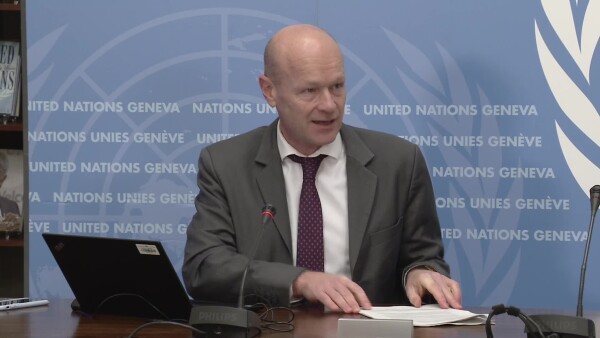
- Wide, press room, podium speakers Jens Laerke and Martin Griffiths holding up copy of the Global Humanitarian Overview 2023.
- SOUNDBITE (ENGLISH) Martin Griffiths, UN Emergency Relief Coordinator: “222 million people - more figures for you - will face acute food insecurity in 53 countries by the end of this year.”
- Medium, AFP TV journalist, adjusting lens on TV camera.
- SOUNDBITE (ENGLISH) Martin Griffiths, UN Emergency Relief Coordinator: “The needs are going up because we’ve been by smitten by the war in Ukraine, by COVID, by climate and I fear that 2023 is going to be an acceleration of all those trends, and that’s why we say in this report and generally that we hope 2023 will be a year of solidarity, just as 2022 has been a year of suffering.”
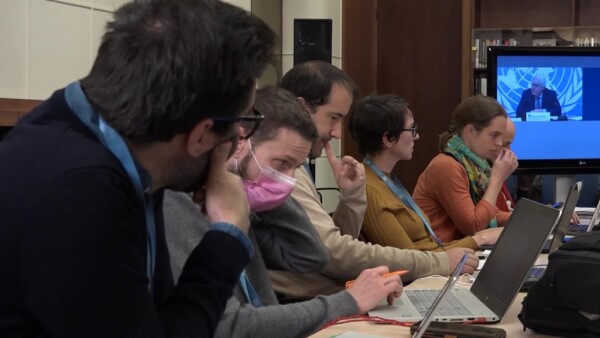
- Close, journalists’ hands typing on laptops, profile.
- SOUNDBITE (ENGLISH) Martin Griffiths, UN Emergency Relief Coordinator: “When you look at the issue of famine, and there is a very complex, detailed, technical process assessing whether famine conditions exist or not, as you probably know, five countries are already experiencing what we call famine like conditions, where we can confidently and unhappily say that people are dying as a result - and it tends to be children – as a result of displacement, food insecurity, lack of food, starvation.”
- Close, journalist’s face reflected in laptop screen.
- SOUNDBITE (ENGLISH) Martin Griffiths, UN Emergency Relief Coordinator: “We’ve provided assistance to 13.6 million in Ukraine and of course as you know, as we go into the winter this ain’t getting any easier or less. And Ukraine’s proposed budget – our proposed budget for Ukraine next year - I think it’s the highest of the list - is $5.1 billion for Ukraine and the region.”
- Medium, Mr. Griffiths speaking, journalist’s head in foreground, blurred.
- SOUNDBITE (ENGLISH) Martin Griffiths, UN Emergency Relief Coordinator: “In 2023, the humanitarian community I think needs to be a lot more organized and indeed vocal about how to be more transparent about climate promises, be more quick about decision to disburse and getting the money that’s promised to the people for whom it’s promised.”
- Medium-wide, press room and participants.
- Medium, journalists in profile.
- Close, showing a camera on table and hand holding pen to write notes on pad.
Similar Stories
1
1
1
Press Conferences | WMO , UNHCR , WHO , ILO
WMO: Greenhouse Gas Bulletin; UNHCR: As attacks intensify UNHCR urges support for war ravaged Ukrainians; WHO: Clinical trials in DRC: vaccines and beyond; ILO: New global and regional estimates on domestic work, informality and working conditions
1
1
1
Edited News | OCHA , UNICEF , WFP
Aid agencies warned on Friday of the fast-developing humanitarian emergency inside Taiz City in Yemen, which has been encircled by de facto Houthi forces fighting government troops along the country’s west coast.
1
1
1
Press Conferences | UN WOMEN , WFP , WHO
UN WOMEN: Sudan Women and girls one year after the fall of El Fasher; increasing drone attacks across the country; WFP: DRC - Ebola spreads to eighth DRC province as WFP delivers food, builds treatment centres and keeps supplies moving; WHO - Update on Ebola (Bundibugyo Virus Disease)
1
12
1
1
Press Conferences , Images | UNOG
Closing Press Conference following the Sixth Consultative Meeting on Enhancing Coordination of Peace Initiatives and Efforts in Sudan

2
17
1
2
Edited News , Press Conferences , Images | OCHA , WMO
Two UN agencies teamed up on Wednesday to issue an appeal for immediate assistance to help communities already being impacted by the strongest El Niño on record.

3
16
2
2
Edited News , B-roll , Conferences , Images | UNITED NATIONS , UNOG
Sixth Consultative Meeting on Enhancing Coordination of Peace Initiatives and Efforts for Sudan
1
1
1
Press Conferences | CITES
Wildlife trade and conservation policy discussions at the 81st meeting of the CITES Standing Committee (SC81)

1
1
1
Edited News | UNICEF , WHO , UNHCR
Yemen war continues to force families from homes amid hunger and disease
More than 250,000 people have now fled renewed fighting in Yemen, the UN said on Tuesday, citing particular concern for those sheltering in the southwestern city of Taiz and the wider governorate, where access is “essentially blocked”.
1
1
1
Press Conferences | UNHCR , UNCTAD , WMO , OCHA , UNICEF , WHO
UNHCR Hungary’s 1956 Refugee Crisis: 70 Years On, UNCTAD World Investment Forum 2026, Doha, WMO Greenhouse Gas Bulletin and Climate Update for COP31, OCHA Afghanistan: Malnutrition, Girls’ Education and Recovery, UNICEF Yemen: Child Malnutrition and Unsafe Water in Taiz, WHO Inequalities in Noncommunicable Diseases and Risk Factors
1
1
1
Press Conferences | UNHCR
End of UNHCR's 77th Annual Executive Committee (ExCom) meeting week

1
1
1
Edited News | UNICEF
A little over one year since a ceasefire agreement was announced between Hamas fighters and Israel, more than 340 children have been reported killed and hundreds more injured, the UN Children’s Fund, UNICEF, said on Friday.
1
1
1
Press Conferences | UNICEF , IOM , UNHCR
UN Special Assistant to the Personal Envoy Office (SUDAN): Peace Initiatives and Efforts in Sudan; UNICEF: Dire situation of children in Gaza; IOM: Damaged Homes and Energy Attacks Risk Displacing Ukrainians for this winter; UNHCR: update on EXCOM week