

The United Nations Office at Geneva
Multimedia Newsroom
UN Chief urges countries to ‘do everything’ against COVID-19, thanks China’s people for sacrifice
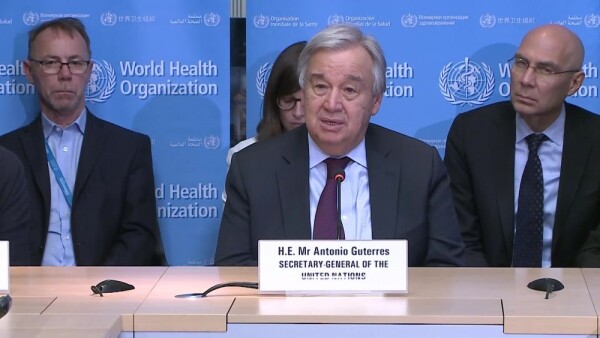
While the World Health Organization (WHO) declared that the COVID-19 outbreak should not be described as a pandemic because it is not spreading uncontrollably, UN Secretary-General on Monday urged all countries to “do everything” to contain the disease.
“I think it’s important to say that all countries - and this is now a problem that is affecting many countries in the world – all countries must do everything to be prepared and all countries must do everything respecting naturally the principle of non-discrimination, without stigmatization, respecting human rights; doing everything that they can to contain the disease,” said António Guterres.
Although it was still possible to contain the disease “if some fail, if some do not do everything that is needed, this can still become out of control with dramatic consequences for global health and the global economy”, he warned.
Earlier, WHO Director-General Dr Tedros Adhanom Ghebreyesus told journalists that while a “sudden increase” in new cases outside China was very concerning, what was most needed was containment, not scaremongering.
As of 6am Geneva time on Monday, China reported a total of 77,362 cases of COVID-19, including 2,618 deaths, he said.
Outside China, “there are now 2074 cases in 28 countries, and 23 deaths...The sudden increases of cases in Italy, the Islamic Republic of Iran and the Republic of Korea are deeply concerning,” he said.
In the past 24 hours, China reported 416 new confirmed cases, and 150 deaths, Dr Tedros noted, adding that the WHO team of experts which visited China had found that the epidemic “peaked and plateaued” between 23 January and 2 February “and has been declining steadily since then”.
Speaking in Geneva at WHO headquarters, Mr Guterres reiterated his “strong appeal” to countries “to assume their responsibilities and knowing that they can fully count on WHO to support them in that effort”.
On the need to support the UN health agency’s $675 million appeal to stop coronavirus from spreading further, Mr Guterres insisted that “if there is something stupid to do in today’s world, it is to not fully fund WHO appeals. Because WHO appeals are vital to support Member States to avoid these tragic diseases to become a global nightmare.”
Answering a reporter’s question in French, he said: ”I can tell you that the information I received from the WHO after the (experts’) visit to China, is that since the beginning of February, the number of cases is starting to fall. I hope that this situation continues in a constant way, and my message to all those who now in China are having to go without a lot of things that are part of normal life, is a message of gratitude – because these are sacrifices that have been made by people who’ve been deprived of all the positive things of life that we enjoy. Those who’ve been deprived of those things to avoid the virus spreading are in the process of doing a great service for humanity.”
- Medium shot: exterior at the World Health Organization (WHO) in Geneva showing António Guterres, UN Secretary-General, approaching and hugging WHO Director-General Dr Tedros Adhanom Ghebreyesus.
- Medium shot: Mr Guterres walks with Dr Tedros and team through WHO lobby.
- Close up: Mr Guterres shown listening to Dr Tedros and greeting well-wishers (off camera) team through WHO lobby.
- Wide shot: Mr Guterres walking through WHO lobby flanked by onlookers; journalists and photographers.
- SOUNDBITE (EN) — António Guterres, UN Secretary-General: “I think it’s important to say that all countries - and this is now a problem that is affecting many countries in the world – all countries must do everything to be prepared and all countries must do everything respecting naturally the principle of non-discrimination, without stigmatization, respecting human rights; doing everything that they can to contain the disease.”
- Medium shot: Mr Guterres arriving for WHO press conference, Dr Tedros behind.
- SOUNDBITE (EN) — António Guterres, UN Secretary-General: “The disease, it’s still possible to be contained, but if some fail, if some do not do everything that is needed, this can still become out of control with dramatic consequences for global health and the global economy.”
- Medium shot: Press conference participants.
- SOUNDBITE (EN) — António Guterres, UN Secretary-General: “So, my strong appeal is to all countries to assume their responsibilities and knowing that they can fully count on WHO to support them in that effort.”
- Close-up: partly obscured TV camera operator, Mr Guterres and participants.
- SOUNDBITE (EN) — António Guterres, UN Secretary-General: “If there is something stupid to do in today’s world, it is to not fully fund WHO appeals. Because WHO appeals are vital to support Member States to avoid these tragic diseases to become a global nightmare.”
- Medium shot, Mr Guterres inspecting a wall-mounted TV screen displaying polio eradication information.
- Close-up, Mr Guterres and Dr Tedros shown listening to an unnamed speaker.
- SOUNDBITE (FR) — SOUNDBITE (EN) — António Guterres, UN Secretary-General: « Je tiens à vous transmettre que l’information que j’ai obtenu de l’organisation mondiale de la santé d’après la visite récemment faite en Chine, c’est que depuis le commencement du mois de février, le nombre de cas est en train de baisser. J’espère que cette indication puisse être maintenue, d’une façon continuée, et mon message à tous ceux qui maintenant en Chine sont privés de beaucoup des aspects d’une vie normale, c’est un message de gratitude, parce que ce sont les sacrifices de ceux qui sont privés de tous les aspects positifs de la vie dont nous jouissons, ceux qui sont privés de ça pour éviter que la maladie se propage, sont en train de rendre service à l’humanité. »
- Medium shot: Mr Guterres and Dr Tedros shown chatting with an unnamed speaker, all are looking at a wall-mounted TV displaying Ebola virus outbreak data from the Democratic Republic of the Congo.
- Close up: Mr. Guterres, Dr Tedros and other speakers shown looking out of shot while unnamed speaker gives presentation on Ebola virus outbreak in the Democratic Republic of the Congo.
- Medium shot: Mr Guterres shown listening to information on Ebola virus outbreak in the Democratic Republic of the Congo.
Similar Stories

1
1
1
Edited News | OCHA , UNICEF , WFP
Aid agencies warned on Friday of the fast-developing humanitarian emergency inside Taiz City in Yemen, which has been encircled by de facto Houthi forces fighting government troops along the country’s west coast.
1
1
1
Press Conferences | UN WOMEN , WFP , WHO
UN WOMEN: Sudan Women and girls one year after the fall of El Fasher; increasing drone attacks across the country; WFP: DRC - Ebola spreads to eighth DRC province as WFP delivers food, builds treatment centres and keeps supplies moving; WHO - Update on Ebola (Bundibugyo Virus Disease)
1
12
1
1
Press Conferences , Images | UNOG
Closing Press Conference following the Sixth Consultative Meeting on Enhancing Coordination of Peace Initiatives and Efforts in Sudan

2
17
1
2
Edited News , Press Conferences , Images | OCHA , WMO
Two UN agencies teamed up on Wednesday to issue an appeal for immediate assistance to help communities already being impacted by the strongest El Niño on record.

3
16
2
2
Edited News , B-roll , Conferences , Images | UNITED NATIONS , UNOG
Sixth Consultative Meeting on Enhancing Coordination of Peace Initiatives and Efforts for Sudan
1
1
1
Press Conferences | CITES
Wildlife trade and conservation policy discussions at the 81st meeting of the CITES Standing Committee (SC81)

1
1
1
Edited News | UNICEF , WHO , UNHCR
Yemen war continues to force families from homes amid hunger and disease
More than 250,000 people have now fled renewed fighting in Yemen, the UN said on Tuesday, citing particular concern for those sheltering in the southwestern city of Taiz and the wider governorate, where access is “essentially blocked”.
1
1
1
Press Conferences | UNHCR , UNCTAD , WMO , OCHA , UNICEF , WHO
UNHCR Hungary’s 1956 Refugee Crisis: 70 Years On, UNCTAD World Investment Forum 2026, Doha, WMO Greenhouse Gas Bulletin and Climate Update for COP31, OCHA Afghanistan: Malnutrition, Girls’ Education and Recovery, UNICEF Yemen: Child Malnutrition and Unsafe Water in Taiz, WHO Inequalities in Noncommunicable Diseases and Risk Factors

1
1
1
Press Conferences | UNHCR
End of UNHCR's 77th Annual Executive Committee (ExCom) meeting week

1
1
1
Edited News | UNICEF
A little over one year since a ceasefire agreement was announced between Hamas fighters and Israel, more than 340 children have been reported killed and hundreds more injured, the UN Children’s Fund, UNICEF, said on Friday.

1
1
1
Press Conferences | UNICEF , IOM , UNHCR
UN Special Assistant to the Personal Envoy Office (SUDAN): Peace Initiatives and Efforts in Sudan; UNICEF: Dire situation of children in Gaza; IOM: Damaged Homes and Energy Attacks Risk Displacing Ukrainians for this winter; UNHCR: update on EXCOM week

1
1
1
Press Conferences | IOM , UNDRR
UN stresses importance of household preparedness for disaster risk reduction.