

The United Nations Office at Geneva
Multimedia Newsroom
Edited News | OCHA , WHO , UNCTAD , FAO
Ukraine Crisis Update WHO - OCHA - FAO - ICRC 29 March 2022
Ukraine: aid convoy reaches war-battered Kharkiv, Mariupol fears remain
Urgently needed aid supplies have reached the embattled Ukrainian city of Kharkiv, UN humanitarians said on Tuesday, amid reports that people are facing “life-and-death decisions” on whether to leave Mariupol and elsewhere, more than a month since the Russian invasion.
On Monday, relief reached “the hard-battered” city of Kharkiv in north-eastern Ukraine “and safely delivered food rations, medical supplies and household items for thousands of people,” said Jens Laerke, spokesperson for the UN humanitarian coordinating office, OCHA.
To the south, in Mariupol and other Ukrainian locations that have been encircled and pummelled by indiscriminate shelling, the International Committee of the Red Cross (ICRC) warned that he the crisis was “deepening…the level of death, destruction and suffering that we are witnessing and that is being inflicted on civilians is abhorrent and unacceptable”.
Briefing journalists in Geneva, ICRC spokesperson Ewan Watson reiterated serious concerns about civilians who have no safe means of escape, and who have faced constant shelling, while also lacking running water and other essentials.
According to OCHA, around 90 per cent of Mariupol’s residential buildings – some 2,600 homes – have been affected by active fighting.
Some 60 per cent of buildings have suffered various degrees of damage from direct shelling, while about 40 per cent have been completely destroyed. Local authorities say the rising civilian death toll is fast-approaching 5,000 people.
“Today civilians are taking life-and-death decisions to flee when there is no ceasefire or other agreements in place that will allow them to leave safely,” said ICRC’s Mr. Watson. “Time is running out for citizens in Mariupol and in other frontline areas who have now gone for weeks with no humanitarian assistance.”
In Kharkiv, where Monday’s UN aid convoy was led by the UN’s top aid official in Ukraine, Osnat Lubrani, the supplies will now be distributed by the Ukrainian Red Cross to the most vulnerable communities in the city, as well as the hard-to-reach suburbs Izium, Balakliia and Chuhuiv.
“There are UNICEF supplies for 6,000 people, UNHCR items for 500 households that include things such as solar lamps, tarpaulins and blankets, WFP food rations for 3,325 people for two weeks, WHO supplies to care for 10,000 primary health care patients for three months, and supplies to treat trauma patients,” said OCHA spokesperson Mr. Laerke.
Briefing journalists in Geneva, he noted that the city’s municipal authorities had reported “that more than 1,140 buildings have been destroyed since the military offensive began” on 24 February. “Of these, nearly 1,000 are residential buildings. This raises serious concerns about both the shelter and protection needs of people.”
Highlighting the risks faced by medical workers and patients in Ukraine, Dr Jarno Habicht, World Health Organization (WHO) Representative in Ukraine, said that there have now been “74 attacks with 72 deaths and 40 injuries in the period of 24 February until 25 March…These attacks are against hospitals, ambulances.”
Dr Habicht confirmed that medical goods were “much-needed in the facilities where the doctors and nurses are doing much of the work, almost 24/7 in these very difficult circumstances”.
Equally worrying are fears that Ukrainians may soon be facing serious food insecurity because of the ongoing conflict, which has already disrupted livelihoods during the agricultural growing season.
The alert from the UN Food and Agriculture Organization (FAO) follows assessments in 19 of Ukraine’s 24 oblasts, or regions, which indicated that it was uncertain whether Ukraine could harvest crops, plant new ones or sustain livestock production.
“An immediate and worrying finding is that food shortages are expected immediately or in the next three months in over 40 per cent of the surveyed areas and cases,” said Rein Paulsen, FAO Director, Office of Emergencies and Resilience.
“When it comes to the all-important production of vegetables, conflict is likely to severely disrupt production for tens of thousands of smallholder farmers, those who have decided to stay behind.”
To help support the relief effort, FAO has appealed for $50 million but it is only 10 per cent funded.
Nonetheless, it has been possible to support more than 14,600 farming families by providing them with more than 740 tonnes of urgently needed seed for planting, Mr. Paulsen explained.
ends
STORY: Ukraine Update – WHO, OCHA, FAO, ICRC
TRT: 3 mins 05s
SOURCE: UNTV CH
RESTRICTIONS: NONE
LANGUAGE: ENGLISH
ASPECT RATIO: 16:9
DATELINE: 29 March 2022 GENEVA, SWITZERLAND
SHOTLIST
- Exterior wide shot, flag alley, UN Geneva.
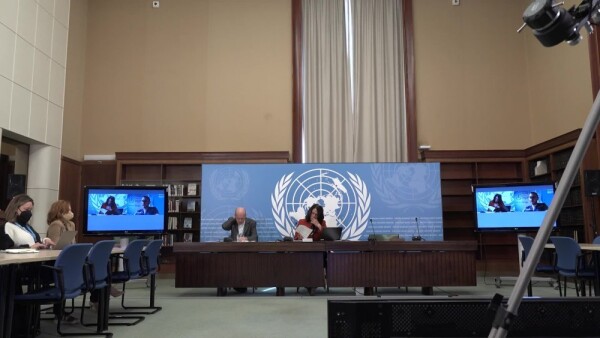
- Wide shot, UN Geneva Press room.
- SOUNDBITE (ENGLISH): Jens Laerke, OCHA: “Yesterday, it made its way into the hard-battered Kharkiv in northern Ukraine and safely delivered food rations, medical supplies and household items for thousands of people.”
- Medium shot, participants, seated, following briefing, a video camera is placed on table.
- SOUNDBITE (ENGLISH): Jens Laerke, OCHA: “There are UNICEF supplies for 6,000 people, UNHCR items for 500 households that include things such as solar lamps, tarpaulins and blankets, WFP food rations for 3,325 people for two weeks, WHO supplies to care for 10,000 primary health care patients for three months, and supplies to treat trauma patients.”
- Medium shot, particupants, masked.
- SOUNDBITE (ENGLISH): Jens Laerke, OCHA: “In Kharkiv, municipal authorities have said that more than 1,140 buildings have been destroyed since the military offensive began. Of these, nearly 1,000 are residential buildings. This raises serious concerns about both the shelter and protection needs of people.”
- Close-up, TV camera on tripod, video journalist filming with DSLR camera.
- SOUNDBITE (ENGLISH): Ewan Watson – ICRC: “The humanitarian crisis is deepening in Ukraine; the level of death, destruction and suffering that we are witnessing and that is being inflicted on civilians is abhorrent and unacceptable.”
- Medium shot, participant wearing mask, hunched over laptop, with hand on forehead.
- SOUNDBITE (ENGLISH): Ewan Watson – ICRC: “Today civilians are taking life-and-death decisions to flee when there is no ceasefire or other agreements in place that will allow them to leave safely. Time is running out for citizens in Mariupol and in other frontline areas who have now gone for weeks with no humanitarian assistance.”
- Close-up, video journalist filming, images on camera display and large TV screen to rear.
- SOUNDBITE (ENGLISH): Dr Jarno Habicht (via Zoom from Lviv), WHO Representative in Ukraine: “What we have observed now is 74 attacks with 72 deaths and 40 injuries in the period of 24 February until 25 March, meaning during one month. These attacks are against hospitals, ambulances.”
- Medium shot, podium speaker and external speaker shown on large screen TV with lighting panel and participants to rear, masked.
- SOUNDBITE (ENGLISH): Dr Jarno Habicht (via Zoom from Lviv), WHO Representative in Ukraine: “Medical goods are much-needed in the facilities where the doctors and nurses are doing much of the work, almost 24/7 in these very difficult circumstances.”
- Medium shot, large screen TV showing podium speaker and external speaker in foreground, podium speakers to rear.
- SOUNDBITE (ENGLISH): Rein Paulsen, Director, Office of Emergencies and Resilience, FAO: “An immediate and worrying finding is that food shortages are expected immediately or in the next three months in over 40 per cent of the surveyed areas and cases.”
- Medium-wide shot, Press room participants filmed from behind the podium, flanked by TV frame and screen.
- SOUNDBITE (ENGLISH): Rein Paulsen, Director, Office of Emergencies and Resilience, FAO: “When it comes to the all-important production of vegetables, conflict is likely to severely disrupt production for tens of thousands of smallholder farmers, those who have decided to stay behind.”
- Wide shot, Press briefing room.
- Medium shot, showing participant wearing facemask in focus to rear, with a laptop and user’s hands in foreground, blurred.
Similar Stories

1
1
1
Edited News | UNICEF
A little over one year since a ceasefire agreement was announced between Hamas fighters and Israel, more than 340 children have been reported killed and hundreds more injured, the UN Children’s Fund, UNICEF, said on Friday.

1
1
1
Edited News | UNICEF , IFRC
Six weeks after Nepal’s deadly flooding disaster, communities are still struggling to rebuild their lives, but they will need sustained help as global warming increases the risk of another Himalayan catastrophe, the UN Children’s Fund (UNICEF) said on Friday.

1
1
1
Edited News | WHO
In suspected Russia plague death, testing and monitoring underway – WHO
The death of a lab worker in Russia’s Siberia region has sparked concerns about plague being the cause, the UN World Health Organization (WHO) said on Tuesday, adding that it was following the situation closely.

1
1
Edited News | OHCHR , UNOG
UN Human Rights Chief Volker Türk on Friday provided and oral update to the 63rd session of the Human rights Council on Ukraine.

1
1
1
Edited News | OHCHR , UNOG
UN Human Rights Chief Volker Türk on Friday provided and oral update to the 63rd session of the Human rights Council on the human rights situation in Haiti.

1
1
1
Edited News | WHO
Repeated delays in bringing lifesaving medicines, prosthetics and more from Israel into Gaza risk having devastating consequences on Palestinians who urgently need them in the wartorn enclave, the UN World Health Organization (WHO) said on Friday. “A truck full of non-priority supplies or the right supplies arriving too late, doesn't save lives. That's the question that actually matters," said Dr Reinhilde Van De Weerdt, WHO Representative in the OPT.

1
1
1
Edited News | WHO
DRC: Early access to care and oxygen decisive for Ebola patients’ survival – WHO
In the Democratic Republic of the Congo (DRC), health workers fighting the country’s largest-ever Ebola outbreak are struggling to overcome critical challenges to patient care, the UN World Health Organization (WHO) warned on Tuesday.

1
1
1
Edited News | OCHA , UN
Civilians in Iran are continuing to feel the consequences of months of conflict and military escalation, the UN’s top official in the country has said, as loss of life, damage to civilian infrastructure and mounting economic pressures leave many facing continued uncertainty.
1
1
1
Edited News | WHO , UNICEF
Aid agencies in Yemen highlighted the growing hunger emergency sparked by renewed fighting between Houthi opposition forces and Government troops, after mobile health clinics reported that hundreds of children displaced by the violence are suffering from the most deadly form of malnutrition.
1
1
1
Edited News | UNHCR
Displacement on the rise in Yemen as fighting continues - UNHCR
As hostilities worsen in Yemen, more people have been fleeing their homes, further intensifying the humanitarian crisis within the region, the UN Refugee Agency (UNHCR) warned on Tuesday.
1
1
1
Edited News | IOM , OHCHR , UNFPA , UNOG , UNHCR , WHO
Yemen’s humanitarian crisis growing by the hour amid spike in displacement
Yemenis displaced by renewed fighting have described fleeing for their lives amid shelling and gunfire, aid agencies reported on Friday, while highlighting the dramatic increase in humanitarian needs in the country and in Djibouti, where thousands have sought shelter.
1
1
1
Edited News | OHCHR , UNOG
The UN Human Rights Office issued on Friday a report documenting a shocking pattern of sexual violence amid Russia’s full-scale armed attack on Ukraine.