

The United Nations Office at Geneva
Multimedia Newsroom
La peur et l'incertitude sont des éléments quotidiens pour les plus vulnérables de Gaza : UNMAS
À Gaza, les opérations militaires israéliennes en cours et le blocus de l'aide continuent d'ajouter aux craintes et aux difficultés quotidiennes auxquelles sont confrontées les personnes dans l'enclave dévastée, a déclaré mercredi le Service de l'action antimines des Nations Unies, UNMAS.
« Ce que les gens font actuellement, c'est qu'ils ont peur », a déclaré Luke Irving, chef du Programme d'action antimines dans les Territoires palestiniens occupés (TPO). « Ils sont préoccupés pour leur sécurité, ils se concentrent sur la survie au jour le jour, si vous voulez, sur la façon dont ils resteraient en sécurité, comment ils se nourriraient, comment ils s'hydrateraient. C'est la réalité à Gaza en ce moment. »
Le bombardement israélien croissant de Gaza entre le 3 et le 8 avril a tué 287 Palestiniens et blessé 912 autres, selon les autorités sanitaires de Gaza.
Entre le 7 octobre 2023 et le 8 avril 2025, les mêmes autorités affirment qu'au moins 50 810 Palestiniens ont été tués et 115 688 blessés.
Le bureau des affaires humanitaires de l'ONU (OCHA) a par ailleurs rapporté que des roquettes ont été tirées depuis Gaza les 3 et 6 avril vers Israël, dont une a frappé la ville d'Ashkelon, blessant au moins 12 Israéliens.
Les travailleurs humanitaires continuent d'être tués à Gaza ; depuis le 7 octobre 2023, le nombre est passé à 412. Ces dernières semaines, les forces israéliennes ont ciblé et tué 14 membres du personnel en service à Rafah de la Société du Croissant-Rouge palestinien, de la Défense civile palestinienne et un travailleur de l'agence des Nations Unies pour les réfugiés palestiniens, UNRWA, provoquant une condamnation généralisée de la part des hauts responsables de l'ONU.
« C'est une période très, très, très difficile et les preuves montrent que nous ne sommes pas protégés en ce moment », a déclaré Luke Irving, chef du Programme d'action antimines dans les Territoires palestiniens occupés (TPO).
S'adressant à ONU Info, il a lancé un appel pour la protection des collègues essayant d'aider les autres dans une zone de combat active « parce que les gens en ont besoin, les civils en ont besoin ».
L'UNMAS fournit un soutien spécialisé pour assurer la sécurité des humanitaires et ses équipes le font tout en menant une mission d'évaluation après qu'une maison d'hôtes marquée par l'ONU a été touchée à Deir Al-Balah, dans le centre de Gaza le mois dernier.
« Le 19 mars, ils faisaient exactement cela. Ils examinaient un bâtiment notifié par l'ONU qui avait été touché la veille et vérifiaient qu'il était exempt de munitions non explosées et que les gens pouvaient retourner dans cette structure. Malheureusement, à un moment donné, il y a eu un incident lorsqu'ils menaient cette mission, qui était une arme explosive et cela a causé un décès et des blessures au personnel de l'ONU. »
Il y a maintenant cinq semaines que les autorités israéliennes ont arrêté toutes les livraisons de secours commerciaux et humanitaires vers Gaza.
Les médicaments et autres provisions médicales « s'épuisent rapidement », avec des unités de sang et d'autres fournitures pour la santé maternelle et infantile à des niveaux critiques, rapportent les équipes d'aide de l'ONU.
« Il n'y a eu aucune aide humanitaire entrant et la situation devient - est déjà désespérée - elle devient de plus en plus désespérée et grave », a déclaré M. Irving.
« C'est un blocus, donc aucune aide humanitaire n'entre. De plus, nous sommes très limités dans nos mouvements en raison des risques que cela pose pour sortir et mener nos missions, etc., cela concerne toutes les agences de l'ONU. »
Les armes non explosées restent une menace majeure à travers Gaza et ont ajouté aux difficultés causées par l'interdiction totale de l'entrée de secours dans la bande.
« Nous rencontrons, vous savez, des roquettes, des bombes, des grenades, tous ces types d'objets qui ne fonctionnent pas lorsqu'ils sont utilisés dans un conflit », a déclaré M. Irving. « Nous avons ces différentes manières dont les munitions non explosées se matérialiseront. Il sera très, très important lorsque nous commencerons à enlever les décombres, la reconstruction, la récupération, que nous ayons la capacité de localiser ces objets, d'avertir les gens - ce que nous pouvons faire maintenant - mais à terme, nous voulons détruire ces munitions. Nous voulons nous débarrasser de ces munitions. Nous voulons les éliminer. »
Rendre Gaza sûre est crucial si les habitants de l'enclave doivent retourner dans leurs champs, a déclaré l'officier de l'UNMAS : « Soixante, 70 pour cent, je comprends, des exportations de Gaza avant le conflit étaient agricoles. Donc, évidemment, il y a beaucoup de cette activité qui reprend en temps de paix, en temps de cessez-le-feu. Donc, lorsqu'ils retournent dans les champs, il pourrait y avoir des munitions non explosées dans ces champs ; ils doivent comprendre ce risque et comprendre qu'ils ne doivent pas les toucher. »
fin
HISTOIRE : Mise à jour de Gaza - UNMAS
TRT : 03’24”
SOURCE : UNTV CH
RESTRICTIONS : AUCUNE
LANGUE : ANGLAIS / SONS AMBIANTS
FORMAT D'IMAGE : 16:9
DATE : 9 AVRIL 2025 GENÈVE, SUISSE, inclut des plans de coupe pris le 08 AVRIL 2025, GAZA CITY
Orateur :
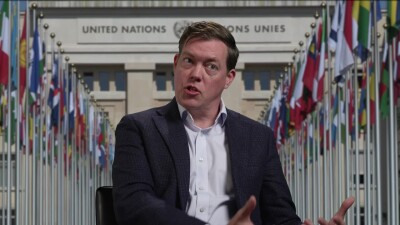
Luke Irving, Chef du Programme d'Action contre les Mines dans les Territoires Palestiniens Occupés (TPO)
LISTE DES PLANS
- Plan extérieur moyen : Palais des Nations, Allée des Drapeaux
- Plan large, destruction massive des bâtiments et infrastructures à Gaza.
- EXTRAIT SONORE (Anglais) – Luke Irving, Chef du Programme d'Action contre les Mines dans les Territoires Palestiniens Occupés (TPO) : « Ce que les gens font actuellement en ce moment, c'est qu'ils ont peur. Ils sont préoccupés par leur sécurité, ils se concentrent sur la survie au jour le jour, si vous voulez, sur comment rester en sécurité, comment se nourrir, comment s'approvisionner en eau. C'est la réalité à Gaza en ce moment. »
- Plan moyen, destruction massive des bâtiments et infrastructures à Gaza.
- EXTRAIT SONORE (Anglais) – Luke Irving, Chef du Programme d'Action contre les Mines dans les Territoires Palestiniens Occupés (TPO) : « Il n'y a pas eu d'aide humanitaire qui est entrée et la situation devient - est déjà désespérée - elle devient de plus en plus désespérée et grave. »
- Plan moyen-large, destruction massive des bâtiments et infrastructures à Gaza.
- EXTRAIT SONORE (Anglais) – Luke Irving, Chef du Programme d'Action contre les Mines dans les Territoires Palestiniens Occupés (TPO) : « Il y a eu un blocus, donc aucune aide humanitaire ne parvient à entrer. De plus, nous sommes très limités dans nos mouvements en raison du risque que cela pose de sortir et de mener nos missions, etc., cela concerne toutes les agences de l'ONU. »
- Plan moyen-large, destruction massive des bâtiments et infrastructures à Gaza.
- EXTRAIT SONORE (Anglais) – Luke Irving, Chef du Programme d'Action contre les Mines dans les Territoires Palestiniens Occupés (TPO) : « Nous rencontrons, vous savez, des roquettes, des bombes, des grenades, tous ces types d'objets qui ne fonctionnent pas lorsqu'ils sont utilisés dans un conflit. »
- Plan moyen-large, des gens marchant au milieu de la destruction massive des bâtiments et infrastructures à Gaza.
- EXTRAIT SONORE (Anglais) – Luke Irving, Chef du Programme d'Action contre les Mines dans les Territoires Palestiniens Occupés (TPO) : « Nous avons ces différentes façons dont les munitions non explosées se matérialiseront. Ce sera très, très important lorsque nous commencerons à enlever les décombres, à reconstruire, à récupérer, que nous ayons la capacité de localiser ces objets, d'avertir les gens - ce que nous pouvons faire maintenant - mais à terme, nous voulons détruire ces munitions. Nous voulons nous débarrasser de ces munitions. Nous voulons nous en débarrasser. »
- Plan moyen-large, un tricycle motorisé transportant des réservoirs d'eau roule le long d'une route bordée d'abris.
- EXTRAIT SONORE (Anglais) – Luke Irving, Chef du Programme d'Action contre les Mines dans les Territoires Palestiniens Occupés (TPO) : « Soixante, 70 pour cent, je crois, des exportations de Gaza avant le conflit étaient agricoles. Donc, évidemment, il y a beaucoup de cette activité qui reprend en temps de paix, en temps de cessez-le-feu. Donc, lorsqu'ils retournent dans les champs, il pourrait y avoir des munitions non explosées dans ces champs ; ils doivent comprendre ce risque et comprendre qu'ils ne doivent pas y toucher. »
- Plan moyen-large, un étal de marché et un camion-citerne de l'ONU au milieu de bâtiments criblés d'impacts.
- EXTRAIT SONORE (Anglais) – Luke Irving, Chef du Programme d'Action contre les Mines dans les Territoires Palestiniens Occupés (TPO) : « Nous fournissons un soutien spécialisé pour garder les humanitaires en sécurité, pour leur permettre de faire leur travail. Le 19 mars, ils faisaient exactement cela. Ils examinaient un bâtiment signalé par l'ONU qui avait été touché la nuit précédente et vérifiaient qu'il était sûr de tout engin non explosé et que les gens pouvaient retourner dans cette structure. Malheureusement, à un moment donné, il y a eu un incident lorsqu'ils effectuaient cette mission, qui était une arme explosive et cela a causé la mort et des blessures au personnel de l'ONU. »
- Plan moyen, camion-citerne de l'ONU en marche arrière.
- EXTRAIT SONORE (Anglais) – Luke Irving, Chef du Programme d'Action contre les Mines dans les Territoires Palestiniens Occupés (TPO) : « C'est une période très, très, très difficile. Et les preuves me montrent que nous ne sommes pas protégés en ce moment. Et j'espère que nous ne verrons pas d'autres humanitaires, travailleurs de la santé tués ou blessés en faisant leur travail à l'avenir, car les gens en ont besoin, les civils en ont besoin. Les innocents ont besoin d'une intervention. »
- Plan large, destruction massive des bâtiments et infrastructures à Gaza.
Similar Stories

1
1
1
Edited News | WHO
In suspected Russia plague death, testing and monitoring underway – WHO
The death of a lab worker in Russia’s Siberia region has sparked concerns about plague being the cause, the UN World Health Organization (WHO) said on Tuesday, adding that it was following the situation closely.

1
1
Edited News | OHCHR , UNOG
UN Human Rights Chief Volker Türk on Friday provided and oral update to the 63rd session of the Human rights Council on Ukraine.

1
1
1
Edited News | OHCHR , UNOG
UN Human Rights Chief Volker Türk on Friday provided and oral update to the 63rd session of the Human rights Council on the human rights situation in Haiti.

1
1
1
Edited News | WHO
Repeated delays in bringing lifesaving medicines, prosthetics and more from Israel into Gaza risk having devastating consequences on Palestinians who urgently need them in the wartorn enclave, the UN World Health Organization (WHO) said on Friday. “A truck full of non-priority supplies or the right supplies arriving too late, doesn't save lives. That's the question that actually matters," said Dr Reinhilde Van De Weerdt, WHO Representative in the OPT.

1
1
1
Edited News | WHO
DRC: Early access to care and oxygen decisive for Ebola patients’ survival – WHO
In the Democratic Republic of the Congo (DRC), health workers fighting the country’s largest-ever Ebola outbreak are struggling to overcome critical challenges to patient care, the UN World Health Organization (WHO) warned on Tuesday.

1
1
1
Edited News | OCHA , UN
Civilians in Iran are continuing to feel the consequences of months of conflict and military escalation, the UN’s top official in the country has said, as loss of life, damage to civilian infrastructure and mounting economic pressures leave many facing continued uncertainty.
1
1
1
Edited News | WHO , UNICEF
Aid agencies in Yemen highlighted the growing hunger emergency sparked by renewed fighting between Houthi opposition forces and Government troops, after mobile health clinics reported that hundreds of children displaced by the violence are suffering from the most deadly form of malnutrition.
1
1
1
Edited News | UNHCR
Displacement on the rise in Yemen as fighting continues - UNHCR
As hostilities worsen in Yemen, more people have been fleeing their homes, further intensifying the humanitarian crisis within the region, the UN Refugee Agency (UNHCR) warned on Tuesday.
1
1
1
Edited News | IOM , OHCHR , UNFPA , UNOG , UNHCR , WHO
Yemen’s humanitarian crisis growing by the hour amid spike in displacement
Yemenis displaced by renewed fighting have described fleeing for their lives amid shelling and gunfire, aid agencies reported on Friday, while highlighting the dramatic increase in humanitarian needs in the country and in Djibouti, where thousands have sought shelter.
1
1
1
Edited News | OHCHR , UNOG
The UN Human Rights Office issued on Friday a report documenting a shocking pattern of sexual violence amid Russia’s full-scale armed attack on Ukraine.
2
1
2
Edited News , Press Conferences | WMO
As world’s water reserves change, countries must prepare for a new reality: WMO
New data showing that rivers were at their lowest level for decades last year provides further evidence that the climate crisis is real and countries must act immediately to protect themselves from the increasing threat to communities and livelihoods, the UN World Meteorological Organization (WMO) said on Thursday.
The key findings from WMO’s State of Global Water Resources 2025 report covering the hydrological cycle and extreme events in the five-year period to last year:
- 2025 was one of driest years for river discharge in 35 years
- Past seven years have seen abnorfmal river flows
- Water storage on Earth’s land surface has decreased in past decade
- Widespread glacier loss across all regions for fourth consecutive year
- Asia and Africa are regions most affected by water-related disasters
- Water data availability has improved, but gaps remain in hard-hit areas
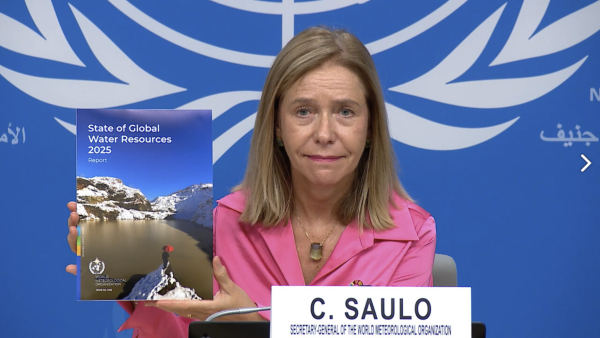
Highlighting the long-term decline in the Earth’s freshwater storage and glacier melt, WMO Secretary-General Celeste Saulo explained that the planet’s water reserves used to act as a planetary “savings account” that absorbed the occasional dry season, avoiding a water crisis. “One of the central stories of the 2025 report is what is happening to that savings account? And the simple answer is that we are depleting it,” she told journalists in Geneva.
Groundwater reserves are equally stretched and have been in decline since 2014, WMO’s report states, with nearly two-thirds of monitored wells worldwide showing levels lower than the historical norm and indicating a shift “further toward deficit…not recovery”.
“At the same time, we are seeing more water-related disasters,” Ms. Saulo said, while also stressing that the currently strengthening El Niño “will increase the risk of drought in some areas, and flooding in others”.
Glaciers disappearing
In 2025, for the fourth consecutive year, every major glaciated region on Earth lost ice mass, leading to short-term hazards including floods and long-term water insecurity, according to WMO.
Responding to a question about whether the changing global water cycle might have contributed to the deadly Nepal-China flooding disaster, Ms. Saulo explained that melting ice and rock was just one factor in the chain of events that ultimately sent a massive and deadly wall of water and debris downstream on 26 August, killing at least 1,367 people.
“You asked if it could happen again? Absolutely; the problem in this region is that there’s 63,700 glaciers at the last count,” she told a Press Conference in Geneva. “Even if you’re looking with remote sensing with satellites at these glaciers, you might see some faults, you might see some slight shifting, that does not mean necessarily catastrophic collapse. So, in order to plan for this, it’s very, very difficult. But the international community is looking very hard at ways in which we can bring people together to solve some of these monitoring issues.”
Data indicates that glaciers shrank between 2023 and 2025 with cumulative losses of 1,400 gigatonnes of water – or about one third of annual fresh water needs.
Every major glacier region on Earth lost ice for the fourth consecutive year.
“All 19 glacier regions around the globe lost ice; in Central Asia, Iceland, the Russian Arctic and western Canada and the United States, it was among the three worst years on record,” said Wayne Jenkinson, WMO’s Director of Hydrology and Cryosphere.
Some regions with smaller glaciers such as Central Europe, the Caucasus, the western Canada and the United States may already have reached “peak water”, Mr. Jenkinson warned.
“After this point, the glacier gives less meltwater each year simply because there is less ice left to melt. That matters for every community downstream that relies on water during hot, dry summers,” he explained.
Narelle van der Wel, WMO’s Head of Cryosphere Monitoring, Predictions and Services, stressed that while some further glacier loss is unavoidable, the eventual scale of the decline is not predetermined.
“Some glacier loss is inevitable, but total loss of glaciers is not yet inevitable,” she said, pointing to emissions reductions as central to limiting future losses.
Preparing for moving baselines
The report does not attribute every observed change to climate change alone. WMO says pressure on water resources and natural variability also contribute.
Mr. Jenkinson said governments need to prepare for “moving baselines” as historical patterns become less reliable.
“The situation 30 years ago is not where we are today,” he said. Countries, he added, need to prepare “for those changes that have really already arrived”.
ends
1
1
1
Edited News | OCHA , WHO
The deadly Ebola virus outbreak in DR Congo continues to spread across the vast country despite some success in containing it, aid officials said on Tuesday, in a renewed call for international support to help responders on the ground.