

The United Nations Office at Geneva
Multimedia Newsroom
Les coupes dans le financement de l'aide américaine créent de la confusion et mettent en péril la prévention du VIH, déclare l'ONUSIDA
La suspension de l'aide étrangère par les États-Unis a créé « beaucoup de confusion » dans le travail communautaire de prévention du VIH, malgré la dérogation accordée pour les programmes de VIH/SIDA, a déclaré vendredi l'agence de l'ONU pour la lutte contre le SIDA (ONUSIDA).
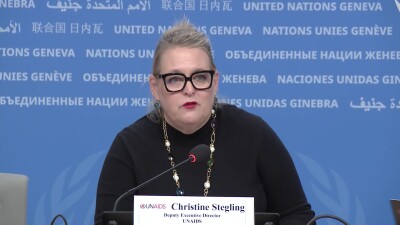
La dérogation permet la continuation ou la reprise de « l'assistance humanitaire vitale », y compris le traitement du VIH. Cela signifie que 20 millions de personnes vivant avec le VIH qui dépendent de l'aide américaine pour leur traitement peuvent continuer à recevoir des médicaments. « Cela représente 20 millions sur les 30 millions de personnes vivant avec le VIH dans le monde, » a déclaré Christine Stegling, directrice exécutive adjointe de l'ONUSIDA, lors d'un point de presse prévu à Genève.
La réponse mondiale au VIH dépend fortement des fonds du Plan d'urgence du président des États-Unis pour la lutte contre le SIDA (PEPFAR); il finance 70 % de la réponse globale au SIDA et soutient directement plus de 20 millions de personnes vivant avec le VIH.
Depuis sa création en 2003, le PEPFAR a sauvé plus de 26 millions de vies en investissant dans des programmes critiques de prévention, de traitement, de soins et de soutien du VIH dans 55 pays, selon l'ONUSIDA.
Néanmoins, « il y a beaucoup de confusion sur le terrain, en particulier au niveau communautaire, quant à la manière dont la dérogation sera mise en œuvre », a rapporté Mme Stegling, soulignant la perturbation des services de traitement. Les services de transport et les agents de santé communautaires sont également toujours impactés par la suspension du financement américain, selon l'ONUSIDA.
Les centres d'accueil en danger
L'agence a souligné que la suspension de l'aide américaine aux programmes communautaires entraînerait la fermeture de nombreux centres de santé d'accueil et la résiliation des contrats des travailleurs de proximité, privant ainsi effectivement les groupes vulnérables de soutien.
La plus grande interruption concernera les services de santé communautaires qui ont été cruciaux dans le succès de la lutte contre le VIH, selon l'ONUSIDA. En Éthiopie, 5 000 contrats de travailleurs de la santé publique dépendent de l'aide américaine. « Tous ceux-ci, dans toutes les régions de l'Éthiopie, ont été résiliés, ainsi que 10 000 commis aux données, très importants en Éthiopie », a ajouté Mme Stegling.
Des milliers d'individus - femmes, jeunes filles et populations prioritaires à risque plus élevé d'infections sexuellement transmissibles - ne pourront plus accéder à des services essentiels, tels que la distribution de préservatifs, le dépistage du VIH, le traitement antirétroviral, la prophylaxie pré-exposition pour la prévention du VIH, les dépistages de la tuberculose ou le soutien pour faire face à la violence basée sur le genre.
L'ONUSIDA est particulièrement préoccupée par l'impact à long terme du gel du financement américain sur la prévention des nouvelles infections par le VIH, car la plupart des services sont basés dans la communauté, tandis que les gouvernements nationaux ont tendance à se concentrer sur le maintien des personnes sous traitement, plutôt que sur la prévention de nouvelles infections.
Si le Plan d'urgence du président des États-Unis pour la lutte contre le SIDA (PEPFAR) n'est pas réautorisé entre 2025 et 2029 et que d'autres ressources ne sont pas trouvées pour la réponse au VIH, « il y aurait une augmentation de 400 % des décès dus au SIDA », a déclaré l'ONUSIDA. « Cela représente 6,3 millions de personnes, 6,3 millions de décès liés au SIDA qui surviendront à l'avenir », a déclaré Mme Stegling aux journalistes.
L'ONUSIDA affirme qu'elle continuera ses efforts pour s'assurer que pendant la pause de 90 jours, toutes les personnes touchées par le VIH continuent d'accéder aux services vitaux.
Fin
Histoire : “Impact des coupes dans le financement de l'aide américaine – ONUSIDA” – Vendredi 07 février 2025
Orateurs :
- Christine Stegling, Directrice exécutive adjointe de l'ONUSIDA
TRT : 02’02”
SOURCE : UNTV CH
LANGUE : ANGLAIS / NATS
RAPPORT D'ASPECT : 16:9
DATELINE : 07 février 2025 - GENÈVE, SUISSE
Conférence de presse à Genève
LISTE DES PLANS
- Plan moyen extérieur : allée des drapeaux de l'ONU.
- Plan moyen du podium avec les orateurs dans la salle de conférence de presse.
- EXTRAIT SONORE (Anglais) Christine Stegling, Directrice exécutive adjointe de l'ONUSIDA : “La dérogation devrait signifier que 20 millions de personnes vivant avec le VIH qui dépendent de l'aide américaine pour leur traitement peuvent continuer leur médication. Cela représente 20 millions sur les 30 millions de personnes vivant avec le VIH dans le monde.”
- Plan large de la salle de conférence de presse.
- EXTRAIT SONORE (Anglais) Christine Stegling, Directrice exécutive adjointe de l'ONUSIDA : “La réponse mondiale au sida a été fortement dépendante des fonds du gouvernement américain, 70 pour cent de tout l'argent pour le VIH provient du gouvernement américain pour la réponse mondiale.”
- Plan large de la salle de conférence de presse.
- EXTRAIT SONORE (Anglais) Christine Stegling, Directrice exécutive adjointe de l'ONUSIDA : “Il y a encore beaucoup de confusion, surtout dans les communautés, sur la manière dont la dérogation sera mise en œuvre. Et nous constatons beaucoup de perturbations dans la prestation des services de traitement, en particulier au niveau communautaire.”
- Plan large : journalistes dans la salle de conférence de presse et salle de contrôle à l'arrière.
- EXTRAIT SONORE (Anglais) Christine Stegling, Directrice exécutive adjointe de l'ONUSIDA : “Nous voyons que la plus grande interruption concernera les systèmes de santé communautaires, qui, comme vous le savez tous, ont été au centre de notre succès face au VIH. Par exemple, en Éthiopie, nous avons 5 000 contrats de travailleurs de la santé publique financés par l'aide américaine. Et tous ceux-ci dans toutes les régions de l'Éthiopie ont été résiliés, ainsi que 10 000 employés de saisie de données, très importants en Éthiopie. Nous continuons donc à surveiller et à veiller à ce que les gens soient sous traitement.”
- Plan de coupe des journalistes dans la salle de conférence de presse.
- EXTRAIT SONORE (Anglais) Christine Stegling, Directrice exécutive adjointe de l'ONUSIDA : “En tant qu'ONUSIDA, nous estimons que si le PEPFAR -Plan d'urgence du président des États-Unis pour la lutte contre le sida (PEPFAR)- n'était pas réautorisé entre 2025 et 2029 et que d'autres ressources n'étaient pas trouvées pour la réponse au VIH, il y aurait une augmentation de 400 pour cent des décès dus au sida. Cela représente 6,3 millions de personnes, 6,3 millions de décès liés au sida qui se produiront à l'avenir.”
- Plan rapproché des journalistes prenant des notes.
- Plans variés de la salle de conférence de presse.
Similar Stories

1
1
1
Edited News | OCHA , UNICEF , WFP
Aid agencies warned on Friday of the fast-developing humanitarian emergency inside Taiz City in Yemen, which has been encircled by de facto Houthi forces fighting government troops along the country’s west coast.

2
17
1
2
Edited News , Press Conferences , Images | OCHA , WMO
Two UN agencies teamed up on Wednesday to issue an appeal for immediate assistance to help communities already being impacted by the strongest El Niño on record.

3
16
2
2
Edited News , B-roll , Conferences , Images | UNITED NATIONS , UNOG
Sixth Consultative Meeting on Enhancing Coordination of Peace Initiatives and Efforts for Sudan

1
1
1
Edited News | UNICEF , WHO , UNHCR
Yemen war continues to force families from homes amid hunger and disease
More than 250,000 people have now fled renewed fighting in Yemen, the UN said on Tuesday, citing particular concern for those sheltering in the southwestern city of Taiz and the wider governorate, where access is “essentially blocked”.

1
1
1
Edited News | UNICEF
A little over one year since a ceasefire agreement was announced between Hamas fighters and Israel, more than 340 children have been reported killed and hundreds more injured, the UN Children’s Fund, UNICEF, said on Friday.

1
1
1
Edited News | UNICEF , IFRC
Six weeks after Nepal’s deadly flooding disaster, communities are still struggling to rebuild their lives, but they will need sustained help as global warming increases the risk of another Himalayan catastrophe, the UN Children’s Fund (UNICEF) said on Friday.

1
1
1
Edited News | WHO
In suspected Russia plague death, testing and monitoring underway – WHO
The death of a lab worker in Russia’s Siberia region has sparked concerns about plague being the cause, the UN World Health Organization (WHO) said on Tuesday, adding that it was following the situation closely.

1
1
Edited News | OHCHR , UNOG
UN Human Rights Chief Volker Türk on Friday provided and oral update to the 63rd session of the Human rights Council on Ukraine.

1
1
1
Edited News | OHCHR , UNOG
UN Human Rights Chief Volker Türk on Friday provided and oral update to the 63rd session of the Human rights Council on the human rights situation in Haiti.

1
1
1
Edited News | WHO
Repeated delays in bringing lifesaving medicines, prosthetics and more from Israel into Gaza risk having devastating consequences on Palestinians who urgently need them in the wartorn enclave, the UN World Health Organization (WHO) said on Friday. “A truck full of non-priority supplies or the right supplies arriving too late, doesn't save lives. That's the question that actually matters," said Dr Reinhilde Van De Weerdt, WHO Representative in the OPT.

1
1
1
Edited News | WHO
DRC: Early access to care and oxygen decisive for Ebola patients’ survival – WHO
In the Democratic Republic of the Congo (DRC), health workers fighting the country’s largest-ever Ebola outbreak are struggling to overcome critical challenges to patient care, the UN World Health Organization (WHO) warned on Tuesday.

1
1
1
Edited News | OCHA , UN
Civilians in Iran are continuing to feel the consequences of months of conflict and military escalation, the UN’s top official in the country has said, as loss of life, damage to civilian infrastructure and mounting economic pressures leave many facing continued uncertainty.