

The United Nations Office at Geneva
Multimedia Newsroom
US aid funding cuts create confusion, put HIV prevention at risk, says UNAIDS
The US pause in foreign assistance funding has created “a lot of confusion” in community HIV prevention work, despite the waiver issued for HIV/AIDS programmes, the UN agency to combat AIDS (UNAIDS) said on Friday.
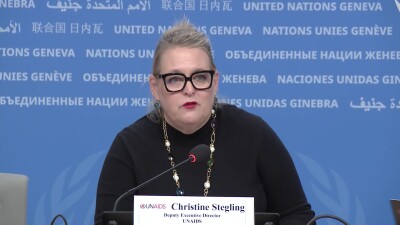
The waiver allows the continuation or resumption of “life-saving humanitarian assistance” including HIV treatment. That means 20 million people living with HIV who depend on US aid for their treatment can continue to receive medication. “That’s 20 million out of the 30 million people living with HIV in the world,” said Christine Stegling, Deputy Executive Director of UNAIDS, at a scheduled press briefing in Geneva.
The HIV global response is heavily dependent on funds from the US President’s Emergency Plan for AIDS Relief (PEPFAR); it finances 70 per cent of the overall AIDS response and directly supports more than 20 million people living with HIV.
Since its creation in 2003, PEPFAR has saved more than 26 million lives by investing in critical HIV prevention, treatment, care and support programs in 55 countries, according to UNAIDS.
Nevertheless, “there is a lot of confusion on the ground especially at the community level on how the waiver will be implemented”, Ms. Stegling reported, pointing to disruption of treatment services. Transport services and community health workers are also still impacted by the US funding pause, according to UNAIDS.
Drop-in centres at risk
The agency highlighted that the pause in US assistance to community programmes would lead to the closure of many drop-in health centres and the termination of outreach workers’ contracts, effectively depriving vulnerable groups of support.
The biggest interruption will be to community health services which have been crucial in the success of the fight against HIV, according to UNAIDS. In Ethiopia 5,000 public health worker contracts depend on US assistance. “All of these, in all regions of Ethiopia, have been terminated, as well as 10,000 data clerks, very important in Ethiopia”, added Ms. Stegling.
Thousands of individuals - women, young girls, and priority populations at higher risk of sexually transmitted infections - will no longer be able to access critical services, such as condom distribution, HIV testing, antiretroviral treatment, pre-exposure prophylaxis for HIV prevention, screenings for tuberculosis or support to address gender-based violence.
UNAIDS is most concerned about the long-term impact of the US funding freeze on prevention of new HIV infections as most services are community-based, while national governments tend to focus on keeping people on treatment, rather than preventing new infections.
If the US President’s Emergency Plan for AIDS Relief (PEPFAR) is not re-authorized between 2025 and 2029 and other resources were not found for the HIV response, “there would be a 400 per cent increase in AIDS death”, UNAIDS said. “That’s 6.3 million people, 6.3 million AIDS related deaths that will occur in the future”, Ms. Stegling told journalists.
UNAIDS says it will continue efforts to ensure that during the 90-day pause, all people affected by HIV continue to access life-saving services.
Ends
Story: “US aid funding cuts impact – UNAIDS” – Friday 07 February 2025
Speakers:
- Christine Stegling, UNAIDS Deputy Executive Director
TRT: 02’02”
SOURCE: UNTV CH
LANGUAGE: ENGLISH / NATS
ASPECT RATIO: 16:9
DATELINE: 07 February 2025 - GENEVA, SWITZERLAND
Geneva Press briefing
SHOTLIST
- Exterior medium shot: UN flag alley.
- Medium shot of the podium with speakers at the press conference room.
- SOUNDBITE (English) Christine Stegling, UNAIDS Deputy Executive Director: “The waiver should mean that 20 million people living with HIV that depend on US aid for their treatment can continue their medication. That's 20 million out of the 30 million people living with HIV in the world.”
- Wide shot of the press conference room.
- SOUNDBITE (English) Christine Stegling, UNAIDS Deputy Executive Director: “Global AIDS response has been heavily dependent on US government funds, 70 per cent of all money for HIV comes from the US government of the global response.”
- Wide shot of the press conference room.
- SOUNDBITE (English) Christine Stegling, UNAIDS Deputy Executive Director: “There's still a lot of confusion, especially in communities, on how the waiver will be implemented. And we're seeing a lot of disruption of delivery of treatment services, especially at the community level.”
- Wide shot: journalists at the press conference room and control room at the back.
- SOUNDBITE (English) Christine Stegling, UNAIDS Deputy Executive Director: “We see that the biggest interruption will be on community health systems, which all of you know, have been at the center of our success to HIV. So, for example, in Ethiopia, we have 5,000 public health worker contracts that are funded by US assistance. And all of these in all regions of Ethiopia have been terminated, and 10,000 data clerks, very important in Ethiopia. So we continue monitoring and ensuring that people are on treatment.”
- Cutaway journalists in the press conference room.
- SOUNDBITE (English) Christine Stegling, UNAIDS Deputy Executive Director: “As UNAIDS, we estimate that if PEPFAR -US President's Emergency Plan for AIDS Relief (PEPFAR)- wasn't re-authorized between 2025 and 2029 and other resources were not found for the HIV response, there would be a 400 per cent increase in AIDS death. That's 6.3 million people, 6.3 million AIDS related deaths that will occur in the future.”
- Close shot of journalists taking notes.
- Various shots of the press conference room.
Similar Stories

1
1
1
Edited News | OCHA , UNICEF , WFP
Aid agencies warned on Friday of the fast-developing humanitarian emergency inside Taiz City in Yemen, which has been encircled by de facto Houthi forces fighting government troops along the country’s west coast.

2
17
1
2
Edited News , Press Conferences , Images | OCHA , WMO
Two UN agencies teamed up on Wednesday to issue an appeal for immediate assistance to help communities already being impacted by the strongest El Niño on record.

3
16
2
2
Edited News , B-roll , Conferences , Images | UNITED NATIONS , UNOG
Sixth Consultative Meeting on Enhancing Coordination of Peace Initiatives and Efforts for Sudan

1
1
1
Edited News | UNICEF , WHO , UNHCR
Yemen war continues to force families from homes amid hunger and disease
More than 250,000 people have now fled renewed fighting in Yemen, the UN said on Tuesday, citing particular concern for those sheltering in the southwestern city of Taiz and the wider governorate, where access is “essentially blocked”.

1
1
1
Edited News | UNICEF
A little over one year since a ceasefire agreement was announced between Hamas fighters and Israel, more than 340 children have been reported killed and hundreds more injured, the UN Children’s Fund, UNICEF, said on Friday.

1
1
1
Edited News | UNICEF , IFRC
Six weeks after Nepal’s deadly flooding disaster, communities are still struggling to rebuild their lives, but they will need sustained help as global warming increases the risk of another Himalayan catastrophe, the UN Children’s Fund (UNICEF) said on Friday.

1
1
1
Edited News | WHO
In suspected Russia plague death, testing and monitoring underway – WHO
The death of a lab worker in Russia’s Siberia region has sparked concerns about plague being the cause, the UN World Health Organization (WHO) said on Tuesday, adding that it was following the situation closely.

1
1
Edited News | OHCHR , UNOG
UN Human Rights Chief Volker Türk on Friday provided and oral update to the 63rd session of the Human rights Council on Ukraine.

1
1
1
Edited News | OHCHR , UNOG
UN Human Rights Chief Volker Türk on Friday provided and oral update to the 63rd session of the Human rights Council on the human rights situation in Haiti.

1
1
1
Edited News | WHO
Repeated delays in bringing lifesaving medicines, prosthetics and more from Israel into Gaza risk having devastating consequences on Palestinians who urgently need them in the wartorn enclave, the UN World Health Organization (WHO) said on Friday. “A truck full of non-priority supplies or the right supplies arriving too late, doesn't save lives. That's the question that actually matters," said Dr Reinhilde Van De Weerdt, WHO Representative in the OPT.

1
1
1
Edited News | WHO
DRC: Early access to care and oxygen decisive for Ebola patients’ survival – WHO
In the Democratic Republic of the Congo (DRC), health workers fighting the country’s largest-ever Ebola outbreak are struggling to overcome critical challenges to patient care, the UN World Health Organization (WHO) warned on Tuesday.

1
1
1
Edited News | OCHA , UN
Civilians in Iran are continuing to feel the consequences of months of conflict and military escalation, the UN’s top official in the country has said, as loss of life, damage to civilian infrastructure and mounting economic pressures leave many facing continued uncertainty.