

The United Nations Office at Geneva
Multimedia Newsroom
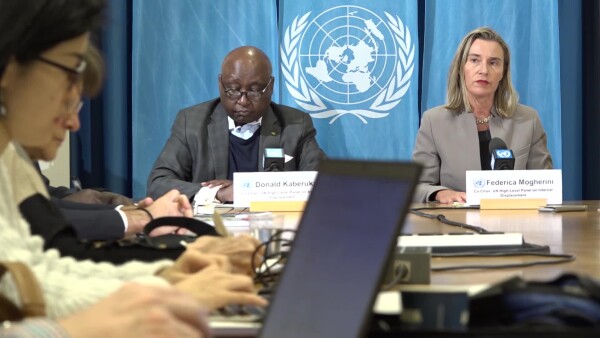
As Geneva prepares to host its first ever high-level panel on Internal Displacement, the co-chair of the panel called the issue “a major humanitarian and political crisis of our times.”
To put internal displacement back on the agenda and shift global focus to the millions of people displaced within their own countries, the United Nations Secretary-General António Guterres established the first high-level panel to address this issue in October 2019. Federica Mogherini, co-chair of this panel told journalists that even though “the issue of internal displacement tends to be forgotten”, she stressed that it is “one of the major, not only humanitarian, but also political, crisis that our times are seeing.”
Scheduled to hold its first meeting on 26 February 2020, the Secretary-General has tasked the panel with finding concrete long-term solutions and to raise global awareness of internal displacement by improving efforts to help all those affected, including both the displaced and their host communities. Ms. Mogherini, listed one of the panel’s tasks as addressing main drivers of displacement, and delving into the reasons why displacement occurs, of which she listed the three main causes as “climate change, disaster risk reduction, and peace action.” She told journalists that the panel has also been tasked with linking “the IDP issue and the 2030 agenda” so as to be able to understand how to “improve the collection of data and the analysis of the phenomenon” as she stressed that “the issue of recognition of the phenomenon is itself the first step to address it.” The 2030 Agenda for Sustainable Development also promises to “leave no one behind”. It incorporates internal displacement issues into its 17 Sustainable Development Goals (SDGs), specifically including IDPs as a vulnerable group that must not be left behind.
Ms. Mogherini worried that the numbers of internally displaced persons have been increasing every year, noting that “41 million people have been displaced by conflict only” in the last year, and millions more are become internally displaced every year “as a consequence of natural disasters or climate-related events.”
The high-level panel draws together expertise from government, international organizations, civil society and the private sector, as focusing only on short-term humanitarian assistance, and narrow goals, have proven to be inadequate, unsustainable, and unsuited to the protracted nature of many IDP crises, according to Donald Kaberuka who maintains that internal displacement is a global problem occurring in all continents, and therefore it requires a global solution. Mr. Kaberuka told journalists that it was not possible “to separate development, environment, and security” and that to be able to respond adequately to the problem, all three must be addressed together, as “we would be failing the Secretary-General if we did not address the issue of climate impact,” he said, stressing the need to make climate change a priority, as well as the urgent need to “bring the international community together to make sure that we resolve this.”
“Internally displaced persons are among the most vulnerable and face a variety of risks to their lives, health and well-being. And ever more people are displaced for longer periods of time, undermining the efforts of affected countries to achieve the Sustainable Development Goals,” said the Secretary-General in a statement on establishing the High-Level Panel on Internal Displacement. The Panel will convene at least four times in Geneva, New York and other locations, and will submit its final recommendations to the Secretary-General in one year.
- Wide shot: exterior, flag alley, Palais des Nations, United Nations Geneva.
- Wide shot, press briefing room
- Medium shot, panel
- SOUNDBITE (EN) Federica Mogherini, Co-Chair, UN High-Level Panel on Internal Displacement: “The issue of internal displacement tends to be forgotten while it is one of the major, not only humanitarian, but also I would say, political crisis that our times are seeing.”
- Close-up: journalists
- SOUNDBITE (EN) Federica Mogherini, Co-Chair, UN High-Level Panel on Internal Displacement: “The terms of reference indicate the need for us to address the link between internal displacement and climate change, disaster risk reduction, and peace action, as we see these three as the main drivers of displacement.”
- Close-up: journalists writing
- SOUNDBITE (EN) Federica Mogherini, Co-Chair, UN High-Level Panel on Internal Displacement: “We are talking about numbers that are increasing every year. Only for reasons of conflict, we are talking about 41 million people internally displaced, and to this you have to add the internally displaced people that are moving as a consequence of natural disasters or climate-related events.”
- Medium shot: journalists
- SOUNDBITE (EN) Federica Mogherini, Co-Chair, UN High-Level Panel on Internal Displacement: “We’ve been tasked to link and to study the link between the IDP issue and the 2030 agenda, so to understand how to include this work into the sustainable development agenda, obviously looking at how we can improve the collection of data and the analysis of the phenomenon; the issue of recognition of the phenomenon is itself the first step to address it.”
- Close-up: camera
- SOUNDBITE (EN) Donald Kaberuka, Co-Chair, UN High-Level Panel on Internal Displacement: “It is not really possible to separate development, environment, and security especially if you focus on where the big numbers are coming from, so we would be failing the Secretary-General if we did not address the issue of climate impact, and try to go beyond that to show this link and what the international community can do together to make sure that we resolve this.”
- Close-up shot: journalist writing
- Medium shot: journalists, panel
- Close-up: journalist
Similar Stories

1
1
1
Edited News | UNICEF , WHO , UNHCR
Yemen war continues to force families from homes amid hunger and disease
More than 250,000 people have now fled renewed fighting in Yemen, the UN said on Tuesday, citing particular concern for those sheltering in the southwestern city of Taiz and the wider governorate, where access is “essentially blocked”.

1
1
1
Edited News | UNICEF
A little over one year since a ceasefire agreement was announced between Hamas fighters and Israel, more than 340 children have been reported killed and hundreds more injured, the UN Children’s Fund, UNICEF, said on Friday.

1
1
1
Edited News | UNICEF , IFRC
Six weeks after Nepal’s deadly flooding disaster, communities are still struggling to rebuild their lives, but they will need sustained help as global warming increases the risk of another Himalayan catastrophe, the UN Children’s Fund (UNICEF) said on Friday.

1
1
1
Edited News | WHO
In suspected Russia plague death, testing and monitoring underway – WHO
The death of a lab worker in Russia’s Siberia region has sparked concerns about plague being the cause, the UN World Health Organization (WHO) said on Tuesday, adding that it was following the situation closely.

1
1
Edited News | OHCHR , UNOG
UN Human Rights Chief Volker Türk on Friday provided and oral update to the 63rd session of the Human rights Council on Ukraine.

1
1
1
Edited News | OHCHR , UNOG
UN Human Rights Chief Volker Türk on Friday provided and oral update to the 63rd session of the Human rights Council on the human rights situation in Haiti.

1
1
1
Edited News | WHO
Repeated delays in bringing lifesaving medicines, prosthetics and more from Israel into Gaza risk having devastating consequences on Palestinians who urgently need them in the wartorn enclave, the UN World Health Organization (WHO) said on Friday. “A truck full of non-priority supplies or the right supplies arriving too late, doesn't save lives. That's the question that actually matters," said Dr Reinhilde Van De Weerdt, WHO Representative in the OPT.

1
1
1
Edited News | WHO
DRC: Early access to care and oxygen decisive for Ebola patients’ survival – WHO
In the Democratic Republic of the Congo (DRC), health workers fighting the country’s largest-ever Ebola outbreak are struggling to overcome critical challenges to patient care, the UN World Health Organization (WHO) warned on Tuesday.

1
1
1
Edited News | OCHA , UN
Civilians in Iran are continuing to feel the consequences of months of conflict and military escalation, the UN’s top official in the country has said, as loss of life, damage to civilian infrastructure and mounting economic pressures leave many facing continued uncertainty.

1
1
1
Edited News | WHO , UNICEF
Aid agencies in Yemen highlighted the growing hunger emergency sparked by renewed fighting between Houthi opposition forces and Government troops, after mobile health clinics reported that hundreds of children displaced by the violence are suffering from the most deadly form of malnutrition.
1
1
1
Edited News | UNHCR
Displacement on the rise in Yemen as fighting continues - UNHCR
As hostilities worsen in Yemen, more people have been fleeing their homes, further intensifying the humanitarian crisis within the region, the UN Refugee Agency (UNHCR) warned on Tuesday.
1
1
1
Edited News | IOM , OHCHR , UNFPA , UNOG , UNHCR , WHO
Yemen’s humanitarian crisis growing by the hour amid spike in displacement
Yemenis displaced by renewed fighting have described fleeing for their lives amid shelling and gunfire, aid agencies reported on Friday, while highlighting the dramatic increase in humanitarian needs in the country and in Djibouti, where thousands have sought shelter.