

The United Nations Office at Geneva
Multimedia Newsroom
Edited News | UNICEF , UNITED NATIONS
Bi-Weekly Press Briefing Deteriorating Situation for Children in Yemen UNICEF 19 October 2021
Another “shameful milestone” has been reached in the conflict in Yemen with 10,000 children killed or maimed since fighting started in March 2015, the United Nations Children’s Fund (UNICEF) said on Tuesday.
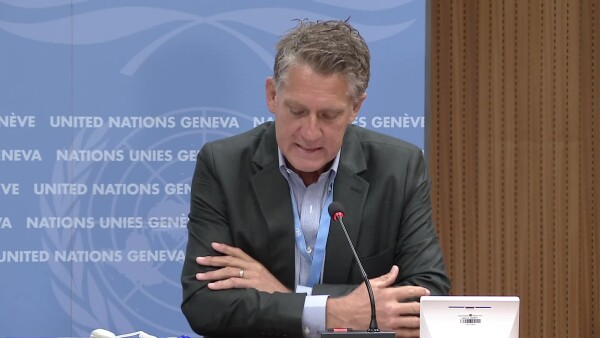
The number is the equivalent of four children every day, UNICEF spokesperson James Elder said. Urging all parties to the conflict to stop the fighting, he added that “ Yemen is the most difficult place in the world to be a child. And, incredulously, it is getting worse.”
Yemen’s humanitarian crisis is “the world’s worst” according to the UNICEF spokesperson who said that it “represents a tragic convergence of four threats: a violent and protracted conflict, economic devastation, social services on the brink of collapse, including health, nutrition, water sanitation, education, protection and a critically underfunded UN system”.
According to UNICEF, over 11 million children, (four in five) are in need of humanitarian assistance in Yemen; 400,000 children suffer from severe acute malnutrition, more than two million children are out of school and two-thirds of teachers, (more than 170,000), have not received a regular salary for more than four years.
Some 1.7 million children are also now internally displaced and 15 million people (more than half of whom are children) do not have access to safe water, sanitation, or hygiene. “At current funding levels and without an end to the fighting, UNICEF simply cannot reach all these children. There's no way to say this simply without international support, more children, those who bear absolutely no responsibility for this conflict will die,” Mr. Elder warned.
UNICEF “urgently needs $235 million to continue its lifesaving work” until mid-2022, Mr. Elder said, while emphasizing that the organization has made a positive impact. It has supported the treatment of severe acute malnutrition in 4,000 primary health care facilities and 130 therapeutic feeding centres; provided emergency cash transfers to 1.5 million households every quarter, which has benefited around nine million people and it has provided safe drinking water to more than five million people. It has also delivered COVID vaccines through the UN-partnered COVAX initiative, provided psychosocial support, mine risk education and direct assistance for the most vulnerable children, and trained and deployed thousands of community health workers. This year alone it has helped 620,000 children access formal and non-formal education and provided vaccines for preventable diseases - including a polio campaign that reached more than five million children.
However, Mr. Elder reiterated the severity of the humanitarian situation in Yemen, where GDP has dropped by 40 per cent since 2015. “Huge numbers of people have lost their jobs, and those who are still working quite frequently go unpaid,” he said. Classrooms with up to 200 children are being taught by unpaid teachers, who are “turning up to those classrooms day after day.” The “bottom line” is that “children in Yemen are not starving because of a lack of food. They are starving because their families cannot afford food. They are starving because adults continue to wage a war in which children are the biggest losers”, he stated. Funding is critical and donor support is clearly in line with lives saved, Mr. Elder said. However, without more funding, UNICEF will have to stop or scale down its emergency assistance.
ENDS
STORY: Deteriorating situation for children in Yemen
TRT: 02:29”
SOURCE: UNTV CH
RESTRICTIONS: NONE
LANGUAGE: ENGLISH
ASPECT RATIO: 16:9
DATELINE: 19 Oct 2021, GENEVA, SWITZERLAND
SHOTLIST
- Exterior wide shot, United Nations flags flying.
- Medium-wide shot, speakers and participants in briefing room.
- SOUNDBITE (English): James Elder, United Nations Children’s Fund (UNICEF) spokesperson: “Today, UNICEF has stated that we have surpassed 10,000 Yemeni children killed or injured. Question must be asked: Do we need to continue to add children to this miserable list, day after day, month after month, year after year. Yemen is the most difficult place in the world to be a child; incredulously, it's getting worse.”
- Medium-wide shot, speakers and participants at briefing.
- SOUNDBITE (English): James Elder, United Nations Children’s Fund (UNICEF) spokesperson: “Yemen's humanitarian crisis, the world's worst, represents the tragic convergence of four main factors; a violent and protracted conflict, economic devastation, social services on the brink of collapse, that's health, nutrition, water sanitation, education, protection and a critically underfunded UN system.”
- Medium shot of the speakers, journalists and screens in briefing room.
- SOUNDBITE (English): James Elder, United Nations Children’s Fund (UNICEF) spokesperson: “Now, at current funding levels and without an end to fighting, UNICEF simply cannot reach all these children. There's no way to say this simply without international support: more children, those who bear absolutely no responsibility for this conflict will die.”
- Close-up of journalist at briefing.
- SOUNDBITE (English): James Elder, United Nations Children’s Fund (UNICEF) spokesperson: “Huge numbers of people have lost their jobs, and those who are still working quite frequently go unpaid. And yet while we've seen thousands of schools either occupied or damaged in this conflict, we still see classrooms of up to 200 children there and teachers are turning up. Yes, those unpaid teachers are turning up to those classrooms day after day.”
- Medium shot of panellists in briefing room.
- SOUNDBITE (English): James Elder, United Nations Children’s Fund (UNICEF) spokesperson: “The bottom line is children in Yemen are starving because adults continue to wage a war in which children are the biggest losers.”
- Close shot of participants in briefing room.
- SOUNDBITE (English): James Elder, United Nations Children’s Fund (UNICEF) spokesperson: “UNICEF urgently needs $235 million to continue its lifesaving work, and that's until the middle of next year. Without that, it will have to stop or scale down some of that emergency assistance I spoke of. Funding, of course, is critical and we can draw a clear line between donor support and lives saved. But even with the increased support, the war must come to an end. We urge all parties to the conflict who have been fighting for too long and for those who have influence over them to stop the fighting.”
- Medium-wide shot of cameramen.
- Medium-wide shot of participant.
- Medium-wide shot of the speakers.
Similar Stories
1
1
1
Edited News | OCHA , UNICEF , WFP
Aid agencies warned on Friday of the fast-developing humanitarian emergency inside Taiz City in Yemen, which has been encircled by de facto Houthi forces fighting government troops along the country’s west coast.

2
17
1
2
Edited News , Press Conferences , Images | OCHA , WMO
Two UN agencies teamed up on Wednesday to issue an appeal for immediate assistance to help communities already being impacted by the strongest El Niño on record.

3
16
2
2
Edited News , B-roll , Conferences , Images | UNITED NATIONS , UNOG
Sixth Consultative Meeting on Enhancing Coordination of Peace Initiatives and Efforts for Sudan

1
1
1
Edited News | UNICEF , WHO , UNHCR
Yemen war continues to force families from homes amid hunger and disease
More than 250,000 people have now fled renewed fighting in Yemen, the UN said on Tuesday, citing particular concern for those sheltering in the southwestern city of Taiz and the wider governorate, where access is “essentially blocked”.

1
1
1
Edited News | UNICEF
A little over one year since a ceasefire agreement was announced between Hamas fighters and Israel, more than 340 children have been reported killed and hundreds more injured, the UN Children’s Fund, UNICEF, said on Friday.

1
1
1
Edited News | UNICEF , IFRC
Six weeks after Nepal’s deadly flooding disaster, communities are still struggling to rebuild their lives, but they will need sustained help as global warming increases the risk of another Himalayan catastrophe, the UN Children’s Fund (UNICEF) said on Friday.

1
1
1
Edited News | WHO
In suspected Russia plague death, testing and monitoring underway – WHO
The death of a lab worker in Russia’s Siberia region has sparked concerns about plague being the cause, the UN World Health Organization (WHO) said on Tuesday, adding that it was following the situation closely.

1
1
Edited News | OHCHR , UNOG
UN Human Rights Chief Volker Türk on Friday provided and oral update to the 63rd session of the Human rights Council on Ukraine.

1
1
1
Edited News | OHCHR , UNOG
UN Human Rights Chief Volker Türk on Friday provided and oral update to the 63rd session of the Human rights Council on the human rights situation in Haiti.

1
1
1
Edited News | WHO
Repeated delays in bringing lifesaving medicines, prosthetics and more from Israel into Gaza risk having devastating consequences on Palestinians who urgently need them in the wartorn enclave, the UN World Health Organization (WHO) said on Friday. “A truck full of non-priority supplies or the right supplies arriving too late, doesn't save lives. That's the question that actually matters," said Dr Reinhilde Van De Weerdt, WHO Representative in the OPT.

1
1
1
Edited News | WHO
DRC: Early access to care and oxygen decisive for Ebola patients’ survival – WHO
In the Democratic Republic of the Congo (DRC), health workers fighting the country’s largest-ever Ebola outbreak are struggling to overcome critical challenges to patient care, the UN World Health Organization (WHO) warned on Tuesday.

1
1
1
Edited News | OCHA , UN
Civilians in Iran are continuing to feel the consequences of months of conflict and military escalation, the UN’s top official in the country has said, as loss of life, damage to civilian infrastructure and mounting economic pressures leave many facing continued uncertainty.