

The United Nations Office at Geneva
Multimedia Newsroom
Edited News | OHCHR , UNOG
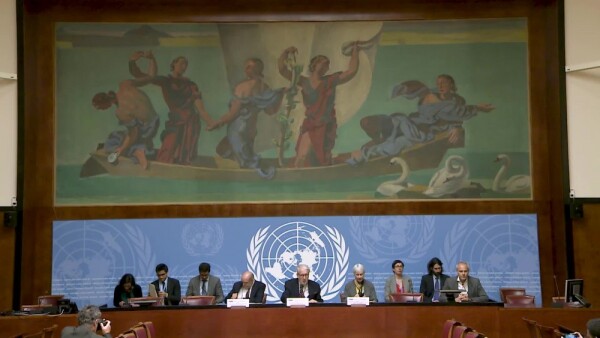
Human Rights Council Press conference: Commission of Inquiry launches report on children in Syria
Children in Syria have been “robbed of their childhood” and forced to “endure numerous violations” in more than eights years of conflict, according to the latest report by the independent body set up by the UN’s Human Rights Council to investigate violations during the civil war in Syria.
“Children have been denied the protection they are entitled to under international law, and victimized on multiple levels” said Paulo Pinheiro, Chairperson of the Independent Commission of Inquiry on the Syrian Arab Republic, on behalf of the three-member group. “Countless girls and boys have been killed and maimed in attacks carried out by all parties to the conflict,” he added.
The 25-page report, released today in Geneva, is entitled “They have erased the dreams of my children: children's rights in the Syrian Arab Republic”, and notes that attacks on civilian infrastructure have had an acute impact on physical health, in particular for those children who suffer from disabilities because of the war.
“Boys as young as six have been recruited to participate in hostilities by warring parties,” Mr. Pinheiro noted as he read one shocking part of the report, “while rape and sexual violence have been used against girls to punish, humiliate and instill fear. In detention, children have been used to extract confession from their parents, subjected to torture and ill-treatment, while consistently denied from accessing food, water and medical care.”
The report says that children’s right to education in Syria has been denied by all parties to the conflict as warring parties have looted and vandalized educational establishments and used schools for military purposes.
The conflict has left an enormous trauma on the physical and mental well-being of an entire generation of Syrian girls and boys but also destroyed the social, economic and cultural fabric required for Syrian communities to start healing, the report states. “Children are dying - many lack civil documentation and in the case of other camps for displaced civilians, are effectively stateless, with the majority of them having missed school for a number of years,” Pinheiro noted.
“Young children being made to hang other young children, to execute them in that way” said Karen Abuzayd, a member of the Commission, while calling attention to the difficulty of pursuing such crimes or tackling the issue of impunity. “Are the children responsible for war crimes? How are we going to handle this?”, she asked.
More than five million children have been displaced by the conflict in Syria, and have become increasingly vulnerable to violations as a result. These children are living in situations of protracted displacement, often with severed family ties, and are worryingly “being displaced again as the fighting has escalated,” according to Hanny Megally, also a member of the Commission.
The number of displaced children “has gone up to about 700,000 over the last ten days or so, which shows the level of escalation in the violence and there is a real concern that preventable deaths are going to be continuing to happen,” Megally said.
Among the recommendations to the Government of Syria and other key actors, the Commission urges respect for the special protection children are entitled to under international humanitarian and human rights law, and to ensure accountability for violations that have occurred. The Commission also makes a series of recommendations aimed at increasing the support for children who have suffered abuses.
- Wide shot: exterior, flag alley, Palais des Nations, United Nations Geneva.
- Medium shot: podium
- Wide shot, press briefing room
- SOUNDBITE (EN) Paulo Pinheiro, Chairperson, Independent Commission of Inquiry on the Syrian Arab Republic: “The report covers multiple violations in the period from September 2011 to October 2019. Since the beginning of the Syrian conflict, children have been denied the protection they are entitled to under international law, and victimized on multiple levels. Countless girls and boys have been killed and maimed in attacks carried out by all parties to the conflict.”
- Medium shot: podium
- Paulo Pinheiro, Chairperson, Independent Commission of Inquiry on the Syrian Arab Republic: “Boys as young as six have been recruited to participate in hostilities by warring parties, while rape and sexual violence have been used against girls to punish, humiliate and instil fear. In detention, children have been used to extract confession from their parents, subjected to torture and ill-treatment, while consistently denied from accessing food, water and medical care.”
- Wide shot, press briefing room, journalists
- SOUNDBITE (EN) Paulo Pinheiro, Chairperson, Independent Commission of Inquiry on the Syrian Arab Republic: “Children are dying- many lack civil documentation and in the case of other camps for displaced civilians, are effectively stateless, with the majority of them having missed school for a number of years.”
- Close-up: journalist
- SOUNDBITE (EN) Karen Abuzayd, Member of the Independent Commission of Inquiry on the Syrian Arab Republic: “Sometimes there are reports even of young children being made to hang other young children to execute them in that way. So again are the children responsible for war crimes? How are we going to handle this?”
- Close-up: camera
- SOUNDBITE (EN) Hanny Megally, Member of the Independent Commission of Inquiry on the Syrian Arab Republic: “Children have been displaced as have their families several times to get to Idlib and now they are being displaced again as the fighting has escalated. I think the number overall has gone up to about 700,000 over the last ten days or so which shows the level of escalation in the violence and there is a real concern that preventable deaths are going to be continuing to happen.”
- Wide shot: press room
- Medium shot: podium
- Medium shot: journalists, cameras
Similar Stories

2
17
1
2
Edited News , Press Conferences | OCHA , WMO
Two UN agencies teamed up on Wednesday to issue an appeal for immediate assistance to help communities already being impacted by the strongest El Niño on record.

3
16
2
2
B-roll , Conferences , Edited News | UNITED NATIONS , UNOG
Sixth Consultative Meeting on Enhancing Coordination of Peace Initiatives and Efforts for Sudan

1
1
1
Edited News | UNICEF , WHO , UNHCR
Yemen war continues to force families from homes amid hunger and disease
More than 250,000 people have now fled renewed fighting in Yemen, the UN said on Tuesday, citing particular concern for those sheltering in the southwestern city of Taiz and the wider governorate, where access is “essentially blocked”.

1
1
1
Edited News | UNICEF
A little over one year since a ceasefire agreement was announced between Hamas fighters and Israel, more than 340 children have been reported killed and hundreds more injured, the UN Children’s Fund, UNICEF, said on Friday.

1
1
1
Edited News | UNICEF , IFRC
Six weeks after Nepal’s deadly flooding disaster, communities are still struggling to rebuild their lives, but they will need sustained help as global warming increases the risk of another Himalayan catastrophe, the UN Children’s Fund (UNICEF) said on Friday.

1
1
1
Edited News | WHO
In suspected Russia plague death, testing and monitoring underway – WHO
The death of a lab worker in Russia’s Siberia region has sparked concerns about plague being the cause, the UN World Health Organization (WHO) said on Tuesday, adding that it was following the situation closely.

1
1
Edited News | OHCHR , UNOG
UN Human Rights Chief Volker Türk on Friday provided and oral update to the 63rd session of the Human rights Council on Ukraine.

1
1
1
Edited News | OHCHR , UNOG
UN Human Rights Chief Volker Türk on Friday provided and oral update to the 63rd session of the Human rights Council on the human rights situation in Haiti.

1
1
1
Edited News | WHO
Repeated delays in bringing lifesaving medicines, prosthetics and more from Israel into Gaza risk having devastating consequences on Palestinians who urgently need them in the wartorn enclave, the UN World Health Organization (WHO) said on Friday. “A truck full of non-priority supplies or the right supplies arriving too late, doesn't save lives. That's the question that actually matters," said Dr Reinhilde Van De Weerdt, WHO Representative in the OPT.

1
1
1
Edited News | WHO
DRC: Early access to care and oxygen decisive for Ebola patients’ survival – WHO
In the Democratic Republic of the Congo (DRC), health workers fighting the country’s largest-ever Ebola outbreak are struggling to overcome critical challenges to patient care, the UN World Health Organization (WHO) warned on Tuesday.

1
1
1
Edited News | OCHA , UN
Civilians in Iran are continuing to feel the consequences of months of conflict and military escalation, the UN’s top official in the country has said, as loss of life, damage to civilian infrastructure and mounting economic pressures leave many facing continued uncertainty.
1
1
1
Edited News | WHO , UNICEF
Aid agencies in Yemen highlighted the growing hunger emergency sparked by renewed fighting between Houthi opposition forces and Government troops, after mobile health clinics reported that hundreds of children displaced by the violence are suffering from the most deadly form of malnutrition.