

The United Nations Office at Geneva
Multimedia Newsroom
Calling for the release “arbitrarily detained” people in Myanmar, including civilian government leader Aung San Suu Kyi, the UN’s top human rights body convened a special session in Geneva today to discuss the military coup of 1 February.
In her opening remarks to the Human Rights Council, the UN’s Deputy High Commissioner for Human Rights Nada Al-Nashif warned that “the world is watching”
Myanmar’s military junta.
“Draconian orders have been issued this week to prevent peaceful assembly and free expression, and police and military presence on the streets has grown progressively over the last several days. Following violent clashes with police on 9 February, at least one woman is in critical condition. Pro-military and nationalist groups have also taken to the streets,” Ms. Al-Nashif said.
A draft resolution presented by the United Kingdom and the European Union, calls for the “immediate and unconditional release” of Ms. Suu Kyi and other senior officials in her government, a lifting of restrictions on the internet and unimpeded humanitarian access, among other things.
“Let us be clear: the indiscriminate use of lethal or less-than-lethal weapons against peaceful protestors is unacceptable. More violence against Myanmar’s people will only compound the illegitimacy of the coup, and the culpability of its leaders”, said the Deputy High Commissioner.
General Min Aung Hlaing’s coup on February 1 ousted the civilian government of Nobel laureate Aung Sang Suu Kyi following a general election in November which her National League for Democracy (NLD) party won by a landslide.
The armed forces had backed the opposition, who were demanding a rerun of the vote, claiming “widespread fraud.” The election commission said there was no evidence to support these claims.
“This crisis was born of impunity”, said the Deputy High Commissioner for Human Rights.
“Long-standing lack of civilian control over the military, its disproportionate influence in the country’s political and economic structures, and ongoing failure to genuinely account for crimes committed by the security forces over decades, have combined to compromise Myanmar’s democratization and indeed its development,” Ms. Al-Nashif added.
The UN official urged “the strongest possible call for the military authorities to respect the result of the election, to return power to civilian control and immediately release all individuals arbitrarily detained”.
The draft resolution sponsored by the UK and the EU also calls to give the independent expert on Myanmar, Special Rapporteur Tom Andrews, access to the country.
Mr. Andrews addressed the Human Rights Council by video conference, saying that “the very act of convening this session makes an important statement of the gravity with which this Council views the coup d’état of a duly elected government and the events that have followed”.
On the accusations of election fraud, he said that “even if election irregularities did exist, there was, and is, no justification for declaring a state of emergency, arresting the civilian leadership, and attempting to destroy Myanmar’s fledgling democracy”.
He added that “the coup is truly illegal in every sense of the word” and that “the international community must refuse to recognize this illegal regime”.
The draft resolution emphasizes that the Myanmar military and other security forces and authorities should respect the right to peaceful assembly and refrain from using any unnecessary or excessive force against the public.
“There are growing reports and photographic evidence that Myanmar security forces have used live ammunition–– lethal force––against protesters”, the Special Rapporteur on Myanmar told the Council. “This violates international law. Arbitrary detentions and intimidation are also on the rise. Not only are political leader targets, but community and civil society leaders as well”.
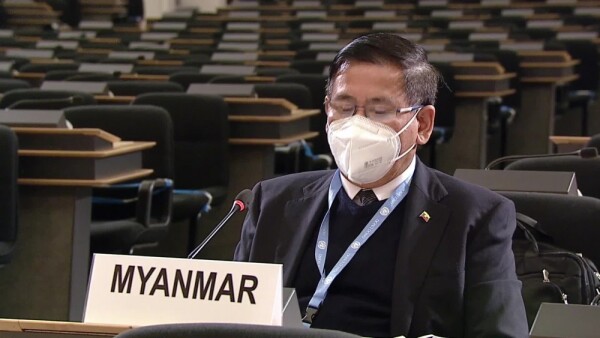
Myanmar’s Ambassador Myint Thu responded by underscoring his country’s commitment to democratic values, and justifying the military’s intervention as necessary.
“In light of the post-election irregularities and the following complex situation, Tatmadaw was compelled to take the State responsibilities in accordance with the State constitution. With the ordinance No. 1/2021 on 1 February 2021, the state of emergency was declared for one year and the legislative, executive and judicial powers of the State were transferred by Acting President to the Commander in Chief of the Defense Forces,” he said, adding that “the State Administrative Council was formed on 2nd February 2021, with 16 members”.
The 47 members of the UN Human Rights Council will vote on the draft resolution in the afternoon, Central European Time.
- Exterior wide shot, pan Ariana Park with Palais des Nations
- Wide shot, Assembly Hall at the UN Geneva
- SOUNDBITE (English) — Nada Al-Nashif, Deputy High Commissioner for Human Rights: “The world is watching. Draconian orders have been issued this week to prevent peaceful assembly and free expression, and police and military presence on the streets has grown progressively over the last several days. Following violent clashes with police on 9 February, at least one woman is in critical condition. Pro-military and nationalist groups have also taken to the streets”.
- Medium shot, podium with speakers at Assembly Hall
- SOUNDBITE (English) - Nada Al-Nashif, Deputy High Commissioner for Human Rights: “Let us be clear: the indiscriminate use of lethal or less-than-lethal weapons against peaceful protestors is unacceptable. More violence against Myanmar’s people will only compound the illegitimacy of the coup, and the culpability of its leaders”.
- Wide shot, Assembly Hall
- SOUNDBITE (English) - Nada Al-Nashif, Deputy High Commissioner for Human Rights: “This crisis was born of impunity. Long-standing lack of civilian control over the military, its disproportionate influence in the country’s political and economic structures, and ongoing failure to genuinely account for crimes committed by the security forces over decades, have combined to compromise Myanmar’s democratization and indeed its development”.
- Wide shot, Assembly Hall with video message
- SOUNDBITE (English) - Nada Al-Nashif, Deputy High Commissioner for Human Rights: “We recommend the strongest possible call for the military authorities to respect the result of the election, to return power to civilian control and immediately release all individuals arbitrarily detained”.
- Medium shot, podium with speakers at Assembly Hall
- SOUNDBITE (English) - Thomas Andrews, Special Rapporteur on the human rights situation in Myanmar: “The very act of convening this session makes an important statement of the gravity with which this Council views the coup d’état of a duly elected government and the events that have followed”.
- Wide shot, Assembly Hall with video message
- SOUNDBITE (English) - Thomas Andrews, Special Rapporteur on the human rights situation in Myanmar: “Even if election irregularities did exist, there was, and is no justification for declaring a state of emergency, arresting the civilian leadership, and attempting to destroy Myanmar’s fledgling democracy”.
- Wide shot, Assembly Hall
- SOUNDBITE (English) - Thomas Andrews, Special Rapporteur on the human rights situation in Myanmar: “The coup is truly illegal in every sense of the word. The international community must refuse to recognize this illegal regime”.
- Wide shot, Assembly Hall
- SOUNDBITE (English) - Thomas Andrews, Special Rapporteur on the human rights situation in Myanmar: “There are growing reports and photographic evidence that Myanmar security forces have used live ammunition–– lethal force––against protesters. This violates international law. Arbitrary detentions and intimidation are also on the rise. Not only are political leader targets, but community and civil society leaders as well”.
- Wide shot, Assembly Hall with video message
- SOUNDBITE (English) - Ambassador Myint Thu, Permanent Representative of Myanmar to the UN Office at Geneva (UNOG): “In light of the post-election irregularities and the following complex situation, Tatmadaw was compelled to take the State responsibilities in accordance with the State constitution. With the ordinance No. 1/2021 on 1 February 2021, the state of emergency was declared for one year and the legislative, executive and judicial powers of the State were transferred by acting president to the Commander in Chief of the Defense Forces. The State Administrative Council was formed on 2nd February 2021, with 16 members”.
- Medium shot, podium with speakers at Assembly Hall
Similar Stories
1
1
1
Edited News | OCHA , UNICEF , WFP
Aid agencies warned on Friday of the fast-developing humanitarian emergency inside Taiz City in Yemen, which has been encircled by de facto Houthi forces fighting government troops along the country’s west coast.

2
17
1
2
Edited News , Press Conferences , Images | OCHA , WMO
Two UN agencies teamed up on Wednesday to issue an appeal for immediate assistance to help communities already being impacted by the strongest El Niño on record.

3
16
2
2
Edited News , B-roll , Conferences , Images | UNITED NATIONS , UNOG
Sixth Consultative Meeting on Enhancing Coordination of Peace Initiatives and Efforts for Sudan

1
1
1
Edited News | UNICEF , WHO , UNHCR
Yemen war continues to force families from homes amid hunger and disease
More than 250,000 people have now fled renewed fighting in Yemen, the UN said on Tuesday, citing particular concern for those sheltering in the southwestern city of Taiz and the wider governorate, where access is “essentially blocked”.

1
1
1
Edited News | UNICEF
A little over one year since a ceasefire agreement was announced between Hamas fighters and Israel, more than 340 children have been reported killed and hundreds more injured, the UN Children’s Fund, UNICEF, said on Friday.

1
1
1
Edited News | UNICEF , IFRC
Six weeks after Nepal’s deadly flooding disaster, communities are still struggling to rebuild their lives, but they will need sustained help as global warming increases the risk of another Himalayan catastrophe, the UN Children’s Fund (UNICEF) said on Friday.

1
1
1
Edited News | WHO
In suspected Russia plague death, testing and monitoring underway – WHO
The death of a lab worker in Russia’s Siberia region has sparked concerns about plague being the cause, the UN World Health Organization (WHO) said on Tuesday, adding that it was following the situation closely.

1
1
Edited News | OHCHR , UNOG
UN Human Rights Chief Volker Türk on Friday provided and oral update to the 63rd session of the Human rights Council on Ukraine.

1
1
1
Edited News | OHCHR , UNOG
UN Human Rights Chief Volker Türk on Friday provided and oral update to the 63rd session of the Human rights Council on the human rights situation in Haiti.

1
1
1
Edited News | WHO
Repeated delays in bringing lifesaving medicines, prosthetics and more from Israel into Gaza risk having devastating consequences on Palestinians who urgently need them in the wartorn enclave, the UN World Health Organization (WHO) said on Friday. “A truck full of non-priority supplies or the right supplies arriving too late, doesn't save lives. That's the question that actually matters," said Dr Reinhilde Van De Weerdt, WHO Representative in the OPT.

1
1
1
Edited News | WHO
DRC: Early access to care and oxygen decisive for Ebola patients’ survival – WHO
In the Democratic Republic of the Congo (DRC), health workers fighting the country’s largest-ever Ebola outbreak are struggling to overcome critical challenges to patient care, the UN World Health Organization (WHO) warned on Tuesday.

1
1
1
Edited News | OCHA , UN
Civilians in Iran are continuing to feel the consequences of months of conflict and military escalation, the UN’s top official in the country has said, as loss of life, damage to civilian infrastructure and mounting economic pressures leave many facing continued uncertainty.