

The United Nations Office at Geneva
Multimedia Newsroom
Syria constitutional talks reconvene after COVID-19 suspension
UN-facilitated talks to discuss a schedule and process for drafting a new constitution for war-torn Syria reconvened at UN Geneva on Thursday after being suspended three days earlier when four participants tested positive for COVID-19.
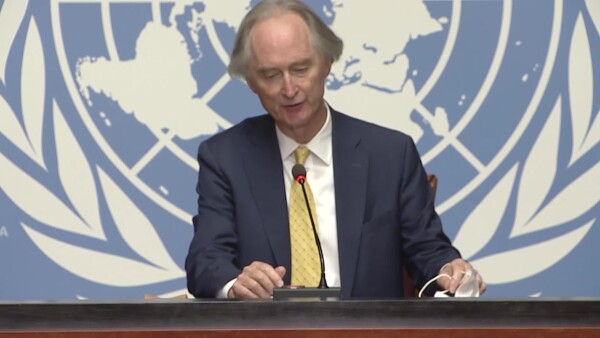
Speaking to journalists, UN Special Envoy for Syria, Geir Pedersen, stressed the desire among participants to continue with the work of the Third Session of the Syrian Constitutional Committee, after a nine-month break.
He envisaged this happening into Saturday “with all necessary precautionary strict measures strictly observed”.
The UN negotiator also explained that those individuals who had tested positive for the new coronavirus would not be taking part in proceedings “out of an abundance of caution”, even though secondary testing had shown that they no longer posed any risk.
“We have a clear agenda for this session and the Small Body had a constructive first meeting on the agenda when they met on Monday,” Mr. Pedersen said, highlighting that these had resulted in “useful points” being raised and some good “interactions”.
“Key international players” following the Syrian-led and Syrian-owned process had also expressed their keen interest in the discussions resuming, Mr. Pedersen continued.
In an earlier Press conference ahead of the latest discussions, he noted his intention to meet representatives from Russia, Iran and Turkey and the United States in Geneva, while stressing the “completely independent” work of the Constitutional Committee.
The convening on Monday of the Small Group of the Syrian Constitutional Committee brings together 15 representatives from Syria’s Government, 15 from the Syrian Negotiations Commission (SNC) and 15 more civil society participants, known as the “middle third”.
A larger group of 150 delegates is also part of the process, but only the smaller group is meeting in Geneva.
Both bodies are meeting on the basis of an agreement between the Government of Syria and the opposition to implement a key part of Security Council resolution 2254 (from 2015), which called for setting a schedule and process for drafting a new constitution.
The latest round of discussions represents the first time that delegates have met after a hiatus of nine months, caused by differences over the agenda which were resolved by March – and then by COVID restrictions.
- Wide shot: exterior, flag alley, Palais des Nations, United Nations Geneva.
- Medium-wide shot, showing a seated and masked UN Special Envoy for Syria, Geir Pedersen, sitting at the podium in Press Room III, UN Geneva, with spokesperson Jenifer Fenton seated apart from him. Photographers take pictures of the Special Envoy.
- SOUNDBITE (EN) - UN Special Envoy for Syria, Geir Pedersen: “Thank you so much Jenifer and thanks to all of you for your understanding. Obviously, the safety for all of us here in the Palais has been our major concern and our top priority. That is why we took no chances and immediately suspended the meeting on the Constitutional Committee of the Small Body on Monday. I’m extremely grateful for the professionalism of the medical advice and the support that we are receiving from the Swiss authorities and from the United Nations Office in Geneva and its medical services. In light of that advice, we are resuming, today, the Third Session of the Constitutional Committee Small Body, with all necessary precautionary strict measures strictly observed, as they were observed in the initial meeting. And thank you for your support, from your side, in observing those strict measures as well. I should add that, while the secondary testing done in recent days indicates that the earlier positive cases do not pose any risk, we are at this stage proceeding here in the Palais des Nations only with those who have tested negative. This is out of an abundance of caution and based on the advice of the United Nations medical authorities. I thank the two co-chairs and indeed the Constitutional Committee Small Body members for their cooperation during this temporary, but necessary, delay, while we addressed the immediate health issues. I equally appreciate their strong desire to resume the work of the Constitutional Committee and I think that is a signal of the importance of this process. I have also received a strong signal of support from key international players for the United Nations’ facilitation of this Syrian-led and Syrian-owned process, and this is indeed very much appreciated. We have a clear agenda for this session and the Small Body had a constructive first meeting on the agenda when they met on Monday. There were some useful points raised and some good interactions. I believe all members are keen to resume the work and have substantive discussions during the remainder of this session. And so, with full safety precautions in place, after extensive medical advice, we are getting back to work now, today, actually in five minutes. And after consultations with the two co-chairs just now, I believe we most probably will be doing sessions today, tomorrow and on Saturday. I hope to get back to you soon when these things are finalised. But as I said, thank you for your cooperation and I hope to talk to you soon.”
- Medium shot: journalist wearing facemask, seated, works on laptop, Press Room III, UN Geneva.
- Medium shot: journalist wearing facemask, seated, works on laptop, Press Room III, UN Geneva.
- Medium shot: journalist with facemask pulled down, seated, works on laptop, Press Room III, UN Geneva.
- Medium shot: journalist with facemask hanging from one ear, seated, works on laptop, Press Room III, UN Geneva.
- Medium-wide shot: journalists wearing facemasks, seated apart from each other, working on laptops, Press Room III, UN Geneva.
Similar Stories

1
1
1
Edited News | OCHA , UNICEF , WFP
Aid agencies warned on Friday of the fast-developing humanitarian emergency inside Taiz City in Yemen, which has been encircled by de facto Houthi forces fighting government troops along the country’s west coast.

2
17
1
2
Edited News , Press Conferences , Images | OCHA , WMO
Two UN agencies teamed up on Wednesday to issue an appeal for immediate assistance to help communities already being impacted by the strongest El Niño on record.

3
16
2
2
Edited News , B-roll , Conferences , Images | UNITED NATIONS , UNOG
Sixth Consultative Meeting on Enhancing Coordination of Peace Initiatives and Efforts for Sudan

1
1
1
Edited News | UNICEF , WHO , UNHCR
Yemen war continues to force families from homes amid hunger and disease
More than 250,000 people have now fled renewed fighting in Yemen, the UN said on Tuesday, citing particular concern for those sheltering in the southwestern city of Taiz and the wider governorate, where access is “essentially blocked”.

1
1
1
Edited News | UNICEF
A little over one year since a ceasefire agreement was announced between Hamas fighters and Israel, more than 340 children have been reported killed and hundreds more injured, the UN Children’s Fund, UNICEF, said on Friday.

1
1
1
Edited News | UNICEF , IFRC
Six weeks after Nepal’s deadly flooding disaster, communities are still struggling to rebuild their lives, but they will need sustained help as global warming increases the risk of another Himalayan catastrophe, the UN Children’s Fund (UNICEF) said on Friday.

1
1
1
Edited News | WHO
In suspected Russia plague death, testing and monitoring underway – WHO
The death of a lab worker in Russia’s Siberia region has sparked concerns about plague being the cause, the UN World Health Organization (WHO) said on Tuesday, adding that it was following the situation closely.

1
1
Edited News | OHCHR , UNOG
UN Human Rights Chief Volker Türk on Friday provided and oral update to the 63rd session of the Human rights Council on Ukraine.

1
1
1
Edited News | OHCHR , UNOG
UN Human Rights Chief Volker Türk on Friday provided and oral update to the 63rd session of the Human rights Council on the human rights situation in Haiti.

1
1
1
Edited News | WHO
Repeated delays in bringing lifesaving medicines, prosthetics and more from Israel into Gaza risk having devastating consequences on Palestinians who urgently need them in the wartorn enclave, the UN World Health Organization (WHO) said on Friday. “A truck full of non-priority supplies or the right supplies arriving too late, doesn't save lives. That's the question that actually matters," said Dr Reinhilde Van De Weerdt, WHO Representative in the OPT.

1
1
1
Edited News | WHO
DRC: Early access to care and oxygen decisive for Ebola patients’ survival – WHO
In the Democratic Republic of the Congo (DRC), health workers fighting the country’s largest-ever Ebola outbreak are struggling to overcome critical challenges to patient care, the UN World Health Organization (WHO) warned on Tuesday.

1
1
1
Edited News | OCHA , UN
Civilians in Iran are continuing to feel the consequences of months of conflict and military escalation, the UN’s top official in the country has said, as loss of life, damage to civilian infrastructure and mounting economic pressures leave many facing continued uncertainty.