

The United Nations Office at Geneva
Multimedia Newsroom
Gaza: UN agencies call for aid ‘surge’ as Israeli distribution plan begins
Reports indicated on Tuesday that Israel’s controversial aid distribution plan had begun in Gaza as the United Nations called once again on the Israeli authorities to allow an “immediate surge” in the amount of supplies reaching the enclave to prevent starvation.
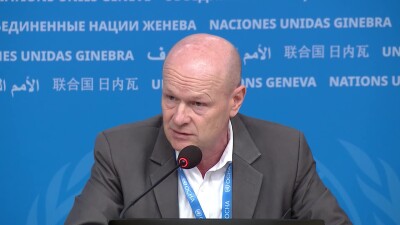
After nearly three months of complete blockade by Israel, a “vastly insufficient” amount of aid was finally allowed into the war-ravaged enclave in the last week, insisted Jens Laerke, spokesperson for the UN aid coordination office, OCHA.
“We have not stopped operating,” he said, referring to staff still inside Gaza, who are tasked with liaising with the Israeli authorities to retrieve supplies allowed into Gaza from Israel, via the Kerem Shalom crossing.
Mr. Laerke insisted that the UN is not participating in the Israeli aid plan: “It is a distraction from what is actually needed, which is a reopening of all the crossings into Gaza, a secure environment within Gaza and faster facilitation of permissions and final approvals of all the emergency supplies that we have just outside the border; [aid] needs to get in.”
The veteran humanitarian stressed the ongoing dangers and obstacles that have prevented aid teams from picking up and dispatching lifesaving supplies.
“We are not always able to collect what is being dropped off on the other side because of the insecure routes that are being assigned to us by the Israeli authorities to use.”
All types of aid must be allowed through and not “cherry-picked”, Mr. Laerke stressed: “The bottom line again is that we are talking about a vastly insufficient amount of aid that eventually enters Gaza at the moment. That’s why we need [the] opening of more crossings, we need all types of aid - not that aid that is cherry-picked by the Israeli side that we are allowed to get in.”
The UN agency for Palestinian refugees, UNRWA, meanwhile, explained that “no supplies whatsoever” prepared by the agency have reached Gaza since the Israeli siege began on 2 March.
This is despite UNRWA having readied more than 3,000 trucks carrying food and medicines in Jordan and Egypt which will perish soon.
“We have clinics, we have pharmacies that the agency runs and there we normally would distribute medicines against chronic diseases…but also basic medicines, things like paracetamol and then childhood diseases and these are the medicines that we're running out of,” said Juliette Touma, UNRWA Director of Communications.
The development comes as UNRWA Commissioner-General Philippe Lazzarini urged the Israeli Government to provide proof to back up repeated damaging allegations of "systemic infiltration by Hamas”.
Investigations carried out internally by the UN last year found sufficient evidence that nine active UNRWA staff out of the many thousands it employs had been involved in the Hamas-led terror attacks in Israel that sparked the war in October 2023.
A separate independent probe commissioned by the UN Secretary-General found that the agency’s rules, mechanisms and procedures were the most “elaborate” within the UN, reflecting the complex and sensitive demands associated with working in the Occupied Palestinian Territories.
“It’s been over 20 months of these claims coming our way, harming the agency's reputation of course, but more importantly, putting the lives of our staff, especially those working in the Occupied Palestinian Territory, at risk,” said Ms. Touma.
Despite numerous requests by UNRWA to the Israeli Government for evidence to substantiate “numerous accusations”, no evidence has been shared to back up the claims against the agency and its personnel, Ms. Touma continued.
ends
STORY: Gaza humanitarian update – OCHA, UNRWA
TRT: 3’53”
SOURCE: UNTV CH
RESTRICTIONS: NONE
LANGUAGE: ENGLISH / NATS
ASPECT RATIO: 16:9
DATELINE: 27 May 2025 GENEVA, SWITZERLAND
Speakers:
- Jens Laerke, spokesperson, OCHA
- Juliette Touma, Director of Communications, UNRWA
SHOTLIST
- Exterior medium-wide: Palais des Nations, Flag Alley
- Wide shot of Press room and podium speakers.
- SOUNDBITE (English) – Jens Laerke, spokesperson, OCHA: “Of course, we have not stopped operating, we have staff, but as you know very well, we're running on almost 12 weeks - I believe - of blockade with an opening where there is allowed a vastly insufficient amount of aid into the Gaza Strip.”
- Medium, journalists.
- SOUNDBITE (English) – Jens Laerke, spokesperson, OCHA: “As we have explained many times, we do not participate in this modality for the reasons that we have given. It is a distraction from what is actually needed, which is a reopening of all the crossings into Gaza, a secure environment within Gaza and faster facilitation of permissions and final approvals of all the emergency supplies that we have just outside the border; it needs to get in.”
- Wide, podium speakers, journalists.
- SOUNDBITE (English) – Jens Laerke, spokesperson, OCHA: “We are not always able to collect what is being dropped off on the other side because of the insecure routes that are being assigned to us by the Israeli authority – authorities - to use.”
- Medium, podium speakers, TV screen showing remote speaker.
- SOUNDBITE (English) – Jens Laerke, spokesperson, OCHA: “The bottom line again is that we are talking about a vastly insufficient amount of aid that eventually enters Gaza at the moment. That’s why we need [the] opening of more crossings, we need all types of aid - not that aid that is cherry-picked by the Israeli side that we are allowed to get in.”
- Wide, journalists.
- SOUNDBITE (English) – Juliette Touma, Director of Communications, UNRWA: “It’s been over 20 months of these claims coming our way, harming the agency's reputation of course, but more importantly, putting the lives of our staff, especially those working in the Occupied Palestinian Territory, at risk.”
- Wide, journalists, TV screens showing Juliette Touma.
- SOUNDBITE (English) – Juliette Touma, Director of Communications, UNRWA: “The Agency has requested on several occasions for cooperation from the Government of Israel by providing information and evidence to substantiate the numerous accusations made against UNRWA. To date, UNRWA has not received any response, nor has the Government of Israel shared any sufficient evidence to back up these very serious claims against the agency and its personnel.”
- Medium-wide, podium speakers, TV screens showing Juliette Touma.
- SOUNDBITE (English) – Juliette Touma, Director of Communications, UNRWA: “When it comes to UNRWA, I can confirm that no supplies whatsoever have gone in since the siege began - Israeli-imposed siege began - on 2 March.”
- Medium-wide, TV screens showing Juliette Touma, journalists and control booths with UN logo reflected in window.
- SOUNDBITE (English) – Juliette Touma, Director of Communications, UNRWA: “We have over 3,000 trucks, in fact, not only a food but also of medicines that are lining up in places like Jordan, like Egypt, that are waiting for the green light to go in and they're carrying medicines and that is expiring soon.”
- Medium, journalists.
- Medium, journalists.
- Medium, journalists.
Similar Stories

1
1
1
Edited News | OCHA , UNICEF , WFP
Aid agencies warned on Friday of the fast-developing humanitarian emergency inside Taiz City in Yemen, which has been encircled by de facto Houthi forces fighting government troops along the country’s west coast.

2
17
1
2
Edited News , Press Conferences , Images | OCHA , WMO
Two UN agencies teamed up on Wednesday to issue an appeal for immediate assistance to help communities already being impacted by the strongest El Niño on record.

3
16
2
2
Edited News , B-roll , Conferences , Images | UNITED NATIONS , UNOG
Sixth Consultative Meeting on Enhancing Coordination of Peace Initiatives and Efforts for Sudan

1
1
1
Edited News | UNICEF , WHO , UNHCR
Yemen war continues to force families from homes amid hunger and disease
More than 250,000 people have now fled renewed fighting in Yemen, the UN said on Tuesday, citing particular concern for those sheltering in the southwestern city of Taiz and the wider governorate, where access is “essentially blocked”.

1
1
1
Edited News | UNICEF
A little over one year since a ceasefire agreement was announced between Hamas fighters and Israel, more than 340 children have been reported killed and hundreds more injured, the UN Children’s Fund, UNICEF, said on Friday.

1
1
1
Edited News | UNICEF , IFRC
Six weeks after Nepal’s deadly flooding disaster, communities are still struggling to rebuild their lives, but they will need sustained help as global warming increases the risk of another Himalayan catastrophe, the UN Children’s Fund (UNICEF) said on Friday.

1
1
1
Edited News | WHO
In suspected Russia plague death, testing and monitoring underway – WHO
The death of a lab worker in Russia’s Siberia region has sparked concerns about plague being the cause, the UN World Health Organization (WHO) said on Tuesday, adding that it was following the situation closely.

1
1
Edited News | OHCHR , UNOG
UN Human Rights Chief Volker Türk on Friday provided and oral update to the 63rd session of the Human rights Council on Ukraine.

1
1
1
Edited News | OHCHR , UNOG
UN Human Rights Chief Volker Türk on Friday provided and oral update to the 63rd session of the Human rights Council on the human rights situation in Haiti.

1
1
1
Edited News | WHO
Repeated delays in bringing lifesaving medicines, prosthetics and more from Israel into Gaza risk having devastating consequences on Palestinians who urgently need them in the wartorn enclave, the UN World Health Organization (WHO) said on Friday. “A truck full of non-priority supplies or the right supplies arriving too late, doesn't save lives. That's the question that actually matters," said Dr Reinhilde Van De Weerdt, WHO Representative in the OPT.

1
1
1
Edited News | WHO
DRC: Early access to care and oxygen decisive for Ebola patients’ survival – WHO
In the Democratic Republic of the Congo (DRC), health workers fighting the country’s largest-ever Ebola outbreak are struggling to overcome critical challenges to patient care, the UN World Health Organization (WHO) warned on Tuesday.

1
1
1
Edited News | OCHA , UN
Civilians in Iran are continuing to feel the consequences of months of conflict and military escalation, the UN’s top official in the country has said, as loss of life, damage to civilian infrastructure and mounting economic pressures leave many facing continued uncertainty.