

The United Nations Office at Geneva
Multimedia Newsroom
Gazans ‘in terror’ after another night of deadly strikes and siege
Amid reports that Israeli strikes across Gaza into Friday killed at least 64 people, aid teams once again pushed back strongly at allegations that aid is being diverted to Hamas and pleaded for the blockade to end.
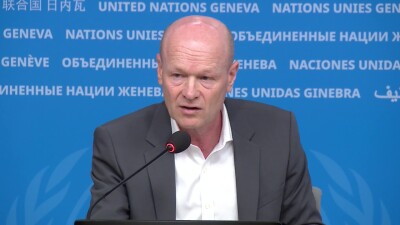
Updating journalists in Geneva, World Health Organization (WHO) spokesperson Dr. Margaret Harris described another night of terror in the war-torn enclave.
She said that some of those injured in the attacks had sought help from the Indonesian hospital in northern Gaza, even though it was now “just a shell” after 19 months of war.
“We've done our best to bring it back together and they are doing their best to treat everyone, but [medical teams] lack everything needed,” she insisted.
Rejecting accusations that relief supplies have been handed over to Hamas, the WHO spokesperson said that “in the health sector, we've not seen that. All we see is a desperate need at all times.”
Echoing that message, the UN aid coordination office, OCHA, explained that a stringent system of checks and reports to donors meant that all relief supplies were closely tracked in real time, making diversion highly unlikely.
Even if it were happening, “it's not at a scale that justifies closing down an entire life-saving aid operation”, OCHA spokesperson Jens Laerke said. “If you had been in a coma for the last three years and you woke up and saw this for the first time, anyone with common sense would say this is insane.”
The development comes more than 10 weeks since the Israeli authorities stopped all food, fuel, medicines and more from reaching Gaza. To date, their proposal for an alternative aid distribution platform – widely criticized by the humanitarian community - has not been implemented.
The result has been rising malnutrition - unknown in Gaza before the war – and looming famine, while thousands of truckloads of essential supplies have had to be stored in Jordan and Egypt, according to UNRWA, the UN agency for Palestine refugees and the largest aid operation in Gaza.
https://x.com/UNRWA/status/1923324552001573284
In its latest update, OCHA said that the UN and its partners have 9,000 truckloads of vital supplies ready to move into Gaza. More than half contain food assistance which could provide months of food for the enclave’s 2.1 million people.
An inventory of the relief supplies “waiting just outside the borders to get in” illustrates their humanitarian purpose, Mr. Laerke said.
“It includes educational supplies, children's bags, shoes, size three to four years old and up to 10 years old; stationery and toys, rice, wheat flour and beans, eggs, pasta, various sweets, tents, water tanks, cold storage boxes, breastfeeding kits, breastmilk substitutes, energy biscuits, shampoo and hand soap, floor cleaner. I ask you, how much war can you wage with this?”
Mr. Laerke said that UN officials have held 14 meetings with the Israeli authorities about their proposed aid scheme, which if implemented would restrict aid “to only part of Gaza” and exclude the most vulnerable. “It makes starvation a bargaining chip,” he maintained.
More than 53,000 people have been killed in Gaza since war erupted on 7 October 2023 in response to Hamas-led terror attacks on Israel, according to the health authorities. WHO said that only 255 patients needing specialist care outside the Strip have been evacuated since 18 March leaving more than 10,000 patients - including approximately 4,500 children – who also need urgent medical attention outside Gaza.
In response to this week’s attack on the European General Hospital in Khan Younis, WHO’s Dr Harris noted that it had been used as a meeting point for an evacuation. “That first bombing, as you probably know, destroyed two of the buses that we'd assembled to take children,” she added.
On Tuesday, the Security Council heard the UN’s top aid official Tom Fletcher call for immediate international pressure to stop Gaza’s “21st century atrocity” – a message amplified by OCHA’s Mr. Laerke:
“The situation as it has developed now is so grotesquely abnormal that some popular pressure on leaders around the world needs to happen,” he said. “We know it is happening, I’m not saying that people are silent, because they are not. But it doesn’t appear that their leaders are listening to them.”
ends
STORY: Gaza humanitarian update –WHO, OCHA
TRT: 4’19”
SOURCE: UNTV CH
RESTRICTIONS: NONE
LANGUAGE: ENGLISH / NATS
ASPECT RATIO: 16:9
DATELINE: 16 May 2025 GENEVA, SWITZERLAND
Speakers:
- Dr. Margaret Harris, WHO (via Zoom)
- Jens Laerke, spokesperson, OCHA
SHOTLIST
- Exterior medium-wide: Palais des Nations, Flag Alley
- Wide shot of Press room and podium speakers.
- SOUNDBITE (English) –Dr Margaret Harris, spokesperson, WHO: “My colleagues in the Strip said it was to use their words, ‘a very loud night’ last night. The people - most of the injured - are going to the Indonesian hospital which as you know was just a shell. We've done our best to bring it back together and they are doing their best to treat everyone, but they lack everything needed to provide those supplies.”
- Medium, journalist.
- SOUNDBITE (English) –Dr Margaret Harris, spokesperson, WHO: “The European General Hospital was one of the best organized hospitals and it was in fact the one we used when we were gathering people together for an evacuation and that first bombing, as you probably know, destroyed two of the buses that we'd assembled to take children.”
- Medium, podium speakers.
- SOUNDBITE (English) – Jens Laerke, spokesperson, OCHA: “The UN has had 14 meetings with the Israelis on the proposed new aid scheme. It excludes many, including people with disabilities, women, children, the elderly and the wounded. It forces further displacement, it exposes thousands of people to harm. It sets an unacceptable precedent for aid delivery not just in the Occupied Palestinian Territory but around the world. It restricts aid not - to only part of Gaza, while leaving other dire needs unmet. It makes aid conditional on political and military aims. It makes starvation a bargaining chip.”
- Medium-wide, podium.
- SOUNDBITE (English) – Jens Laerke, spokesperson, OCHA: “I received this morning of some of the aid that's waiting just outside the borders to get in. It includes educational supplies, children's bags, shoes, size three to four years old and up to 10 years old; stationery and toys, rice, wheat flour and beans, eggs, pasta, various sweets, tents, water tanks, cold storage boxes, breastfeeding kits, breastmilk substitutes, energy biscuits, shampoo and hand soap, floor cleaner. I ask you, how much war can you wage with this?”
- Wide, Press room, TV screens, control booths.
- SOUNDBITE (English) – Jens Laerke, spokesperson, OCHA: “I cannot be 100 per cent sure say that nothing has been diverted, nobody can do that in an operation, anywhere. But it's not at a scale that justifies closing down an entire life-saving aid operation. If you had been in a coma for the last three years and you woke up and saw this for the first time, anyone with common sense would say this is insane.”
- Medium-wide, podium, journalists.
- SOUNDBITE (English) –Dr Margaret Harris, spokesperson, WHO: “I’d emphasize this false narrative that this has to happen because it's aid diversion; in the health sector, we've not seen that. All we see is a desperate need at all times.”
- Wide, TV screens, journalists.
- SOUNDBITE (English) –Dr Margaret Harris, spokesperson, WHO: “So far we've only had 255 patients in total evacuated since 18 March, and as I said last week, more than 10,000 patients, including approximately 4,500 children, need urgent medical care outside Gaza.”
- Wide, press room.
- SOUNDBITE (English) –Dr Margaret Harris, spokesperson, WHO: “People are in terror. This is two million people in terror and human beings are not built for endless fear. Even the strongest break under this weight of constant trauma.”
- Wide, press room.
- SOUNDBITE (English) – Jens Laerke, spokesperson, OCHA: “The situation as it has developed now is so grotesquely abnormal that some popular pressure on leaders around the world needs to happen. We know it is happening, I’m not saying that people are silent, because they are not. But it doesn’t appear that their leaders are listening to them.”
- Medium, journalist.
Similar Stories

2
17
1
2
Edited News , Press Conferences , Images | OCHA , WMO
Two UN agencies teamed up on Wednesday to issue an appeal for immediate assistance to help communities already being impacted by the strongest El Niño on record.

3
16
2
2
Edited News , B-roll , Conferences , Images | UNITED NATIONS , UNOG
Sixth Consultative Meeting on Enhancing Coordination of Peace Initiatives and Efforts for Sudan

1
1
1
Edited News | UNICEF , WHO , UNHCR
Yemen war continues to force families from homes amid hunger and disease
More than 250,000 people have now fled renewed fighting in Yemen, the UN said on Tuesday, citing particular concern for those sheltering in the southwestern city of Taiz and the wider governorate, where access is “essentially blocked”.

1
1
1
Edited News | UNICEF
A little over one year since a ceasefire agreement was announced between Hamas fighters and Israel, more than 340 children have been reported killed and hundreds more injured, the UN Children’s Fund, UNICEF, said on Friday.

1
1
1
Edited News | UNICEF , IFRC
Six weeks after Nepal’s deadly flooding disaster, communities are still struggling to rebuild their lives, but they will need sustained help as global warming increases the risk of another Himalayan catastrophe, the UN Children’s Fund (UNICEF) said on Friday.

1
1
1
Edited News | WHO
In suspected Russia plague death, testing and monitoring underway – WHO
The death of a lab worker in Russia’s Siberia region has sparked concerns about plague being the cause, the UN World Health Organization (WHO) said on Tuesday, adding that it was following the situation closely.

1
1
Edited News | OHCHR , UNOG
UN Human Rights Chief Volker Türk on Friday provided and oral update to the 63rd session of the Human rights Council on Ukraine.

1
1
1
Edited News | OHCHR , UNOG
UN Human Rights Chief Volker Türk on Friday provided and oral update to the 63rd session of the Human rights Council on the human rights situation in Haiti.

1
1
1
Edited News | WHO
Repeated delays in bringing lifesaving medicines, prosthetics and more from Israel into Gaza risk having devastating consequences on Palestinians who urgently need them in the wartorn enclave, the UN World Health Organization (WHO) said on Friday. “A truck full of non-priority supplies or the right supplies arriving too late, doesn't save lives. That's the question that actually matters," said Dr Reinhilde Van De Weerdt, WHO Representative in the OPT.

1
1
1
Edited News | WHO
DRC: Early access to care and oxygen decisive for Ebola patients’ survival – WHO
In the Democratic Republic of the Congo (DRC), health workers fighting the country’s largest-ever Ebola outbreak are struggling to overcome critical challenges to patient care, the UN World Health Organization (WHO) warned on Tuesday.

1
1
1
Edited News | OCHA , UN
Civilians in Iran are continuing to feel the consequences of months of conflict and military escalation, the UN’s top official in the country has said, as loss of life, damage to civilian infrastructure and mounting economic pressures leave many facing continued uncertainty.
1
1
1
Edited News | WHO , UNICEF
Aid agencies in Yemen highlighted the growing hunger emergency sparked by renewed fighting between Houthi opposition forces and Government troops, after mobile health clinics reported that hundreds of children displaced by the violence are suffering from the most deadly form of malnutrition.