

The United Nations Office at Geneva
Multimedia Newsroom
UN GENEVA PRESS BRIEFING
16 May 2025
Situation in Gaza
Responding to questions from the media, Jens Laerke, for the Office for the Coordination of Humanitarian Affairs (OCHA), said that killings of civilians continued and the bombing of hospitals where survivors were receiving care continued. Humanitarian agencies had not seen any aid enter Gaza for over two months. The Israeli-backed alternative plan to bring aid into Gaza had been analyzed and discussed in depth in more than 14 meetings between the UN and the Israeli authorities. This plan was exclusive in nature and would lead to further displacement. It restricted aid to only parts of Gaza while leaving others’ needs unmet. This “Plan B” was a cynical sideshow. The only logical solution to improve the situation of people in Gaza was the obvious one – “Plan A”, which had been designed and tested by those who had actually delivered aid in this conflict, with the supplies which had already been paid for by donors.
While Israel said that the aid delivered by the UN would be diverted to the hands of Hamas and other groups, Mr. Laerke provided the list of some aid items waiting to enter Gaza: shoes for children, stationery and toys, pasta, eggs, sweets, tents, water tanks, breastfeeding kits, breast milk substitutes, shampoo and hand soap. How much war could you wage with those items? These were not dual-use products, he stressed, and all these items had already been cleared by the Israeli side. The world needed to come to the conclusion that the blockade had to end immediately. A famine warning was in place across the Gaza Strip, reminded Mr. Laerke. UN and partners had very robust mechanisms in place to monitor aid distribution and avoid its diversion in Gaza, stressed Mr. Laerke responding to another question. During the ceasefire, some 800 trucks of aid had come in every day; it was impossible to claim with absolute certainty that none of that aid had been diverted, but did that warrant shutting down the entire humanitarian operation, knowing that the UN had robust control mechanisms in place? Some of the items waiting to enter Gaza were perishable and would be wasted if not brought in soon.
The flawed “Plan B” would see the number of distribution points go from the current 400 to only four or five. What effect would that have on people with disabilities, of whom there were many there, following more than 1.5 years of violent conflict? OCHA was a central part of the tried-and-tested aid distribution mechanism and knew what it was doing; OCHA would not participate in the alternative plan, if it was implemented, as it found it to be deeply flawed. The alternative plan, a cynical distraction, spoke of bringing in 68 trucks of aid per day, while during the ceasefire the UN and partners had been bringing in 800 trucks per day and could easily do it again, if access would be granted.
Margaret Harris, for the World Health Organization (WHO), answering further questions, informed that the European hospital, one of the best organized hospitals in Gaza, had now been bombed, leading to evacuations of children sick with cancer. If you had cancer and were not receiving treatment, you would suffer and eventually die, said Ms. Harris. The bombing had continued overnight, and the Indonesian hospital, to which some patients had moved, lacked the necessary supplies, added Ms. Harris. Human beings were not built for constant, ongoing terror to which they were now exposed day after day, night after night. People were resilient, but hate was killing them, from the outside and the inside. At least 61 people had been killed overnight, according to the local health authorities, said Ms. Harris. She explained that all WHO movements within the Gaza Strip had been approved and all sides had always been duly informed. In order to adequately distribute medical aid, you needed to have trained, experienced logisticians in place. Like other humanitarian agencies, WHO was now not allowed to bring anything into the Gaza Strip. Close to 53,000 people had been killed so far, according to the Ministry of Health. Some medical evacuations could still occur, informed Ms. Harris, but more than 10,000 patients, including 4,500 children, currently needed urgent medical care outside Gaza.
Also answering questions, Alessandra Vellucci, for the United Nations Information Service (UNIS), said that the UN had been pressing countries with influence to do everything possible to allow for the delivery of aid and respect for international humanitarian aid. The UN would certainly continue doing this effort. The UN Security Council, she reminded, was the key body responsible for international peace and security, and referred to the UN Humanitarian Coordinator’s briefing to the Council earlier this week. Assistant Secretary-General Khaled Khiari had addressed this week a meeting of the Committee on the Exercise of the Inalienable Rights of the Palestinian People. On another question, Ms. Vellucci said that from day one the Secretary-General had been speaking out very clearly and loudly about the situation in Gaza. The UN had been in constant contact with both US and Israeli authorities, which were also participating in Security Council meetings on this subject. Answering another question, Ms. Vellucci recalled what was said by many instances, that if the UN and partners were not allowed to bring in and distribute humanitarian aid, that responsibility lay with Israel as the occupying power. A durable, long-lasting and fair solution to the Israeli-Palestinian conflict had to be found, and the UN kept repeating that this solution included two independent States living in peace, side by side, reiterated the Secretary-General in his briefing to the press yesterday.
World Health Assembly
Margaret Harris, for the World Health Organization (WHO), responding to questions, said that the World Health Assembly, which would open at the Palais des Nations on 19 May, would consider over 40 draft resolutions on a wide range of topics. All information can be found here. WHO needed to inform security of the journalists attending; some spots in the room would be saved for the accredited media, she explained. The WHA plenary would start at 9 am; the candidates for the Director of the WHO African Region would be presenting themselves from 10:15 am to 1:15 pm. The interviews of the nominated candidates would be broadcast on the Regional Office‘s website.
Alessandra Vellucci, for the United Nations Information Service (UNIS), added that access to the Palais des Nations through Pregny and Peace gates might be slower during the WHA and the usage of the Chemin de Fer gate was encouraged. If the full parking capacity at the Palais grounds was reached, the security could temporarily restrict car access.
On another question, Ms. Harris said that the WHO was indeed facing a funding problem, but this crisis was also an opportunity to make the organization leaner and more effective. WHA, among other topics, would discuss which areas of work to prioritize with the diminished resources. A dialogue on financing would be held early the following week.
Announcements
Alessandra Vellucci, for the United Nations Information Service (UNIS), informed that on 20 May at 12 noon, there would be an in-person press conference on the pandemic treaty and the French and European development policies, with Thani Mohamed-Soilihi, Minister of State for Francophonie and International Partnerships; Anne-Claire Amprou, French Ambassador for Global Health; and Céline Jurgensen, Permanent Representative of France to the United Nations Office at Geneva.
The Committee on the Rights of the Child was concluding this morning its review of Iraq. The following reviews would be those of Qatar, Romania, and Brazil.
On 17 May, the International Telecommunication Union (ITU) would be marking its 160th anniversary, which would include a light show at the ITU tower on Place des Nations, streamed live on social media. More information is available here. The UN Secretary-General’s message on the World Telecommunication and Information Society Day has been shared.
Finally, on a question regarding funding crisis and possible cuts, Jens Laerke, for the Office for the Coordination of Humanitarian Affairs (OCHA), said that considerations were under way on how to make efficiencies. Eujin Byun, for the United Nations Refugee Agency (UNHCR), added that UNHCR was also undergoing the same process, and no definite decision had been made yet. Catherine Huissoud, for the United Nations Trade and Development (UNCTAD), said that budget conservation measures were on board. UNCTAD had very little presence outside of Geneva; small offices existed in Addis Ababa and New York.
***
Similar Stories
1
1
1
Press Conferences | UN WOMEN , WFP , WHO
UN WOMEN: Sudan Women and girls one year after the fall of El Fasher; increasing drone attacks across the country; WFP: DRC - Ebola spreads to eighth DRC province as WFP delivers food, builds treatment centres and keeps supplies moving; WHO - Update on Ebola (Bundibugyo Virus Disease)
1
12
1
1
Press Conferences , Images | UNOG
Closing Press Conference following the Sixth Consultative Meeting on Enhancing Coordination of Peace Initiatives and Efforts in Sudan

2
17
1
2
Edited News , Press Conferences , Images | OCHA , WMO
Two UN agencies teamed up on Wednesday to issue an appeal for immediate assistance to help communities already being impacted by the strongest El Niño on record.
1
1
1
Press Conferences | CITES
Wildlife trade and conservation policy discussions at the 81st meeting of the CITES Standing Committee (SC81)
1
1
1
Press Conferences | UNHCR , UNCTAD , WMO , OCHA , UNICEF , WHO
UNHCR Hungary’s 1956 Refugee Crisis: 70 Years On, UNCTAD World Investment Forum 2026, Doha, WMO Greenhouse Gas Bulletin and Climate Update for COP31, OCHA Afghanistan: Malnutrition, Girls’ Education and Recovery, UNICEF Yemen: Child Malnutrition and Unsafe Water in Taiz, WHO Inequalities in Noncommunicable Diseases and Risk Factors
1
1
1
Press Conferences | UNHCR
End of UNHCR's 77th Annual Executive Committee (ExCom) meeting week
1
1
1
Press Conferences | UNICEF , IOM , UNHCR
UN Special Assistant to the Personal Envoy Office (SUDAN): Peace Initiatives and Efforts in Sudan; UNICEF: Dire situation of children in Gaza; IOM: Damaged Homes and Energy Attacks Risk Displacing Ukrainians for this winter; UNHCR: update on EXCOM week
1
1
1
Press Conferences | IOM , UNDRR
UN stresses importance of household preparedness for disaster risk reduction.
1
1
1
Statements , Press Conferences | OHCHR
1
1
1
Press Conferences | UNHCR , UNICEF , IFRC , OHCHR , UN WOMEN , IOM , OCHA , WHO
UNHCR – ExCom Meeting, UNICEF – Nepal Recovery, IFRC – Flash Floods, WHO – Mental Health, IOM – South Sudan Floods, OCHA – DRC Humanitarian aid, UNHCR – Sahel Displacement, UNICEF – Yemen Update, IOM – Gaza Shelter, UN Women – Gaza Women, OHCHR – Arrests and detentions of Syrians by Israeli force
2
1
2
Press Conferences | UNCTAD
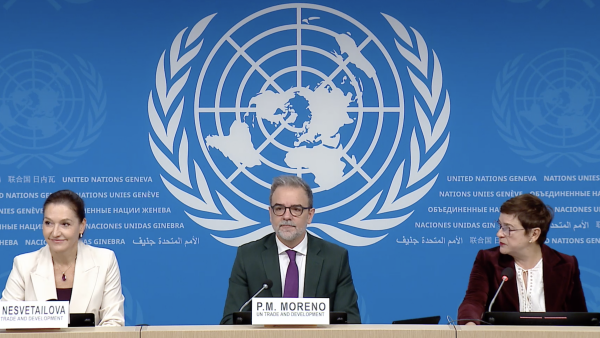
Presentation of the Trade and Developement Report 2026
Embargoed until 9 October 2026 at 11 a.m. (Geneva Time)
UNCTAD: UNCTAD’s flagship report finds that governments increasingly use industrial, trade, financial and technology policies to pursue economic and national security objectives. Market access and the ability to move into higher-value activities now depend more heavily on technology, finance and geopolitics.
1
1
1
Press Conferences | UPU
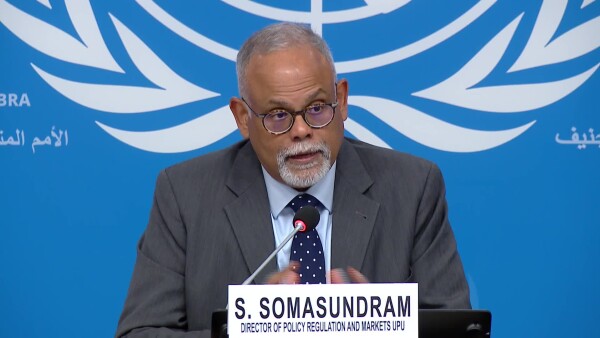
Release of the State of the Postal Sector Report 2026