

The United Nations Office at Geneva
Multimedia Newsroom
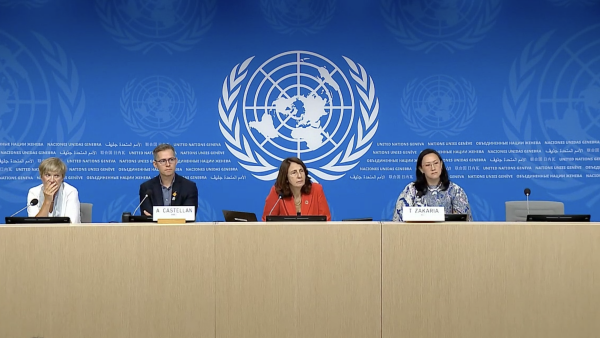
Alessandra Vellucci, Director of the United Nations Information Service (UNIS) at Geneva, chaired a hybrid press briefing, which was attended by spokespersons and representatives of the International Organization for Migration, the World Health Organization, the United Nations High Commissioner for Refugees and the World Meteorological Organization.
Protecting Victims of Trafficking in Online Scam Operations
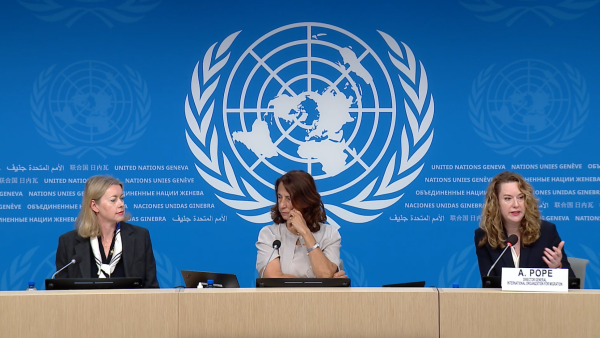
Amy Pope, Director General of the International Organization for Migration (IOM), said she was briefing in advance of World Trafficking Day on Thursday, regarding people being trafficked through online scam centres. These cases were increasing, with victims from over 80 different countries, particularly across Asia. Criminal networks were luring people on social media networks with fake job opportunities, using recruiters who spoke English well. However, when the victims arrived at the scam centre their passports were confiscated and they were often subjected to physical abuse and prevented from leaving. This was one of the fastest growing kinds of human trafficking in the world; it was highly organised and profitable. Data estimated that combined annual losses from scam offences in 2025 across East Asia, South-East Asia, Australia, and New Zealand were between USD 88.3 billion and USD 114.1 billion.
The families of the victims often sold land and went into debt to enable their family member to get the job, and then also later through ransom payments. People were returning home traumatised, with few resources and in debt. IOM were increasingly being called to work with governments to build capacity to identify victims, support safe return and reintegration, and strengthen cooperation across borders, as well as to ensure accountability for traffickers. Criminal networks were adept at operating beyond borders and escaping detection. World Trafficking Day was an opportunity to raise awareness of these crimes and ensure victims could recognise the risks and know where to seek help.
The full press release is available here.
Responding to questions from the media, Ms. Pope said IOM had assisted victims from over 30 countries, but there were victims from over 80 countries. The job presented to them as legitimate, were seeking those with college degrees, knowledge of the English language and technology skills, typically in countries with fewer job opportunities. It was important to disseminate information about the scams to enable people to seek further and concrete information when considering job opportunities, including phone numbers and addresses. Additionally, many people given tourist visas to come into a country, not proper work visas; this was a significant warning sign. IOM were working with trafficked individuals who had shared their stories to build public awareness raising campaigns.
Also answering questions, Ms. Pope said the issue of trafficking had evolved over the years, including the way people were being trafficked. Currently, social media platforms were being widely used by the traffickers to reach a wider audience and recruit more people into jobs. It was difficult to determine how long this had been going on; there had been fully established and constructed scam centres for some years, but the scope had expanded dramatically in the last year. People were primarily being trafficked from Asia, but now people were trafficked from all over the world.
The scams often targeted the elderly people, which was why scam gangs were looking for people with proper English language skills and technology. This had been seen significantly in the United States, Australia and New Zealand. It was also a prominent issue in Thailand, and the Thai Government had become more engaged in fighting it. Unfortunately, centres were often operating right at borders, and sometimes there was not the equivalent law enforcement engagement on both sides. There were around 300,000 people estimated to be working at these South-East Asian centres; not all were victims of trafficking, but there were a significant portion who were there against their will.
Answering further questions, Ms. Pope said many of the scam centres were operating in parts of countries which did not have strong governance or law enforcement networks, allowing them to proliferate dramatically. IOM aimed to build the capacity of governments to undertake investigations and prosecute the scam centres, but unfortunately many governments did not have capacity to address the full scale of the problem. Social media platforms had been working with the anti-trafficking community for many years. It was a situation which was constantly evolving, and the traffickers were always innovating. There was promising potential for the use of AI in identifying trafficking schemes and providing analytics but there was still a long way to go.
Responding to additional questions, Ms. Pope said the scam centre trafficking scheme was a relatively new model which had been evolving at a faster pace over the past couple of years, with people being recruited from all over the world to run scams. Significant networks were based within Asia, but social media had expanded their reach. Partnerships with the United Nations Office on Drugs and Crime (UNODC) and the International Labour Organization (ILO) were critical and the data shared was informed by IOM’s partners. Information shared between governments depended on their capacity. Trafficking was a criminal enterprise happening in the shadows, meaning any information being presented was IOM’s best estimate, but it was likely that the figures were far greater.
Answering final questions, Ms. Pope said the 300,000 people working in scam centres were in South-East Asia. The situation pointed to a weakness in governments’ protection of trafficking victims, including insufficient penalties and capacity to conduct investigations. The fact that the trafficking was operating across borders often allowed the perpetrators to escape accountability.
On another matter, responding to questions on an article from PassBlue published in June, Ms. Pope said third country nationals being deported by the United States were being done so involuntarily. IOM was working with trafficking victims and those who were being returned to a third country, to provide them with humanitarian support. The United Nations High Commissioner for Refugees (UNHCR) were also a key partner working on this issue. Ms. Pope clarified that the expression “voluntary deportation” did not exist. The resources coming in to support victims of trafficking did not meet the level of needs. IOM provided support to all affected individuals, regardless of the funding situation.
Answering another question regarding the article, Ms. Pope said a significant portion of the article was not accurate, and IOM had responded to PassBlue in this regard. IOM had no role when a Government negotiated an agreement with another Government; however, they helped the receiving country provide support, integrate people and assess protection claims, among other issues. It was critical there were safeguards in place to help people being returned into vulnerable situations. IOM worked with countries to provide support around community stabilisation, job training and support for vulnerable situations. There were places where the organisation was unable to provide support due to a lack of capacity or security issues. IOM was not involved in the majority of returns to third countries, unless specific requests were made by the host country.
World Hepatitis Day
Christian Lindmeier, for the World Health Organization (WHO), said today was World Hepatitis Day, under the theme “Hepatitis: Let’s Break it Down!” to break down the barriers for those receiving treatment. The high-level commemoration was currently taking place in Rio de Janeiro, on the sidelines of AIDS 2026. The event would be attended by Brazil’s Minister of Health, the WHO Director-General, as well as civil society leaders and global partners, aiming to accelerate progress towards the 2026 hepatitis elimination target.
Dr. Olufunmilayo ‘Funmi’ Lesi, Cross-cutting Lead, Hepatitis Programme and Partnerships, for the World Health Organization (WHO), said yesterday, WHO had launched the mid-term assessment of the Global Health Sector Strategies on HIV, viral hepatitis, and sexually transmitted infections. While the world had made important progress, action had not been taken fast enough to achieve the shared goal of eliminating viral hepatitis as a public health threat by 2030. The report presented reasons for optimism, including that many countries had demonstrated that elimination was possible and curative treatment continued to grow. However, it also showed that viral hepatitis remained the major communicable disease for which mortality was still increasing. In 2024 alone, hepatitis B and hepatitis C claimed 1.3 million lives, around 3,500 deaths every day. Most of these deaths were caused by chronic liver cirrhosis and liver cancer over many years and were largely preventable. Only around one quarter of the people living with chronic hepatitis B and just over one third of those living with hepatitis C had been diagnosed, and just 4.3 percent of people with hepatitis B were receiving treatment, while only 20 percent of people living with hepatitis C had accessed curative therapy.
The report highlighted that it was vital to focus on preventing new infections, including through the Hepatitis B vaccination at birth, especially in Africa where coverage remained at just 17 percent; to drastically expand diagnosis and treatment and equitable access; and to integrate Hepatitis services with other healthcare services, including HIV, maternal and child health; and to ensure sustained political commitment and investment. The mid-term assessment clearly stated that what was needed now was greater urgency, stronger political leadership and accelerated implementation in the countries carrying the greatest burden. On World Hepatitis Day, WHO called on governments, partners, civil society and communities to work together to break down the barriers that continued to prevent millions of people from accessing vaccination, testing and life-saving treatment.
Responding to a question from the media, Dr. Funmi said part of the reason for the increase in Hepatitis cases was because less than one quarter of those who needed to be treated knew they were infected and therefore weren’t receiving treatment. The infrastructure and funding landscape for Hepatitis were part of the problem; it continued to be treated as a specialized disease in hospitals and tertiary centres. Hepatitis B was concentrated in the African and western pacific region while Hepatitis C was spread across various regions; programmes did not exist in many regions. Integrating Hepatitis into existing healthcare services, such as HIV, would increase the number of people who could have access to diagnosis and treatment. The lack of global funding of HIV had stunted the number of interventions for Hepatitis cases.
Anniversary of the 1951 Refugee Convention
Matthew Saltmarsh, for the United Nations High Commissioner for Refugees (UNHCR), said an advisory had been sent out regarding an event to commemorate the seventy-fifth anniversary of the 1951 Refugee Convention taking place at the Palais des Nations today, featuring speeches from the UNHCR High Commissioner, among others. There would also be a media stake-out after the event at 5 p.m. which would take place in Hall 14. Journalists were requested to inform the UNHCR press team if they wished to attend.
Alessandra Vellucci, Director of the United Nations Information Service (UNIS) at Geneva, said the statement of the Secretary-General had been shared with the media honoring this anniversary.
Extreme heat and fires
Responding to a question from the media, regarding France’s outlook on the severe wildfires, Clare Nullis, for the World Meteorological Organization (WMO), said it was important to consult Météo-France. These fires were also impacted by wind direction, not just heat. A pyrocumulonimbus cloud had been formed by the fires, which was the first time this had ever happened in France. Switzerland was also in for another extreme heat event, combined with extreme drought. The heat was expected to be punishing for snow, ice and glacier melt-age, as well as for the environment in general, agriculture and human health.
Answering another question, Ms. Nullis said fires were not usually started by the weather alone, but the conditions for the fire weather in Spain and France and parts of Switzerland were there. Climate change and more extreme heat would aggravate the risk of fire weather, while a summer storm could help mitigate the wildfires.
Announcements
Alessandra Vellucci, Director of the United Nations Information Service (UNIS) at Geneva, said that a press conference on the Commemoration of the Yazidi Genocide would be held on 30 July at 1 p.m., convened by the Permanent Mission of France to the United Nations in Geneva, and Nadia’s Initiative. The Conference was in-person only and would hear from Nobel Peace Prize laureate, Nadia Murad.
The Secretary-General was travelling to Cyprus as part of his Good Offices Mission and would meet with Greek Cypriot and Turkish Cypriot leaders, to discuss methods to advance the peace process.
Finally, Ms. Vellucci said this Friday the Palais des Nations would be closed to commemorate National Swiss Day and there would be no press briefing.
WHO Christian Lindmeier (Zoom) with Dr. Olufunmilayo (‘Funmi) LESI; Cross-cutting Lead, Hepatitis Programme & Partnerships, WHO (Zoom)
- World Hepatitis Day
IOM IOM Director General Amy Pope
- Protecting Victims of Trafficking in Online Scam Operations
Similar Stories
1
1
1
Statements , Press Conferences | OHCHR
1
1
1
Press Conferences | UNHCR , UNICEF , IFRC , OHCHR , UN WOMEN , IOM , OCHA , WHO
UNHCR – ExCom Meeting, UNICEF – Nepal Recovery, IFRC – Flash Floods, WHO – Mental Health, IOM – South Sudan Floods, OCHA – DRC Humanitarian aid, UNHCR – Sahel Displacement, UNICEF – Yemen Update, IOM – Gaza Shelter, UN Women – Gaza Women, OHCHR – Arrests and detentions of Syrians by Israeli force
2
1
2
Press Conferences | UNCTAD
Presentation of the Trade and Developement Report 2026
Embargoed until 9 October 2026 at 11 a.m. (Geneva Time)
UNCTAD: UNCTAD’s flagship report finds that governments increasingly use industrial, trade, financial and technology policies to pursue economic and national security objectives. Market access and the ability to move into higher-value activities now depend more heavily on technology, finance and geopolitics.
1
1
1
Press Conferences | UPU
Release of the State of the Postal Sector Report 2026
1
1
1
Press Conferences | IOM , ITU , UNECE , UNICEF , WHO , WMO
UNICEF: Ebola, DRC - children orphans or separating them from parents and caregivers; IOM: Humanitarian needs in Djibouti amid arrivals from Yemen and increased migrant movements; WHO: Darfur, scale of health needs far exceeds available resources; WMO co-sponsored Global Heat Forum, Bangkok, monthly Global Seasonal Climate Update; UNECE: UN Forum of Mayors; ITU Plenipotentiary Conference 2026; WHO: child and adolescent obesity guidelines and new global roadmap to tackle pregnancy hypertension, a leading cause of maternal mortality
1
1
1
Press Conferences | OCHA , UN WOMEN , UNHCR , WFP , WHO , WTO , UNEP
OCHA – $160M CERF allocation to 12 underfunded crises; UNHCR – 5.8M refugee children remain out of school amid funding cuts; UN Women – Middle East escalation and food security among women/girls; WHO – Gaza supplies and overall situation; WFP – Yemen food insecurity and impact on global hunger ; UNEP - First International Conference of the Global Framework on Chemicals in Geneva | 16-20 November 2026
1
1
1
Press Conferences | UNHCR , WHO
Yemen's health system nears collapse amid conflict, causing rising casualties and medicine shortages.
1
1
1
Press Conferences | HRC
Update by the Expert Mechanism to Advance Racial Justice and Equality in Law Enforcement
1
1
1
Press Conferences | WIPO , WHO , UNICEF , UNHCR , IOM , WFP , FAO
WIPO Global Innovation Index 2026 launch and press conference, WHO Composition of influenza vaccines for the 2027 Southern Hemisphere flu season, UNICEF Yemen hunger and malnutrition; UNHCR Sudan displacement into Chad; IOM Ebola and population movements in DRC; WFP emergency food assistance in Nepal; and FAO food loss and waste.
2
1
2
Press Conferences | UNCTAD
Gaza reconstruction needs reach $71.5 billion as Palestinian economy and public finances face severe strain. Latest UNCTAD report documents the loss of decades of development gains, economic collapse in Gaza and tightening economic constraints in the West Bank.
The report identifies three immediate priorities: transferring withheld Palestinian revenues, safeguarding the banking system and aligning reconstruction support with the documented scale of damage and economic losses.
1
1
1
Press Conferences | HRC
Press conference on the situation of human rights in Nicaragua by the UN Group of Human Rights Experts
1
1
1
Press Conferences | ITU , UNHCR , WHO , WMO
YEMEN - UNHCR: Escalating conflict in Yemen could fuel more displacement, refugee movement
CLIMATE - WHO / WMO: Health and Climate impact of El Niño