

The United Nations Office at Geneva
Multimedia Newsroom
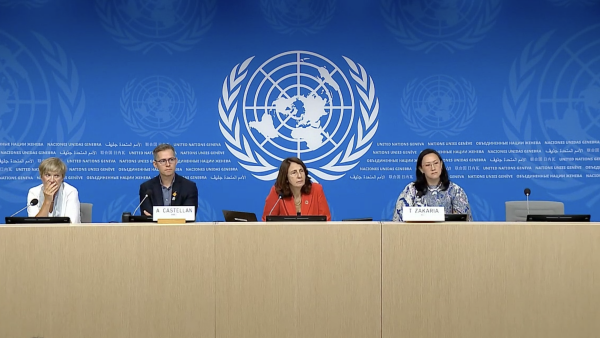
Alessandra Vellucci, Director of the United Nations Information Service (UNIS) in Geneva, chaired the hybrid briefing, which was attended by spokespersons and representatives from UN Women, the World Health Organization and the World Meteorological Organization.
New UN Women report on the impact of aid cuts on women's organizations
Sofia Calltorp, UN Women Chief of Humanitarian Action, said UN Women was launching today a new report on the impact of aid cuts on women’s organizations, and on the women and girls that these organizations served.
The report showed that since January 2025, at least one million women and girls affected by conflict and crisis had lost access to critical services and support. UN Women had spoken to 855 women’s organizations, working in 52 countries, who said that these women and girls had been turned away due to funding cuts that were dismantling their organizations.
Cases of conflict-related sexual violence had doubled in 2025 and yet nearly two thirds of women's organizations said that safe spaces and gender-based violence services had been significantly reduced, or were no longer available, in their communities. Some 9 in 10 women’s organizations noted an increase in poverty among the women they served, 8 in 10 an increase in girls dropping out of school, and 7 in 10 an increase in forced marriage.
In this context, and as the level of armed conflict had now reached its highest level in decades, 4 in 10 women’s organizations working in humanitarian crises expected to close in the next 12 months. Nearly two-thirds of the surveyed organizations said that their staff were working without pay to keep critical support for women and girls afloat.
The cuts to women’s organizations were happening when women’s rights were being eroded. These two things were deeply connected. Funding shortfalls deepened inequality and division, both of which were very costly; at the same time, women’s organizations were highly cost-effective. UN Women called for immediate action from donors and the humanitarian community to prioritize funding for women’s organizations.
Answering questions from journalists, Ms. Calltorp underlined two reinforcing trends: funding cuts that had an immediate effect on critical services to women and girls, and, at the same time, an erosion of women’s organizations’ leadership and capacity to work within their communities. Women organizations were the backbone of humanitarian response: without those community-led responses, access was extremely difficult for international actors, Ms. Calltorp stressed.
Read the press release.
Shible Sahbani, World Health Organization (WHO) Representative to Sudan, said that despite relentless humanitarian efforts and the dedication of Sudan’s health leadership and workers, the humanitarian and health situation in Sudan remained concerning. More than 33 million people needed assistance, including 21 million requiring health services. Despite recent returns, displacement also remained high, with 13.4 million people displaced, of which nearly 9 million internally.
Outbreaks of dengue, malaria, measles, meningitis, hepatitis E were affecting several states. A new cholera outbreak had been declared on 27 June: from West Kordofan, the disease had since spread to North Kordofan, Central Darfur and South Darfur, causing more than 1,330 cases and 114 deaths – a case fatality rate of 13.7 percent, which was very high. WHO was particularly concerned by the spread of cholera to El Obeid (North Kordofan), where health facilities were overwhelmed and access to care very limited. Beyond cholera, WHO was deeply concerned about the broader humanitarian needs and growing protection risks facing the people of El Obeid, echoing what had unfolded in El Fasher last year.
WHO was coordinating the cholera response by strengthening surveillance, case management, infection prevention and control, community engagement, and the distribution of supplies. WHO had prepositioned 64 metric tons of cholera kits across Sudan to support its response.
In a context where immense health needs were placing enormous pressure on the health system, the commitment of health workers and health authorities was remarkable. But without adequate financing, neither partners nor the health system could meet the scale of the needs. More than halfway through the year, WHO’s humanitarian appeal for Sudan was less than 15 percent funded. However, even amid the conflict, WHO was planning for recovery, rehabilitation, rebuilding, which was a powerful sign of hope.
Answering questions from journalists, Mr. Sahbani said WHO was investing to strengthen the Sudanese health system, so that it could respond to all needs regardless of the status of the population: refugees, IDPs, returnees, or host population. At the same time, WHO must respond to acute needs in Sudan, like cholera. For this, WHO had asked USD 167 million: only 11 percent of this amount had been obtained, which was very low at the seventh month of 2026.
The situation in El Obeid, Mr. Sahbani noted, continued to worsen, with a risk that it became a second Al Fasher, or worse. WHO was struggling to deploy its staff and send supplies there. The UN Security Council had expressed concern over the imminent risk of mass atrocities and had demanded an immediate end to the assault, which could help WHO to access the area. The Organization had already prepositioned supplies to be able to meet the health needs of more than 25,000 people, but that would not suffice, Mr. Sahbani admitted. WHO called for respect of the sanctity of health and for the protection of health workers, he added.
Finally, Mr. Sahbani warned that “all the ingredients in the country were there” to have new waves of cholera: lack of access, lack of water and sanitation, displacement of people who may be infected and moving from one state to another. WHO’s role was to strengthen the EWARS, the “early warning alert and response system”, to detect cases and respond before the outbreak could spread in all states. Unfortunately, lack of access was a major issue in implementing this warning system everywhere; another issue was a lack of funding to preposition cholera kits where necessary.
Ms. Vellucci, for the United Nations Information Service, reiterated the UN’s appeal for increased, timely and flexible funding. The 2026 humanitarian response plan of the UN was less than one-third funded, having received USD 930 million, out of the nearly USD 2.9 billion that were needed. It was an urgent appeal to all donors to fund the UN’s life-saving activities in Sudan.
WMO Airborne Dust Bulletin shows sand and dust storm hotspots and impacts
Clare Nullis, for the World Meteorological Organization (WMO) said the European Union, in monthly figures released yesterday, had pointed to the hottest June on record in parts of Western Europe, and to the second hottest June in Western Europe as a whole. Sea surface temperatures globally were also the highest on record, which meant more heat to come.
Spain's Fabra Observatory – one of WMO's long-term observing stations – had recorded 40.5 degrees Celsius on 8 July, the highest temperature there in more than one century of data. France was seeing extreme temperatures too, including dangerously high overnight temperatures. Furthermore, heat, very dry soils, drought and low humidity had combined to lead to a high fire danger level. Devastating fires were raging, particularly in Spain, with loss of life. The WMO was working closely with the World Health Organization to mobilize heat health action plans to save lives and to protect livelihoods.
Leilani Dulguerov, of the Global Atmospheric Watch Team at WMO, then presented the tenth edition of the WMO Airborne Dust Bulletin, which provided an annual assessment of major sand and dust storm events in 2025 and advances in monitoring and forecasting.
Airborne dust was a truly global problem. Dust emitted from major sources in North Africa, the Middle East, and Asia could be transported thousands of kilometres, affecting air quality, weather, climate, ecosystems, transportation, agriculture, and public health. The Bulletin showed that global dust conditions in 2025 had been comparable to those in 2024, with regional variations.
A widespread East Asian dust outbreak had thus reached parts of southern China rarely affected by such events: inhalable particulate matter (PM) levels had reached 3,000 to 4,000 micrograms per cubic meter in northern China. Another exceptionally active dust season had been observed along the border of Mexico and the United States: levels had peaked at more than 8,000 micrograms per cubic meter in El Paso, Texas, forcing the closure of schools and airports. 45 micrograms per cubic meter was the 24-hour threshold considered by the WHO air quality guidelines.
Taking questions from the press, Sara Basart, Scientific Officer and Report Coordinator at WMO, noted that, at concentrations in the thousands of micrograms per cubic meter, health risks were related not only to breathing, but also to scratching eyes and skin. During these extreme events, the recommendation was to stay at home. Another question was raised regarding the effect of dust storms on meningitis. Ms. Nullis said that there had been progress in dealing with this problem: meteorological authorities tried to provide forecasts and information to enable health authorities to act on, vaccinations being a very important part of that.
Ms. Nullis also said WMO was working to improve forecasts of fire risks.
Ms. Dulguerov noted that the 2025 Bulletin showed important scientific advances in, for instance, artificial intelligence and machine learning for dust forecasting. Ms. Nullis and Ms. Dulguerov gave examples of the use of AI to support better meteorological and flooding forecasting, and to identify hotspots and their causes.
Ms. Vellucci stressed that 12 July would be not only the International Day of Combating Sand and Dust Storms, but also the International Day of Hope.
Election of the next UN Secretary-General
Finally, a question was raised on one candidate to the election of the next UN Secretary-General. Ms. Vellucci reminded that this process was in the hands of the President of the General Assembly and Member States.
TOPICS
- UN WOMEN Sofia Calltorp (from Stockholm)
New UN Women global report on the impact of aid cuts on women's organizations, including new data on women and girls losing access to critical support.
- WHO Tarik Jašarević (PR) with Dr Shible Sahbani, WHO Representative to Sudan (from Tripoli, Libya)
Update on the health situation in Sudan
- WMO Clare Nullis (PR) with Leilani Dulguerov, Global Atmosphere Watch programme
WMO Airborne Dust Bulletin shows sand and dust storm hotspots and impacts.
Similar Stories

1
1
1
Statements , Press Conferences | OHCHR

1
1
1
Press Conferences | UNHCR , UNICEF , IFRC , OHCHR , UN WOMEN , IOM , OCHA , WHO
UNHCR – ExCom Meeting, UNICEF – Nepal Recovery, IFRC – Flash Floods, WHO – Mental Health, IOM – South Sudan Floods, OCHA – DRC Humanitarian aid, UNHCR – Sahel Displacement, UNICEF – Yemen Update, IOM – Gaza Shelter, UN Women – Gaza Women, OHCHR – Arrests and detentions of Syrians by Israeli force

2
1
2
Press Conferences | UNCTAD
Presentation of the Trade and Developement Report 2026
Embargoed until 9 October 2026 at 11 a.m. (Geneva Time)
UNCTAD: UNCTAD’s flagship report finds that governments increasingly use industrial, trade, financial and technology policies to pursue economic and national security objectives. Market access and the ability to move into higher-value activities now depend more heavily on technology, finance and geopolitics.

1
1
1
Press Conferences | UPU
Release of the State of the Postal Sector Report 2026
1
1
1
Press Conferences | IOM , ITU , UNECE , UNICEF , WHO , WMO
UNICEF: Ebola, DRC - children orphans or separating them from parents and caregivers; IOM: Humanitarian needs in Djibouti amid arrivals from Yemen and increased migrant movements; WHO: Darfur, scale of health needs far exceeds available resources; WMO co-sponsored Global Heat Forum, Bangkok, monthly Global Seasonal Climate Update; UNECE: UN Forum of Mayors; ITU Plenipotentiary Conference 2026; WHO: child and adolescent obesity guidelines and new global roadmap to tackle pregnancy hypertension, a leading cause of maternal mortality
1
1
1
Press Conferences | OCHA , UN WOMEN , UNHCR , WFP , WHO , WTO , UNEP
OCHA – $160M CERF allocation to 12 underfunded crises; UNHCR – 5.8M refugee children remain out of school amid funding cuts; UN Women – Middle East escalation and food security among women/girls; WHO – Gaza supplies and overall situation; WFP – Yemen food insecurity and impact on global hunger ; UNEP - First International Conference of the Global Framework on Chemicals in Geneva | 16-20 November 2026
1
1
1
Press Conferences | UNHCR , WHO
Yemen's health system nears collapse amid conflict, causing rising casualties and medicine shortages.
1
1
1
Press Conferences | HRC
Update by the Expert Mechanism to Advance Racial Justice and Equality in Law Enforcement
1
1
1
Press Conferences | WIPO , WHO , UNICEF , UNHCR , IOM , WFP , FAO
WIPO Global Innovation Index 2026 launch and press conference, WHO Composition of influenza vaccines for the 2027 Southern Hemisphere flu season, UNICEF Yemen hunger and malnutrition; UNHCR Sudan displacement into Chad; IOM Ebola and population movements in DRC; WFP emergency food assistance in Nepal; and FAO food loss and waste.
2
1
2
Press Conferences | UNCTAD
Gaza reconstruction needs reach $71.5 billion as Palestinian economy and public finances face severe strain. Latest UNCTAD report documents the loss of decades of development gains, economic collapse in Gaza and tightening economic constraints in the West Bank.
The report identifies three immediate priorities: transferring withheld Palestinian revenues, safeguarding the banking system and aligning reconstruction support with the documented scale of damage and economic losses.
1
1
1
Press Conferences | HRC
Press conference on the situation of human rights in Nicaragua by the UN Group of Human Rights Experts
1
1
1
Press Conferences | ITU , UNHCR , WHO , WMO
YEMEN - UNHCR: Escalating conflict in Yemen could fuel more displacement, refugee movement
CLIMATE - WHO / WMO: Health and Climate impact of El Niño