

The United Nations Office at Geneva
Multimedia Newsroom
Edited News , Press Conferences | OCHA
OCHA - Press Conference: Briefing on the first regional mission of UN and NGO Emergency Directors to the Middle East
More than 280,000 people have been uprooted in northwest Syria in a matter of days following the sudden and massive offensive into Government-controlled areas led by Hayat Tahrir al-Sham (HTS), which is sanctioned by the Security Council as a terrorist group.
Aid has continued to flow from Türkiye across three border crossings into the embattled northwest and the UN World Food Programme (WFP) said that it had opened community kitchens in Aleppo and Hama – cities now reportedly occupied by HTS fighters.
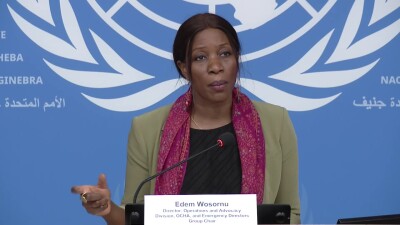
In neighbouring Lebanon, meanwhile, senior UN aid official Edem Wosornu expressed deep concerns for the safety of more than 600,000 people who have begun to return to their devastated homes, after a ceasefire between Israel and Hezbollah kicked in on 27 November. “I'm sure they are settling back, the problem is what they would find when they go back home,” she told journalists in Geneva, highlighting the potential dangers to farmers from unexploded ordnance.
Syria: a crisis upon a crisis
Speaking in Geneva after a joint UN and NGO Emergency Directors assessment mission to the Middle East from 25 November to 1 December, the UN World Food Programme (WFP’s) Samer AbdelJaber described Syria’s new unfolding emergency as “a crisis on top of another” – a reference to the country’s civil war that began in 2011, sparked by a civil uprising against the Government. Since then, it has drawn in regional and international powers and defied the efforts of the Security Council and wider global community to bring it to an end. Hundreds of thousands are believed to have been killed and many more are believed to remain in the Government’s prisons.
Mr. AbdelJaber, who heads WFP’s Emergency Coordination, Strategic Analysis and Humanitarian Diplomacy arm, warned that around 1.5 million people are likely to be displaced “and will be requiring our support. Of course, the humanitarian partners are working on both sides of the front lines we're trying to reach the communities wherever their needs are.”
The WFP official noted that the sudden escalation has not shut down three humanitarian border crossings with Türkiye and that aid continues to flow into Aleppo, Syria’s second city. The UN agency “has opened and supported two community kitchens that are providing hot meals in both Aleppo as well as in Hama,” he said, adding that “the aid partners are on the ground and doing everything they can to basically provide the assistance to the people”.
Millions of Syrians are already in crisis because of the war which has destroyed the economy and people’s livelihoods, threatening their survival. “It’s at a breaking point at the moment in Syria, after 13 or 14 years of a conflict, over three million Syrians are severely food insecure and cannot afford enough food,” Mr. AbdelJaber said, adding that a total of 12.9 million people in Syria needed food assistance before the latest crisis.
Despite the clear need for more support, international funding for Syria’s $4.1 billion humanitarian response plan “faces its largest shortfall ever”, the WFP official continued, with less than one-third needed for 2024 received to date.
Lebanon returnees in danger
In neighbouring Lebanon, senior UN humanitarian official Edem Wosornu, Director, Operations and Advocacy Division at the UN aid coordination office, OCHA, said that people affected by the war between Israel and Hezbollah fighters “have returned faster than they even left the conflict; more than 600,000 people have begun to go back home, and as we speak, I'm sure they are settling back. The problem is what they would find when they go back home and the need for our response to pivot very quickly.”
Among those in need today are many Syrian refugees who fled the war in their country, only to be displaced several times since their arrival, explained Isabel Gomes, Global Lead of Disaster Management at NGO World Vision International: “There was this particular girl that we spoke with; she told us the story that at the time of the conflict, when she had to move, she was pregnant, close to nine months, and she had to walk kilometres and kilometres and kilometres. Then she asked us if she could show us her baby, and we saw her baby was two months. But when we asked if the baby had received vaccines, she said the baby had never received vaccines.”
Returning farming communities also face deadly dangers from the fighting in southern Lebanon’s wartorn zones, OCHA’s Ms. Wosornu explained: “We also are concerned about the impact of mines and unexploded ordnance in the some of these locations…we are really asking our mine action colleagues and others to support the Government in demining activities because when people who want to go back home, who’ve gone back home, the farmers who are trying to salvage the rest of the olive harvest, there's fears that this that could be impact there.”
ends
Syria, Lebanon update – OCHA, WFP, World Vision International
TRT: 03 min 35s
SOURCE: UNTV CH
RESTRICTIONS: NONE
LANGUAGE: ENGLISH / NATS
ASPECT RATIO: 16:9
DATELINE: 06 DECEMBER 2024 GENEVA, SWITZERLAND
Speakers:
- Edem Wosornu, Director, Operations and Advocacy Division, OCHA, and Emergency Directors Group Chair
- Samer AbdelJaber, Director, Emergency Coordination, Strategic Analysis and Humanitarian Diplomacy, WFP
- Isabel Gomes, Global Lead Disaster Management, World Vision International
SHOTLIST
-
- Exterior médium-wide: UN Geneva flag alley.
- Medium wide, UN Geneva Press room, podium and speakers.
- SOUNDBITE (English) Samer AbdelJaber, Director, Emergency Coordination, Strategic Analysis and Humanitarian Diplomacy, WFP: “The recent escalation is a crisis on top of another. Over 280,000 people have fled their homes in northwest Syria; this number could go up very fast. Throughout the mission, it was clear that there is no humanitarian solution to the crisis that besets this region.”
- Medium wide, UN Geneva Press room, podium and speakers.
- SOUNDBITE (English) Samer AbdelJaber, Director, Emergency Coordination, Strategic Analysis and Humanitarian Diplomacy, WFP: “So far, the three border crossings with Türkiye are still operational, so we didn't see any impact on the crossings. Aid is coming in by different partners supporting the aid deliveries from [the] Türkiye side. But maybe also in Aleppo, I can say there is distributions of aid; WFP, for example, has opened and supported two community kitchens that are providing hot meals in both Aleppo as well as in Hama, so, the aid partners are on the ground and doing everything they can to basically provide the assistance to the people.”
- Medium-wide, speakers at podium, Press room.
- SOUNDBITE (English) Samer AbdelJaber, Director, Emergency Coordination, Strategic Analysis and Humanitarian Diplomacy, WFP: “It’s at a breaking point at the moment in Syria, after 13 or 14 years of a conflict, over three million Syrians are severely food insecure and cannot afford enough food and malnutrition is at global levels - emergency levels - a total of 12.9 million people in Syria were classified as food insecure and needed food assistance before the recent crisis. So that’s why it’s another call for support for funding to all the organizations and humanitarians working across and all over Syria.”
- Medium, journalist.
- SOUNDBITE (English) Samer AbdelJaber, Director, Emergency Coordination, Strategic Analysis and Humanitarian Diplomacy, WFP: “The humanitarian response in Syria faces its largest shortfall ever, with less than a third of the [$] 4.1 billion needed for 2024 received to date, immediate investment in serious humanitarian and recovery efforts is crucial to ensure that the needs of those who crossed back are adequately met.”
- Medium-wide, automatic camera and TV screen showing Edem Wosornu.
- SOUNDBITE (English) Edem Wosornu, Director, Operations and Advocacy Division, OCHA, and Emergency Directors Group Chair: “People have returned faster than they even left the conflict; more than 600,000 people have begun to go back home, and as we speak, I'm sure they are settling back. The problem is what they would find when they go back home and the need for our response to pivot very quickly.”
- Medium-wide, Press room, journalists.
- SOUNDBITE (English) – Isabel Gomes, Global Lead Disaster Management, World Vision International: “There was this particular girl that we spoke with; she told us the story that at the time of the conflict, when she had to move, she was pregnant, close to nine months, and she had to walk kilometres and kilometres and kilometres. Then she asked us if she could show us her baby, and we saw her baby was two months. But when we asked if the baby had received vaccines, she said the baby had never received vaccines.”
- Medium, Edem Wosornu speaking into mic.
- SOUNDBITE (English) – Edem Wosornu, Director, Operations and Advocacy Division, OCHA, and Emergency Directors Group Chair: “We also are concerned about the impact of mines and unexploded ordnance in the some of these locations. We've seen the impacts of this across in different contexts and we are really asking our mine action colleagues and others to support the Government in demining activities because when people who want to go back home, who’ve gone back home, the farmers who are trying to salvage the rest of the olive harvest, there's fears that this that could be impacted there.”
- Wide, TV journalists, control booths.
- Medium-wide, journalists filming with mobile phone.
Similar Stories

1
1
1
Edited News | UNICEF , IFRC
Six weeks after Nepal’s deadly flooding disaster, communities are still struggling to rebuild their lives, but they will need sustained help as global warming increases the risk of another Himalayan catastrophe, the UN Children’s Fund (UNICEF) said on Friday.

1
1
1
Statements , Press Conferences | OHCHR

1
1
1
Press Conferences | UNHCR , UNICEF , IFRC , OHCHR , UN WOMEN , IOM , OCHA , WHO
UNHCR – ExCom Meeting, UNICEF – Nepal Recovery, IFRC – Flash Floods, WHO – Mental Health, IOM – South Sudan Floods, OCHA – DRC Humanitarian aid, UNHCR – Sahel Displacement, UNICEF – Yemen Update, IOM – Gaza Shelter, UN Women – Gaza Women, OHCHR – Arrests and detentions of Syrians by Israeli force

2
1
2
Press Conferences | UNCTAD
Presentation of the Trade and Developement Report 2026
Embargoed until 9 October 2026 at 11 a.m. (Geneva Time)
UNCTAD: UNCTAD’s flagship report finds that governments increasingly use industrial, trade, financial and technology policies to pursue economic and national security objectives. Market access and the ability to move into higher-value activities now depend more heavily on technology, finance and geopolitics.

1
1
1
Press Conferences | UPU
Release of the State of the Postal Sector Report 2026

1
1
1
Edited News | WHO
In suspected Russia plague death, testing and monitoring underway – WHO
The death of a lab worker in Russia’s Siberia region has sparked concerns about plague being the cause, the UN World Health Organization (WHO) said on Tuesday, adding that it was following the situation closely.
1
1
1
Press Conferences | IOM , ITU , UNECE , UNICEF , WHO , WMO
UNICEF: Ebola, DRC - children orphans or separating them from parents and caregivers; IOM: Humanitarian needs in Djibouti amid arrivals from Yemen and increased migrant movements; WHO: Darfur, scale of health needs far exceeds available resources; WMO co-sponsored Global Heat Forum, Bangkok, monthly Global Seasonal Climate Update; UNECE: UN Forum of Mayors; ITU Plenipotentiary Conference 2026; WHO: child and adolescent obesity guidelines and new global roadmap to tackle pregnancy hypertension, a leading cause of maternal mortality

1
1
Edited News | OHCHR , UNOG
UN Human Rights Chief Volker Türk on Friday provided and oral update to the 63rd session of the Human rights Council on Ukraine.

1
1
1
Edited News | OHCHR , UNOG
UN Human Rights Chief Volker Türk on Friday provided and oral update to the 63rd session of the Human rights Council on the human rights situation in Haiti.

1
1
1
Edited News | WHO
Repeated delays in bringing lifesaving medicines, prosthetics and more from Israel into Gaza risk having devastating consequences on Palestinians who urgently need them in the wartorn enclave, the UN World Health Organization (WHO) said on Friday. “A truck full of non-priority supplies or the right supplies arriving too late, doesn't save lives. That's the question that actually matters," said Dr Reinhilde Van De Weerdt, WHO Representative in the OPT.
1
1
1
Press Conferences | OCHA , UN WOMEN , UNHCR , WFP , WHO , WTO , UNEP
OCHA – $160M CERF allocation to 12 underfunded crises; UNHCR – 5.8M refugee children remain out of school amid funding cuts; UN Women – Middle East escalation and food security among women/girls; WHO – Gaza supplies and overall situation; WFP – Yemen food insecurity and impact on global hunger ; UNEP - First International Conference of the Global Framework on Chemicals in Geneva | 16-20 November 2026

1
1
1
Edited News | WHO
DRC: Early access to care and oxygen decisive for Ebola patients’ survival – WHO
In the Democratic Republic of the Congo (DRC), health workers fighting the country’s largest-ever Ebola outbreak are struggling to overcome critical challenges to patient care, the UN World Health Organization (WHO) warned on Tuesday.