

The United Nations Office at Geneva
Multimedia Newsroom
International panel set up to help protect undersea cables
An international panel has been set up to protect undersea communications cables that are crucial for international trade and security, the UN International Telecommunication Union (ITU) said on Friday.
The creation of the International Advisory Body for Submarine Cable Resilience comes amid an ongoing investigation into the severing of two fibre optic cables in the Baltic Sea, in less than 24 hours between 17 and 18 November.
Beijing has denied any involvement but expressed its readiness to cooperate with Sweden in an investigation, after reports that a Chinese vessel was in the vicinity at the time both incidents occurred.
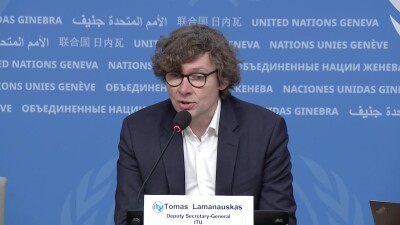
The international body - created by ITU and the International Cable Protection Committee (ICPC) - is “an important milestone in protecting the global digital infrastructure, ensuring its resilience and that it serves well our global economy,” said Tomas Lamanauskas, ITU Deputy Secretary-General.
Submarine cables carry around 99 per cent of global internet traffic. That means that “anything we do today in the digital world depends on submarine cables, from our emails and text messages to financial transactions, critical government communications, cloud services, social media, our video streaming services, and so on,” Mr. Lamanauskas told journalists in Geneva.
Damage to submarine cables happens regularly, with an average of 150 to 200 breaches occurring globally each year and requiring about three cable repairs per week, according to ICPC.
It usually takes a few weeks to fix, but this depends on various factors such as the type of break, depth, or weather conditions. The volcanic eruption in the southern Pacific Ocean triggered by a tsunami in 2022 disconnected Tonga for several weeks. It took nearly 18 months to repair the damage fully.
This, in turn, limited essential emergency response and support for disaster management and recovery in the archipelago. “This critical infrastructure is vulnerable to disruptions, from accidental human activity, from natural hazards, from ageing infrastructure,” explained Mr. Lamanauskas.
The new advisory body will aim to improve cable resilience by promoting best practices and principles for all governments and industry players. It is tasked with ensuring the timely deployment and speedy repair of submarine cables, to reduce the risk of damage and enhance the continuity of affected communications.
Asked about the cause of the most recent incident in the Baltic Sea, Mr. Lamanauskas noted that ITU does not attribute “the causes of the disruptions. What our partners, international or some international cable protection committees say is that around 80 per cent of the cable disruptions are caused by accidental human activity or natural hazards.”
The advisory body’s 40 members include government ministers, heads of regulatory authorities, industry executives and senior experts in the field of telecommunication cables from all over the world. The body will meet at least two times a year. The first virtual meeting is scheduled next month, December 2024. The first physical meeting is scheduled to take place during the Submarine Cable Resilience Summit, planned for late February 2025 in Abuja, Nigeria.
Ends
Story: “Submarine cable resilience – ITU” – 29 November 2024
Speakers:
- Tomas Lamanauskas, Deputy Secretary-General, International Telecommunication Union (ITU)
TRT: 01’58”
SOURCE: UNTV CH
LANGUAGE: ENGLISH / NATS
ASPECT RATIO: 16:9
DATELINE: 29 November 2024 - GENEVA, SWITZERLAND
Geneva Press briefing
SHOTLIST
- Exterior medium shot: UN flag alley.
- Wide shot of the podium with speakers at the press conference room.
- SOUNDBITE (English) Tomas Lamanauskas, Deputy Secretary-General, International Telecommunication Union (ITU): “We're launching the international advisory body for submarine cable resilience that is an important milestone in protecting our global digital infrastructure, ensuring its resilience and ensuring that it serves well our global economy.”
- Medium shot of the press conference room.
- SOUNDBITE (English) Tomas Lamanauskas, Deputy Secretary-General, International Telecommunication Union (ITU): “Submarine cables carry around 99 per cent of the global internet traffic. So, that means that anything we do today in the digital world is dependent on submarine cables, from our emails and text messages to financial transactions, critical government communications, cloud services, social media, our video streaming services, and so on.”
- Wide shot of the press conference room and control room.
- SOUNDBITE (English) Tomas Lamanauskas, Deputy Secretary-General, International Telecommunication Union (ITU): “We see this critical infrastructure is vulnerable to disruptions, from accidental human activity, from natural hazards, from aging infrastructure. We usually identify around 150 -200 faults that occur globally each year, equivalent to about three faults per week.”
- Medium shot: journalists in the press conference room.
- SOUNDBITE (English) Tomas Lamanauskas, Deputy Secretary-General, International Telecommunication Union (ITU): “It's not our role to investigate, to attribute or to determine the issues. What we do to help the member states is referring them to the practices that they can use to do that, to apply in this regard.”
- Close shot: journalist listening in the press conference room.
- SOUNDBITE (English) Tomas Lamanauskas, Deputy Secretary-General, International Telecommunication Union (ITU): “We don't do the attribution of the causes of the disruptions. What our partners, international or some international Cable Protection Committees say is that around 80 per cent of the cable disruptions are caused by accidental human activity or natural hazards.”
- Wide shot of the press conference room.
- Various shots of the press conference room.
Similar Stories

2
17
1
2
Edited News , Press Conferences | OCHA , WMO
Two UN agencies teamed up on Wednesday to issue an appeal for immediate assistance to help communities already being impacted by the strongest El Niño on record.

3
16
2
2
B-roll , Conferences , Edited News | UNITED NATIONS , UNOG
Sixth Consultative Meeting on Enhancing Coordination of Peace Initiatives and Efforts for Sudan

1
1
1
Edited News | UNICEF , WHO , UNHCR
Yemen war continues to force families from homes amid hunger and disease
More than 250,000 people have now fled renewed fighting in Yemen, the UN said on Tuesday, citing particular concern for those sheltering in the southwestern city of Taiz and the wider governorate, where access is “essentially blocked”.

1
1
1
Edited News | UNICEF
A little over one year since a ceasefire agreement was announced between Hamas fighters and Israel, more than 340 children have been reported killed and hundreds more injured, the UN Children’s Fund, UNICEF, said on Friday.

1
1
1
Edited News | UNICEF , IFRC
Six weeks after Nepal’s deadly flooding disaster, communities are still struggling to rebuild their lives, but they will need sustained help as global warming increases the risk of another Himalayan catastrophe, the UN Children’s Fund (UNICEF) said on Friday.

1
1
1
Edited News | WHO
In suspected Russia plague death, testing and monitoring underway – WHO
The death of a lab worker in Russia’s Siberia region has sparked concerns about plague being the cause, the UN World Health Organization (WHO) said on Tuesday, adding that it was following the situation closely.

1
1
Edited News | OHCHR , UNOG
UN Human Rights Chief Volker Türk on Friday provided and oral update to the 63rd session of the Human rights Council on Ukraine.

1
1
1
Edited News | OHCHR , UNOG
UN Human Rights Chief Volker Türk on Friday provided and oral update to the 63rd session of the Human rights Council on the human rights situation in Haiti.

1
1
1
Edited News | WHO
Repeated delays in bringing lifesaving medicines, prosthetics and more from Israel into Gaza risk having devastating consequences on Palestinians who urgently need them in the wartorn enclave, the UN World Health Organization (WHO) said on Friday. “A truck full of non-priority supplies or the right supplies arriving too late, doesn't save lives. That's the question that actually matters," said Dr Reinhilde Van De Weerdt, WHO Representative in the OPT.

1
1
1
Edited News | WHO
DRC: Early access to care and oxygen decisive for Ebola patients’ survival – WHO
In the Democratic Republic of the Congo (DRC), health workers fighting the country’s largest-ever Ebola outbreak are struggling to overcome critical challenges to patient care, the UN World Health Organization (WHO) warned on Tuesday.

1
1
1
Edited News | OCHA , UN
Civilians in Iran are continuing to feel the consequences of months of conflict and military escalation, the UN’s top official in the country has said, as loss of life, damage to civilian infrastructure and mounting economic pressures leave many facing continued uncertainty.
1
1
1
Edited News | WHO , UNICEF
Aid agencies in Yemen highlighted the growing hunger emergency sparked by renewed fighting between Houthi opposition forces and Government troops, after mobile health clinics reported that hundreds of children displaced by the violence are suffering from the most deadly form of malnutrition.