

The United Nations Office at Geneva
Multimedia Newsroom
Edited News | OHCHR , UNOG
UN Human Rights Spokesperson Jeremy Laurence on 1000 days since Russian Federation launched full-scale attack on Ukraine
“Over the past two days, at least 30 civilians have reportedly been killed in a series of deadly strikes in residential areas in Sumy City, Odesa and Hlukhiv. In the very latest attack in Hlukhiv, which occurred late last night, nine civilians, including a child, were reportedly killed, and 11, including two children, injured. Search and rescue operations are ongoing,” he said.
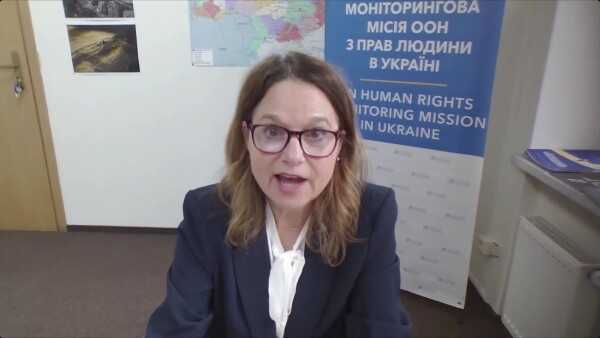
“On Monday, the Head of the UN Human Rights Monitoring Mission in Ukraine, Danielle Bell, visited several locations in Zaporizhzhia that had recently been struck by Russian glide bombs. These weapons carry large amounts of explosive material which – when deployed in cities and other populated areas – cause extensive civilian casualties and damage to civilian property,” Laurence added.
“Among the sites visited was an oncology centre hit by a glide bomb on 7 November at 2:30 PM, where cancer patients were undergoing chemotherapy at the time of the attack. The medical centre sustained severe damage and is now undergoing repairs,” Laurence stated.
Bell also visited the site of an apartment building where half of the structure was destroyed by another glide bomb, also on 7 November. In this incident, 10 people lost their lives.
“Colleagues in our Human Rights Monitoring Mission in Ukraine later spoke with a man whose home had been destroyed after two vehicles, thrown through the air by the blast wave on the same day, struck his house. Next door, a family suffered a devastating loss: their 20-year-old son was killed in the attack. His mother, who was severely injured, remains hospitalized. The family’s two-storey home, the largest in the neighborhood, was almost completely levelled by the glide bomb’s direct impact,” he said.
“As the High Commissioner has said, it has been 1,000 days too many of senseless pain and suffering. Violations of human rights have become the order of the day, both in the conduct of hostilities and in areas under occupation,” Laurence stated
“We call on all parties to ensure the safety and protection of civilians. Effective measures must also be taken to fully and impartially investigate where there are credible allegations of violations. The violence must stop – for the sake of the people of Ukraine, the people of Russia, and the world,” he said.
“The High Commissioner repeats his call on the Russian Federation to cease immediately its armed attack and to withdraw all of its military forces from Ukraine. Russia must meet its international obligations under the UN Charter, the order of the International Court of Justice and other applicable law,” Laurence stated
ENDS
For more information and media requests, please contact
In Geneva:
Liz Throssell + 41 22 917 9296 / elizabeth.throssell@un.org
Jeremy Laurence - + 41 22 917 9383 / jeremy.laurence@un.org
Tag and share - Twitter: @UNHumanRights and Facebook: unitednationshumanrights
STORY: UN Human Rights Spokesperson Jeremy Laurence on 1000 days since the Russian Federation launched its full-scale armed attack on Ukraine
TRT: 04:13
SOURCE: UNOG / OHCHR
RESTRICTIONS: NONE
LANGUAGE: English/NATS
ASPECT RATIO: 16:9
DATELINE: 19 November 2024 GENEVA, SWITZERLAND
SHOTLIST
- Exterior shot:
- SOUNDBITE (English)— Jeremy Laurence, Spokesperson for the Office of the UN High Commissioner for Human Rights (OHCHR): “ Today marks the grim milestone of 1,000 days since the Russian Federation launched its full-scale armed attack on Ukraine. Our Office has verified that at least 12,162 civilians have been killed since 24 February 2022, among them 659 children. At least another 26,919 civilians have been injured.”
- SOUNDBITE (English)— Jeremy Laurence, Spokesperson for the Office of the UN High Commissioner for Human Rights (OHCHR): “ Over the past two days, at least 30 civilians have reportedly been killed in a series of deadly strikes in residential areas in Sumy City, Odesa and Hlukhiv. In the very latest attack in Hlukhiv, which occurred late last night, nine civilians, including a child, were reportedly killed, and 11, including two children, injured. Search and rescue operations are ongoing.”
- SOUNDBITE (English)— Jeremy Laurence, Spokesperson for the Office of the UN High Commissioner for Human Rights (OHCHR): “On Monday, the Head of the UN Human Rights Monitoring Mission in Ukraine, Danielle Bell, visited several locations in Zaporizhzhia that had recently been struck by Russian glide bombs. These weapons carry large amounts of explosive material which – when deployed in cities and other populated areas – cause extensive civilian casualties and damage to civilian property .”
- SOUNDBITE (English)— Jeremy Laurence, Spokesperson for the Office of the UN High Commissioner for Human Rights (OHCHR): “Among the sites visited was an oncology centre hit by a glide bomb on 7 November at 2:30 PM, where cancer patients were undergoing chemotherapy at the time of the attack. The medical centre sustained severe damage and is now undergoing repairs .”
- SOUNDBITE (English)— Jeremy Laurence, Spokesperson for the Office of the UN High Commissioner for Human Rights (OHCHR): “Colleagues in our Human Rights Monitoring Mission in Ukraine later spoke with a man whose home had been destroyed after two vehicles, thrown through the air by the blast wave on the same day, struck his house. Next door, a family suffered a devastating loss: their 20-year-old son was killed in the attack. His mother, who was severely injured, remains hospitalized. The family’s two-storey home, the largest in the neighborhood, was almost completely levelled by the glide bomb’s direct impact .”
- SOUNDBITE (English)— Jeremy Laurence, Spokesperson for the Office of the UN High Commissioner for Human Rights (OHCHR): “As the High Commissioner has said, it has been 1,000 days too many of senseless pain and suffering. Violations of human rights have become the order of the day, both in the conduct of hostilities and in areas under occupation .”
- SOUNDBITE (English)— Jeremy Laurence, Spokesperson for the Office of the UN High Commissioner for Human Rights (OHCHR): “We call on all parties to ensure the safety and protection of civilians. Effective measures must also be taken to fully and impartially investigate where there are credible allegations of violations. The violence must stop – for the sake of the people of Ukraine, the people of Russia, and the world .”
- SOUNDBITE (English)— Jeremy Laurence, Spokesperson for the Office of the UN High Commissioner for Human Rights (OHCHR): “The High Commissioner repeats his call on the Russian Federation to cease immediately its armed attack and to withdraw all of its military forces from Ukraine. Russia must meet its international obligations under the UN Charter, the order of the International Court of Justice and other applicable law .”
Similar Stories

1
1
1
Edited News | UNICEF
A little over one year since a ceasefire agreement was announced between Hamas fighters and Israel, more than 340 children have been reported killed and hundreds more injured, the UN Children’s Fund, UNICEF, said on Friday.

1
1
1
Edited News | UNICEF , IFRC
Six weeks after Nepal’s deadly flooding disaster, communities are still struggling to rebuild their lives, but they will need sustained help as global warming increases the risk of another Himalayan catastrophe, the UN Children’s Fund (UNICEF) said on Friday.

1
1
1
Edited News | WHO
In suspected Russia plague death, testing and monitoring underway – WHO
The death of a lab worker in Russia’s Siberia region has sparked concerns about plague being the cause, the UN World Health Organization (WHO) said on Tuesday, adding that it was following the situation closely.

1
1
Edited News | OHCHR , UNOG
UN Human Rights Chief Volker Türk on Friday provided and oral update to the 63rd session of the Human rights Council on Ukraine.

1
1
1
Edited News | OHCHR , UNOG
UN Human Rights Chief Volker Türk on Friday provided and oral update to the 63rd session of the Human rights Council on the human rights situation in Haiti.

1
1
1
Edited News | WHO
Repeated delays in bringing lifesaving medicines, prosthetics and more from Israel into Gaza risk having devastating consequences on Palestinians who urgently need them in the wartorn enclave, the UN World Health Organization (WHO) said on Friday. “A truck full of non-priority supplies or the right supplies arriving too late, doesn't save lives. That's the question that actually matters," said Dr Reinhilde Van De Weerdt, WHO Representative in the OPT.

1
1
1
Edited News | WHO
DRC: Early access to care and oxygen decisive for Ebola patients’ survival – WHO
In the Democratic Republic of the Congo (DRC), health workers fighting the country’s largest-ever Ebola outbreak are struggling to overcome critical challenges to patient care, the UN World Health Organization (WHO) warned on Tuesday.

1
1
1
Edited News | OCHA , UN
Civilians in Iran are continuing to feel the consequences of months of conflict and military escalation, the UN’s top official in the country has said, as loss of life, damage to civilian infrastructure and mounting economic pressures leave many facing continued uncertainty.
1
1
1
Edited News | WHO , UNICEF
Aid agencies in Yemen highlighted the growing hunger emergency sparked by renewed fighting between Houthi opposition forces and Government troops, after mobile health clinics reported that hundreds of children displaced by the violence are suffering from the most deadly form of malnutrition.
1
1
1
Edited News | UNHCR
Displacement on the rise in Yemen as fighting continues - UNHCR
As hostilities worsen in Yemen, more people have been fleeing their homes, further intensifying the humanitarian crisis within the region, the UN Refugee Agency (UNHCR) warned on Tuesday.
1
1
1
Edited News | IOM , OHCHR , UNFPA , UNOG , UNHCR , WHO
Yemen’s humanitarian crisis growing by the hour amid spike in displacement
Yemenis displaced by renewed fighting have described fleeing for their lives amid shelling and gunfire, aid agencies reported on Friday, while highlighting the dramatic increase in humanitarian needs in the country and in Djibouti, where thousands have sought shelter.
1
1
1
Edited News | OHCHR , UNOG
The UN Human Rights Office issued on Friday a report documenting a shocking pattern of sexual violence amid Russia’s full-scale armed attack on Ukraine.