UNRWA – Press conference: Philippe Lazzarini
/
44:20
/
MP4
/
2.6 GB
Teleprompter
Download Expired

Edited News , Press Conferences | UNRWA

UNRWA – Press conference: Philippe Lazzarini

Gaza: more aid needed urgently to prevent a worsening famine trend, says UNRWA chief
The United Nations Relief and Works Agency for Palestine Refugees in the Near East (UNRWA) warns that much more assistance to Palestinians in Gaza is necessary to prevent a worsening famine trend, despite some recent improvements in the flow of aid.
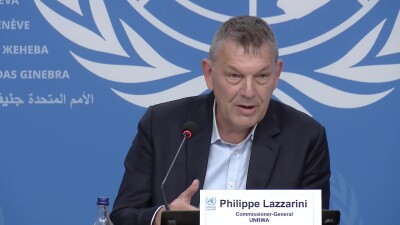
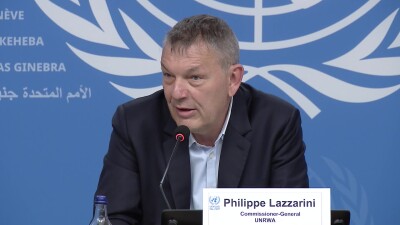
“We believe that that much more needs to be done. It is true that there have been more supply entering during the months of April, but this is still far from enough to reverse the negative trend we have seen,” said UNRWA Commissioner-General Philippe Lazzarini.
Highlighting the urgency of the situation, Mr. Lazzarini described the efforts to combat hunger as "a race against the clock," particularly in northern Gaza. He noted that although food is available in local markets, accessibility remains a challenge due to the lack of circulating cash in the region.
Mr. Lazzarini also addressed ongoing concerns about the Israeli hostages held by Hamas and Palestinian detainees in Israeli custody, stressing the need for their unconditional and immediate release.
“Hostages are still in captivity with the Hamas and that […] the Secretary-General, [me and] other UN officials keep asking for the unconditional and immediate release of the hostages,” Mr. Lazzarini said. “But I have also shared our deep concern regarding the Gazans detained by Israeli security forces,” he added.
According to testimonies received by UNRWA,Palestinian detainees often face severe mistreatment. “People have told us that they are routinely rounded up when they were arrested, […] stripped to the underwear and loaded into trucks, blindfolded and bombed,” Mr. Lazzarini reported. “Most of the time, once arrested, these detainees remain incommunicado and they are subjected to shocking, inhuman treatment. Among the inhuman treatment they have described to us waterboarding, severe beatings, attacked by dogs,” he added.
The fear of an Israeli attack into Rafah, the southern part of the Gaza strip, adds to the constant state of trauma among the people there, Mr. Lazzarini reported.
Regarding UNRWA's funding crisis, Mr. Lazzarini revealed that sixteen countries suspended contributions to the agency, but most have since resumed their support. “Up to sixteen countries suspended the contribution to the Agency (UNRWA). The good news is that, as of today, most of the donor countries have resumed their contribution to the Agency. We just have a handful of countries who still need to take a decision. We know that the main contributor, the US, has indicated that they will not be able to support the Agency before March 2025,” Mr. Lazzarini said.
Despite challenges, UNRWA has secured USD 115 million in private funding and received contributions from previously non-contributing countries, ensuring its humanitarian operations can continue until June.
Following allegations against some UNRWA staff in the Hamas attack of 7 October, some donor countries withheld funds from the agency. However, an independent review led by the former French foreign minister Catherine Colonna, to assess whether UNRWA is doing everything within its power to ensure neutrality, found UNRWA’s procedures to be robust.
UNRWA remains the largest humanitarian organization in besieged Gaza, providing the backbone to aid operations in the enclave, where over 34,000 Palestinians have been killed since October 7, according to authorities. The Commissioner-General asserted that if the political will exists to reactivate and pursue a two-state solution, UNRWA could once again regain its vocation as a temporary aid agency. In such a context, the agency could also play a vital role in the transition to the establishment of a Palestinian state, he said.
“If really today there is a genuine commitment to reactivate and bring back the two-state solution on the table, the agency can retrieve its temporary nature and supporting the transition leading to the two- state solution, the transition leading to the day after,” Mr. Lazzarini said.
-ends-

STORY: Update situation in the OPT - UNRWA

TRT: 2:41”

SOURCE: UNTV CH

RESTRICTIONS: NONE

LANGUAGE: ENGLISH / NATS

ASPECT RATIO: 16:9

DATELINE: 30 April 2024 GENEVA, SWITZERLAND

  1. Exterior med shot: UN flag alley
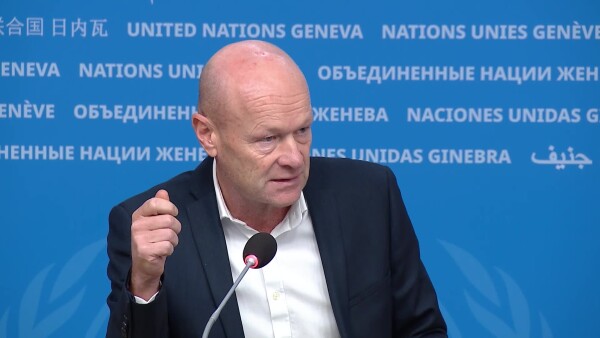
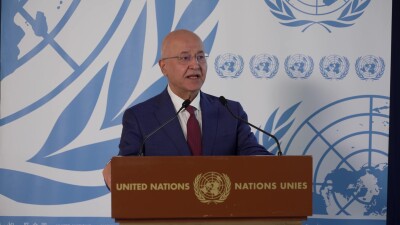
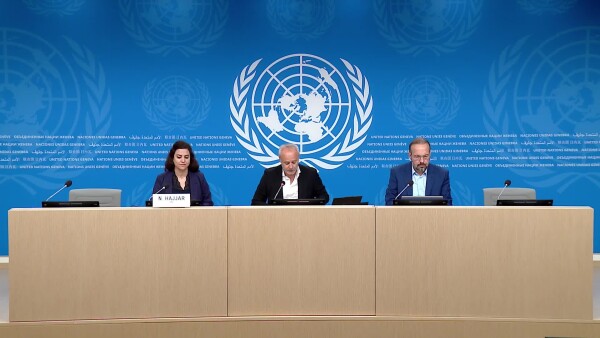
  2. Wide shot: Speaker at the podium during press conference with journalists
  3. SOUNDBITE (English) – Philippe Lazzarini, Commissioner-General, UNRWA: “We believe that that much more needs to be done. It is true that there have been more supply entering during the months of April, but this is still far from enough to reverse the negative trend we have seen.”
  4. Wide shot: Speakers at the podium, with photographers and journalists in the room
  5. SOUNDBITE (English) – Philippe Lazzarini, Commissioner-General, UNRWA: “Hostages are still in captivity with the Hamas and that both, the Secretary-General, myself but other UN officials keep asking for the unconditional and immediate release of the hostages. But I have also shared this morning our deep concern regarding the Gazans detained by Israeli security forces.”
  6. Med shot: speakers at the podium with journalists in room
  7. SOUNDBITE (English) – Philippe Lazzarini, Commissioner-General, UNRWA: “People have told us that they are routinely rounded up when they were arrested, they were routinely rounded up, stripped to the underwear and loaded into trucks, blindfolded and bombed. Most of the time, once arrested, these detainees, remain incommunicado and they are subjected to shocking, inhuman treatment. Among the inhuman treatment they have described to us waterboarding, severe beatings, attacked by dogs.”
  8. Med shot: Journalists in the press room
  9. SOUNDBITE (English) – Philippe Lazzarini, Commissioner-General, UNRWA: “Up to sixteen countries suspended the contribution to the Agency (UNRWA). The good news is that, as of today, most of the donor countries have resumed their contribution to the Agency. We just have a hand full of country who still need to take a decision. We know that the main contributor, the US, has indicated that they will not be able to support the Agency before March 2025.”
  10. Med shot, journalist listening in press briefing
  11. SOUNDBITE (English) – Philippe Lazzarini, Commissioner-General, UNRWA: “If really today there is a genuine commitment to reactivate and bring back the two- state solution on the table, the Agency can retrieve its temporary nature and supporting the transition leading to the two- state solution, the transition leading to the day after.”
  12. Med shot, cameraman filming with speaker on screen
  13. Wide shot, cameramen filming with journalist listening

Documents 1
Download Storyline
Download Expired

Audio Files 2
Download UNRWA – Press conference: Philippe Lazzarini (Continuity)
Download Expired
Download Update on the situation in the OPT - UNRWA Commissioner General 30 April 2024
Download Expired

Similar Stories

HRC - Press conference: Fact-Finding Mission on the Bolivarian Republic of Venezuela

1

1

1

Press Conferences | HRC

HRC - Press conference: Fact-Finding Mission on the Bolivarian Republic of Venezuela ENG FRA

Press conference on the latest report of the Independent International Fact-Finding Mission on the Bolivarian Republic of Venezuela to the UN Human Rights Council

OHCHR - Press conference: A Global Briefing on Transitional Justice Around the World

1

1

1

Press Conferences | OHCHR

OHCHR - Press conference: A Global Briefing on Transitional Justice Around the World ENG FRA

Victims Still Waiting: A Global Briefing on Transitional Justice Around the World


WMO - Press conference: State of Global Water Resources Report 2025 (embargo lifts 6am CET 17 Sept.)

2

1

2

Edited News , Press Conferences | WMO

WMO - Press conference: State of Global Water Resources Report 2025 (embargo lifts 6am CET 17 Sept.) ENG FRA

As world’s water reserves change, countries must prepare for a new reality: WMO

New data showing that rivers were at their lowest level for decades last year provides further evidence that the climate crisis is real and countries must act immediately to protect themselves from the increasing threat to communities and livelihoods, the UN World Meteorological Organization (WMO) said on Thursday.  
The key findings from WMO’s State of Global Water Resources 2025 report covering the hydrological cycle and extreme events in the five-year period to last year:

  • 2025 was one of driest years for river discharge in 35 years
  • Past seven years have seen abnorfmal river flows
  • Water storage on Earth’s land surface has decreased in past decade
  • Widespread glacier loss across all regions for fourth consecutive year
  • Asia and Africa are regions most affected by water-related disasters
  • Water data availability has improved, but gaps remain in hard-hit areas

Highlighting the long-term decline in the Earth’s freshwater storage and glacier melt, WMO Secretary-General Celeste Saulo explained that the planet’s water reserves used to act as a planetary “savings account” that absorbed the occasional dry season, avoiding a water crisis. “One of the central stories of the 2025 report is what is happening to that savings account? And the simple answer is that we are depleting it,” she told journalists in Geneva.

Groundwater reserves are equally stretched and have been in decline since 2014, WMO’s report states, with nearly two-thirds of monitored wells worldwide showing levels lower than the historical norm and indicating a shift “further toward deficit…not recovery”.
“At the same time, we are seeing more water-related disasters,” Ms. Saulo said, while also stressing that the currently strengthening El Niño “will increase the risk of drought in some areas, and flooding in others”. 
Glaciers disappearing

In 2025, for the fourth consecutive year, every major glaciated region on Earth lost ice mass, leading to short-term hazards including floods and long-term water insecurity, according to WMO.

Responding to a question about whether the changing global water cycle might have contributed to the deadly Nepal-China flooding disaster, Ms. Saulo explained that melting ice and rock was just one factor in the chain of events that ultimately sent a massive and deadly wall of water and debris downstream on 26 August, killing at least 1,367 people.

You asked if it could happen again? Absolutely; the problem in this region is that there’s 63,700 glaciers at the last count,” she told a Press Conference in Geneva. “Even if you’re looking with remote sensing with satellites at these glaciers, you might see some faults, you might see some slight shifting, that does not mean necessarily catastrophic collapse. So, in order to plan for this, it’s very, very difficult. But the international community is looking very hard at ways in which we can bring people together to solve some of these monitoring issues.”

Data indicates that glaciers shrank between 2023 and 2025 with cumulative losses of 1,400 gigatonnes of water – or about one third of annual fresh water needs.

Every major glacier region on Earth lost ice for the fourth consecutive year.

“All 19 glacier regions around the globe lost ice; in Central Asia, Iceland, the Russian Arctic and western Canada and the United States, it was among the three worst years on record,” said Wayne Jenkinson, WMO’s Director of Hydrology and Cryosphere.

Some regions with smaller glaciers such as Central Europe, the Caucasus, the western Canada and the United States may already have reached “peak water”, Mr. Jenkinson warned.

“After this point, the glacier gives less meltwater each year simply because there is less ice left to melt. That matters for every community downstream that relies on water during hot, dry summers,” he explained.

Narelle van der Wel, WMO’s Head of Cryosphere Monitoring, Predictions and Services, stressed that while some further glacier loss is unavoidable, the eventual scale of the decline is not predetermined.

“Some glacier loss is inevitable, but total loss of glaciers is not yet inevitable,” she said, pointing to emissions reductions as central to limiting future losses.

Preparing for moving baselines

The report does not attribute every observed change to climate change alone. WMO says pressure on water resources and natural variability also contribute.

Mr. Jenkinson said governments need to prepare for “moving baselines” as historical patterns become less reliable.

“The situation 30 years ago is not where we are today,” he said. Countries, he added, need to prepare “for those changes that have really already arrived”.

ends

DR Congo Ebola update - OCHA, WHO

1

1

1

Edited News | OCHA , WHO

DR Congo Ebola update - OCHA, WHO ENG FRA

The deadly Ebola virus outbreak in DR Congo continues to spread across the vast country despite some success in containing it, aid officials said on Tuesday, in a renewed call for international support to help responders on the ground.

UN Geneva Press Briefing - 15 September 2026

1

1

1

Press Conferences | WMO , OCHA , WHO , UNICEF , UN WOMEN , OHCHR , IOM , UNHCR

UN Geneva Press Briefing - 15 September 2026 ENG FRA

Update on Ebola from WHO and OCHA, update on the situation of children with the beginning of school in Ukraine from UNICEF, UN Women on the impact of the settlers and restrictions on women and girls in West Bank, OHCHR on the recovery of extensive human remains in Gaza, IOM and UNHCR on the new wave of displacement in Yemen 

South Sudan hunger crisis - WFP

2

1

2

Press Conferences , Edited News | WFP

South Sudan hunger crisis - WFP ENG FRA

‘Super El Niño’ and converging crises worsen hunger in South Sudan and across the region - WFP

South Sudan’s hunger crisis is becoming increasingly catastrophic as violence, extreme weather and dwindling aid leave millions without enough food, the UN World Food Programme (WFP) warned on Tuesday.

HRC - Press conference: Group of Independent Experts on Belarus

1

1

1

Press Conferences | HRC

HRC - Press conference: Group of Independent Experts on Belarus ENG FRA

Update on the human rights situation in Belarus by the UN Group of Independent Experts on the Human Rights Situation in Belarus

HRC CoI on Syria Press conference - 08 September 2026

1

1

1

Press Conferences | HRC , OHCHR

HRC CoI on Syria Press conference - 08 September 2026 ENG FRA

Update on the human rights situation in Syria by the Independent International Commission of Inquiry on the Syrian Arab Republic

Gaza update - UN Women

1

1

1

Edited News | UN WOMEN

Gaza update - UN Women ENG FRA

In war-torn Gaza, a growing number of women-headed households face “impossible decisions” every day, amid ongoing Israeli airstrikes and still-scarce resources, UN humanitarians said on Tuesday.

UN Geneva Press Briefing - 08 September 2026

1

1

1

Press Conferences | UNOG , IOM , UN WOMEN , UNCTAD , WHO , UNECE

UN Geneva Press Briefing - 08 September 2026 ENG FRA

IOM Yemen's Western Coast displacement; UN WOMEN on Gaza; UNCTAD Strait of Hormuz disruptions impacts; WHO Ebola logistics in DRC; WHO smoking and infertility; UNECE Data centres and energy.

UN High Commissioner for Human Rights Volker Türk’s remarks during the human rights council interactive dialogue on Myanmar

1

1

1

Edited News | OHCHR , UNOG

UN High Commissioner for Human Rights Volker Türk’s remarks during the human rights council interactive dialogue on Myanmar ENG FRA

UN Human Rights Chief Volker Türk made the following remarks to the Enhanced Interactive Dialogue on the Independent Investigative Mechanism for Myanmar at the 63rd Human Rights Council.

UN High Commissioner for Human Rights Volker Türk’s Global Update to the 63rd session of the Human Rights Council

1

Edited News | OHCHR , UNOG

UN High Commissioner for Human Rights Volker Türk’s Global Update to the 63rd session of the Human Rights Council ENG FRA

UN Human Rights Chief Volker Türk today delivered an update on the global human rights situation to the 63rdsession of the Human Rights Council in Geneva.