

The United Nations Office at Geneva
Multimedia Newsroom
STORYLINE
Following the serious allegations that several staff working for the UN agency assisting Palestine refugees (UNRWA) in the Gaza Strip were involved in the 7 October terror attacks in southern Israel which has led numerous states to temporarily suspend their payment to the aid organization, the World Health Organization (WHO) today (30 January) appealed to donors “not to suspend their funding to UNRWA at this critical moment. Cutting of funding will only hurt the people of Gaza who desperately needs support”.
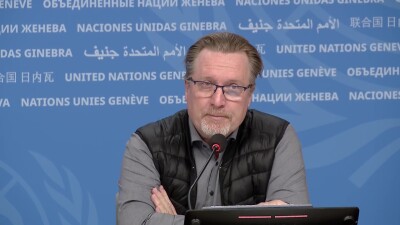
When briefing journalists at the UN in Geneva, WHO’s spokesperson Christian Lindmeier said that “criminal activity can never go unpunished. But the discussion right now is much of a distraction from what's really going on every day, every hour, every minute in Gaza. It's a distraction from close to 27,000 deaths by now, out of which 70 per cent are women and children.”
Mr. Lindmeier added that “it's a distraction from preventing an entire population from access to clean water, food, shelter. It's a distraction from preventing electricity to come into Gaza for more than 100 days.”
In addition to its programmes in the Gaza Strip, UNRWA provides vital humanitarian aid to Palestine refugees in Jordan, Lebanon, Syria, and in the West Bank including East Jerusalem.
In the Gaza Strip, the agency is providing lifesaving aid to over two million civilians, operating shelters for over one million and providing food, water and healthcare services.
Mr. Lindmeier reminded of a very dire situation where the “food and water situation is extremely bad, food cut off in Gaza since more than 100 days, fresh water supplies are cut off, water is mixed with wastewater”. Also, the pumping stations are not working because of a lack of fuel and the population is at the border of famine.
“We had a convoy just this morning trying to reach Nasser Hospital with patients, health care staff, everybody. They are needing food, but the very needy population already before basically took the supplies - as we can call it - this was a self-distribution of supplies, which only shows how dire the needs are,” said the WHO spokesperson.
According to the latest report of the UN Office for the Coordination of Humanitarian Affairs (OCHA), hostilities were particularly intense in Khan Younis, with heavy fighting reported near Nasser and Al Amal hospitals. There are also reports of Palestinians fleeing to the southern town of Rafah, which is already overcrowded, despite the lack of safe passage.
OCHA’s spokesperson Jens Laerke emphasized that “UNRWA has not stopped working, UNRWA continues to work. It's the pipeline of funding that is in danger while it’s irreplaceable in the humanitarian operation.”
UN Secretary-General Antonio Guterres will host a meeting today (30 January) with major UNRWA donors in New York to issue an urgent plea to keep lifesaving funds flowing.
-ends-
STORY: Gaza Update – WHO, OCHA
TRT: 2:09”
SOURCE: UNTV CH
RESTRICTIONS: NONE
LANGUAGE: ENGLISH / NATS
ASPECT RATIO: 16:9
DATELINE: 30 January 2024 GENEVA, SWITZERLAND
- Exterior medium shot: UN flag alley
- Wide shot: speakers at the press conference
- SOUNDBITE (English) – Christian Lindmeier, spokesperson for the World Health Organization (WHO): “Criminal activity can never go unpunished. But the discussion right now is much of a distraction from what's really going on every day, every hour, every minute in Gaza. It's a distraction from close to 27,000 deaths by now, out of which 70 per cent are women and children.”
- Wide shot: press room with journalists
- SOUNDBITE (English) – Christian Lindmeier, spokesperson for the World Health Organization (WHO): “It's a distraction from preventing an entire population from access to clean water, food, shelter. It's a distraction from preventing electricity to come into Gaza for more than 100 days.”
- Medium shot: journalist standing in press room
- SOUNDBITE (English) – Christian Lindmeier, spokesperson for the World Health Organization (WHO): “We appeal to donors not to suspend their funding to UNRWA at this critical moment. Cutting of funding will only hurt the people of Gaza who desperately needs support”.
- Close up: journalist typing in laptop
- SOUNDBITE (English) – Christian Lindmeier, spokesperson for the World Health Organization (WHO): “We had a convoy just this morning trying to reach Nasser Hospital with patients, health care staff, everybody. They are needing food, but the very needy population already before basically took the supplies - as we can call it - this was a self-distribution of supplies, which only shows how dire the needs are.”
- Wide shot: press room with journalists and speakers at the podium
- SOUNDBITE (English) – Jens Laerke, spokesperson for the UN Office for the Coordination of Humanitarian Affairs (OCHA): “UNRWA has not stopped working, UNRWA continues to work. It's the pipeline of funding that is in danger while it’s irreplaceable in the humanitarian operation.”
- Close up, journalist typing
- Close up, journalist listening
- Close up, journalist reading
Similar Stories

1
1
1
Edited News | OCHA , UNICEF , WFP
Aid agencies warned on Friday of the fast-developing humanitarian emergency inside Taiz City in Yemen, which has been encircled by de facto Houthi forces fighting government troops along the country’s west coast.

2
17
1
2
Edited News , Press Conferences , Images | OCHA , WMO
Two UN agencies teamed up on Wednesday to issue an appeal for immediate assistance to help communities already being impacted by the strongest El Niño on record.

3
16
2
2
Edited News , B-roll , Conferences , Images | UNITED NATIONS , UNOG
Sixth Consultative Meeting on Enhancing Coordination of Peace Initiatives and Efforts for Sudan

1
1
1
Edited News | UNICEF , WHO , UNHCR
Yemen war continues to force families from homes amid hunger and disease
More than 250,000 people have now fled renewed fighting in Yemen, the UN said on Tuesday, citing particular concern for those sheltering in the southwestern city of Taiz and the wider governorate, where access is “essentially blocked”.

1
1
1
Edited News | UNICEF
A little over one year since a ceasefire agreement was announced between Hamas fighters and Israel, more than 340 children have been reported killed and hundreds more injured, the UN Children’s Fund, UNICEF, said on Friday.

1
1
1
Edited News | UNICEF , IFRC
Six weeks after Nepal’s deadly flooding disaster, communities are still struggling to rebuild their lives, but they will need sustained help as global warming increases the risk of another Himalayan catastrophe, the UN Children’s Fund (UNICEF) said on Friday.

1
1
1
Edited News | WHO
In suspected Russia plague death, testing and monitoring underway – WHO
The death of a lab worker in Russia’s Siberia region has sparked concerns about plague being the cause, the UN World Health Organization (WHO) said on Tuesday, adding that it was following the situation closely.

1
1
Edited News | OHCHR , UNOG
UN Human Rights Chief Volker Türk on Friday provided and oral update to the 63rd session of the Human rights Council on Ukraine.

1
1
1
Edited News | OHCHR , UNOG
UN Human Rights Chief Volker Türk on Friday provided and oral update to the 63rd session of the Human rights Council on the human rights situation in Haiti.

1
1
1
Edited News | WHO
Repeated delays in bringing lifesaving medicines, prosthetics and more from Israel into Gaza risk having devastating consequences on Palestinians who urgently need them in the wartorn enclave, the UN World Health Organization (WHO) said on Friday. “A truck full of non-priority supplies or the right supplies arriving too late, doesn't save lives. That's the question that actually matters," said Dr Reinhilde Van De Weerdt, WHO Representative in the OPT.

1
1
1
Edited News | WHO
DRC: Early access to care and oxygen decisive for Ebola patients’ survival – WHO
In the Democratic Republic of the Congo (DRC), health workers fighting the country’s largest-ever Ebola outbreak are struggling to overcome critical challenges to patient care, the UN World Health Organization (WHO) warned on Tuesday.

1
1
1
Edited News | OCHA , UN
Civilians in Iran are continuing to feel the consequences of months of conflict and military escalation, the UN’s top official in the country has said, as loss of life, damage to civilian infrastructure and mounting economic pressures leave many facing continued uncertainty.