

The United Nations Office at Geneva
Multimedia Newsroom
UN human rights office concerned about violence spilling into Rafah amid disastrous living conditions
As conflict in Gaza intensifies in the Khan Younis area and pushes more Palestinians south in search of shelter, increasingly desperate civilians continue to bear the brunt of the escalation, the UN human rights office said on Friday.
“In Rafah, I saw displaced people who had been ordered by Israeli authorities to leave their homes with no provision for their accommodation, literally living on the street with sewage running in the streets, and conditions of desperation conducive for a complete breakdown in order,” said Ajith Sunghay, Head of the UN Human Rights Office for the Occupied Palestinian Territory.
Speaking from Jordan’s capital, Amman, to journalists in Geneva, the OHCHR officer added that people feared the extreme violence would “spill into Rafah, with catastrophic implications for the more than 1.3 million people already crowded there”, almost 50 per cent of the population of the Strip.
Intense fighting in and around Khan Younis, in southwest Gaza, in the last three days has claimed lives and damaged vital civilian infrastructure. On Wednesday, a strike against a UN shelter in Khan Younis killed 13 people and injured 56, despite being an area where the Israeli military had previously told Gazans to flee for their safety, explained Mr. Sunghay.
“The Israeli Defense Forces’ (IDF) shelling continues in areas that it has unilaterally designated as safe areas, including a mosque in western Khan Yunis. Even after explosions were reported in Al-Mawasi on 22 and 23 January, the IDF continued to order residents of western Khan Younis to move there,” he said.
Evacuation orders were reissued “repeatedly” on 23, 24 and 25 January, reportedly impacting more than half a million people as well as three hospitals which have faced heavy attacks and siege. “The continued attacks on specifically protected facilities such as hospitals will kill civilians and there will be a further massive impact on access to health care, safety and security in general of Palestinians,” Mr. Sunghay maintained.
The development came as the Israel military continues its offensive against Hamas amid reports that Israeli leaders have said that to complete their destruction of Hamas, they must eventually widen their offensive to Rafah, at the border crossing with Egypt.
“That will be disastrous because there are two places’ people can flee to,” explained Mr. Sunghay.
“On one side you have the Mediterranean Sea, on the other side you have the Egyptian border. You have fighting? in the north and you have fighting? on the Khan Younis side. So, you can only speculate what's going to happen. We are talking about 1.3 million already. If you have people moving in large numbers from Khan Younis and other places, this is going to be a massive catastrophe.”
Amid Israeli airstrikes and street-to-street fighting between IDF soldiers and Palestinian armed groups, the UN World Health Organization (WHO) also reiterated serious concerns for healthcare workers and patients caught up in the violence.
Since war erupted in Gaza, there have been “676 attacks verified in the occupied Palestinian territories”, said Christian Lindmeier, WHO spokesperson. “That's 318 in Gaza and 358 in the West Bank. It's always important to note that we have more attacks in the West Bank than in Gaza,” he added. According to the UN health agency, “only 14 hospitals out of the 36 health facilities are still functioning, seven in the south and seven in the north. Twenty hospitals are not functioning at all.”
Since 7 October when heavy Israeli bombardment began in Gaza in response to Hamas-led terror attacks in which some 1,200 people were butchered and more than 250 taken hostage, more than 26,000 Palestinians have died, according to the enclave’s health officials. A full 75 per cent of the victims are children and women, and there have been at least 60,000 registered injuries. The UN health agency said that an estimated additional 8,000 are missing, presumed dead under the rubble.
Ends
Story: Gaza update
Speakers:
- Ravina Shamdasani, OHCHR Spokesperson
- Ajith Sunghay, Head of the UN Human Rights Office for the Occupied Palestinian Territory (speaking from Jordan) and
- Christian Lindmeier, WHO Spokesperson
TRT: 3’32”
SOURCE: UNTV CH
LANGUAGE: ENGLISH
ASPECT RATIO: 16:9
DATELINE: 26 January 2024 - GENEVA, SWITZERLAND
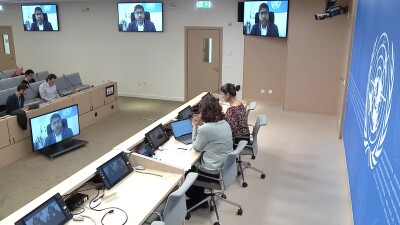
Geneva press briefing at UNOG
SHOTLIST
- Exterior medium shot: UN flag alley
- Wide shot: speakers at the press conference
- SOUNDBITE (English) – Ajith Sunghay, Head of UN Human Rights Office in the Occupied Palestinian Territory: “In Rafah, I saw displaced people who had been ordered by Israeli authorities to leave their homes, with no provision for their accommodation, literally living on the street, with sewage running in the streets and conditions of desperation conducive for a complete breakdown in order.”
- Wide shot: press room with journalists and speakers at the podium
- SOUNDBITE (English) – Ajith Sunghay, Head of UN Human Rights Office in the Occupied Palestinian Territory: “The people I spoke to fear the extreme violence is spilling into Rafah, which will have catastrophic implications for the more than 1.3 million people already crowded there. The IDF (Israel Defense Forces) shelling continues in areas that were unilaterally designated as “safe” areas, including Al-Mawasi in western Khan Younis. Even after the explosions were reported in Al-Mawasi on 22nd and 23rd January, the IDF continued to order residents of western Khan Younis to move there.”
- Medium shot: press room with journalists and speakers at the podium and photographer
- SOUNDBITE (English) – Ajith Sunghay, Head of UN Human Rights Office in the Occupied Palestinian Territory: “Having personally witnessed and heard the testimonies of those who have endured so much pain and suffering, I am very, very worried. I fear that many more civilians will die. The continued attacks on specifically protected facilities, such as hospitals, will kill civilians, and there will be a further, massive impact on access to health care, safety and security in general of Palestinians.”
- Medium shot: podium with speakers and screen showing remote speaker
- SOUNDBITE (English) – Ajith Sunghay, Head of UN Human Rights Office in the Occupied Palestinian Territory: “If the incursions and the bombardments or the street-to-street fights move from Khan Younis into Rafah, that will be disastrous further, because there are only two places people can flee to: on one side you have the Mediterranean Sea, on the other side you have the Egyptian border. You have fight in the north, and you have fight on the Khan Younis side. So, you can only speculate what's going to happen. And we are talking about 1.3 million already, and if you have people moving in large numbers from Khan Younis and other places, this is going to be a massive catastrophe.”
- Medium shot: press room with journalists and speaker on screen
- SOUNDBITE (English) – Christian Lindmeier, spokesperson for the World Health Organization (WHO): “We have now registered over 26,000 deaths with 75 per cent being children and women, and at least 60,000 registered injuries. But as colleagues also just said, over 8,000 are missing and presumed dead under the rubble, they have not yet been counted into the casualty count.”
- Wide shot: press room with journalists and speakers at the podium
- SOUNDBITE (English) – Christian Lindmeier, spokesperson for the World Health Organization (WHO): “We have 676 attacks verified in the occupied Palestinian territories, and that's 318 in Gaza and 358 in the West Bank. I find this is always important to note that we have more attacks in the West Bank than in Gaza and that's with the horrific scenario we know from Gaza.”
- Wide shot: press briefing room with journalists and speakers at the podium
- SOUNDBITE (English) – Christian Lindmeier, spokesperson for the World Health Organization (WHO): “Only 14 out of the 36 health facilities, the hospitals, are partially functioning for the whole of Gaza: seven in the south, seven in the north, 20 hospitals are not functioning at all.”
- Close up, journalist listening
- Medium shot, journalists listening
Similar Stories

1
1
1
Edited News | WHO
In suspected Russia plague death, testing and monitoring underway – WHO
The death of a lab worker in Russia’s Siberia region has sparked concerns about plague being the cause, the UN World Health Organization (WHO) said on Tuesday, adding that it was following the situation closely.

1
1
Edited News | OHCHR , UNOG
UN Human Rights Chief Volker Türk on Friday provided and oral update to the 63rd session of the Human rights Council on Ukraine.

1
1
1
Edited News | OHCHR , UNOG
UN Human Rights Chief Volker Türk on Friday provided and oral update to the 63rd session of the Human rights Council on the human rights situation in Haiti.

1
1
1
Edited News | WHO
Repeated delays in bringing lifesaving medicines, prosthetics and more from Israel into Gaza risk having devastating consequences on Palestinians who urgently need them in the wartorn enclave, the UN World Health Organization (WHO) said on Friday. “A truck full of non-priority supplies or the right supplies arriving too late, doesn't save lives. That's the question that actually matters," said Dr Reinhilde Van De Weerdt, WHO Representative in the OPT.

1
1
1
Edited News | WHO
DRC: Early access to care and oxygen decisive for Ebola patients’ survival – WHO
In the Democratic Republic of the Congo (DRC), health workers fighting the country’s largest-ever Ebola outbreak are struggling to overcome critical challenges to patient care, the UN World Health Organization (WHO) warned on Tuesday.

1
1
1
Edited News | OCHA , UN
Civilians in Iran are continuing to feel the consequences of months of conflict and military escalation, the UN’s top official in the country has said, as loss of life, damage to civilian infrastructure and mounting economic pressures leave many facing continued uncertainty.
1
1
1
Edited News | WHO , UNICEF
Aid agencies in Yemen highlighted the growing hunger emergency sparked by renewed fighting between Houthi opposition forces and Government troops, after mobile health clinics reported that hundreds of children displaced by the violence are suffering from the most deadly form of malnutrition.
1
1
1
Edited News | UNHCR
Displacement on the rise in Yemen as fighting continues - UNHCR
As hostilities worsen in Yemen, more people have been fleeing their homes, further intensifying the humanitarian crisis within the region, the UN Refugee Agency (UNHCR) warned on Tuesday.
1
1
1
Edited News | IOM , OHCHR , UNFPA , UNOG , UNHCR , WHO
Yemen’s humanitarian crisis growing by the hour amid spike in displacement
Yemenis displaced by renewed fighting have described fleeing for their lives amid shelling and gunfire, aid agencies reported on Friday, while highlighting the dramatic increase in humanitarian needs in the country and in Djibouti, where thousands have sought shelter.
1
1
1
Edited News | OHCHR , UNOG
The UN Human Rights Office issued on Friday a report documenting a shocking pattern of sexual violence amid Russia’s full-scale armed attack on Ukraine.
2
1
2
Edited News , Press Conferences | WMO
As world’s water reserves change, countries must prepare for a new reality: WMO
New data showing that rivers were at their lowest level for decades last year provides further evidence that the climate crisis is real and countries must act immediately to protect themselves from the increasing threat to communities and livelihoods, the UN World Meteorological Organization (WMO) said on Thursday.
The key findings from WMO’s State of Global Water Resources 2025 report covering the hydrological cycle and extreme events in the five-year period to last year:
- 2025 was one of driest years for river discharge in 35 years
- Past seven years have seen abnorfmal river flows
- Water storage on Earth’s land surface has decreased in past decade
- Widespread glacier loss across all regions for fourth consecutive year
- Asia and Africa are regions most affected by water-related disasters
- Water data availability has improved, but gaps remain in hard-hit areas
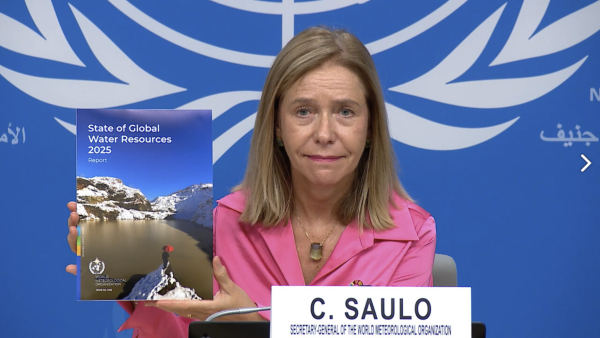
Highlighting the long-term decline in the Earth’s freshwater storage and glacier melt, WMO Secretary-General Celeste Saulo explained that the planet’s water reserves used to act as a planetary “savings account” that absorbed the occasional dry season, avoiding a water crisis. “One of the central stories of the 2025 report is what is happening to that savings account? And the simple answer is that we are depleting it,” she told journalists in Geneva.
Groundwater reserves are equally stretched and have been in decline since 2014, WMO’s report states, with nearly two-thirds of monitored wells worldwide showing levels lower than the historical norm and indicating a shift “further toward deficit…not recovery”.
“At the same time, we are seeing more water-related disasters,” Ms. Saulo said, while also stressing that the currently strengthening El Niño “will increase the risk of drought in some areas, and flooding in others”.
Glaciers disappearing
In 2025, for the fourth consecutive year, every major glaciated region on Earth lost ice mass, leading to short-term hazards including floods and long-term water insecurity, according to WMO.
Responding to a question about whether the changing global water cycle might have contributed to the deadly Nepal-China flooding disaster, Ms. Saulo explained that melting ice and rock was just one factor in the chain of events that ultimately sent a massive and deadly wall of water and debris downstream on 26 August, killing at least 1,367 people.
“You asked if it could happen again? Absolutely; the problem in this region is that there’s 63,700 glaciers at the last count,” she told a Press Conference in Geneva. “Even if you’re looking with remote sensing with satellites at these glaciers, you might see some faults, you might see some slight shifting, that does not mean necessarily catastrophic collapse. So, in order to plan for this, it’s very, very difficult. But the international community is looking very hard at ways in which we can bring people together to solve some of these monitoring issues.”
Data indicates that glaciers shrank between 2023 and 2025 with cumulative losses of 1,400 gigatonnes of water – or about one third of annual fresh water needs.
Every major glacier region on Earth lost ice for the fourth consecutive year.
“All 19 glacier regions around the globe lost ice; in Central Asia, Iceland, the Russian Arctic and western Canada and the United States, it was among the three worst years on record,” said Wayne Jenkinson, WMO’s Director of Hydrology and Cryosphere.
Some regions with smaller glaciers such as Central Europe, the Caucasus, the western Canada and the United States may already have reached “peak water”, Mr. Jenkinson warned.
“After this point, the glacier gives less meltwater each year simply because there is less ice left to melt. That matters for every community downstream that relies on water during hot, dry summers,” he explained.
Narelle van der Wel, WMO’s Head of Cryosphere Monitoring, Predictions and Services, stressed that while some further glacier loss is unavoidable, the eventual scale of the decline is not predetermined.
“Some glacier loss is inevitable, but total loss of glaciers is not yet inevitable,” she said, pointing to emissions reductions as central to limiting future losses.
Preparing for moving baselines
The report does not attribute every observed change to climate change alone. WMO says pressure on water resources and natural variability also contribute.
Mr. Jenkinson said governments need to prepare for “moving baselines” as historical patterns become less reliable.
“The situation 30 years ago is not where we are today,” he said. Countries, he added, need to prepare “for those changes that have really already arrived”.
ends
1
1
1
Edited News | OCHA , WHO
The deadly Ebola virus outbreak in DR Congo continues to spread across the vast country despite some success in containing it, aid officials said on Tuesday, in a renewed call for international support to help responders on the ground.