

The United Nations Office at Geneva
Multimedia Newsroom
Arrival of El Niño likely to bring surging record temperatures
The El Niño weather pattern has developed in the Pacific Ocean for the first time in seven years, increasing the likelihood of more heat and new temperature records, the World Meteorological Organization (WMO) said on Tuesday.
El Niño is a natural phenomenon and one of the major drivers of the Earth’s climate system. Its onset follows a three-year La Niña spell, which is linked to ocean cooling.
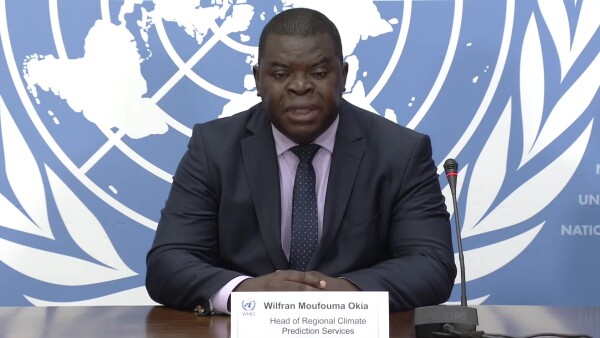
Wilfran Moufouma Okia, WMO’s Head of Regional Climate Prediction Services, told reporters in Geneva that “the tropical Pacific Ocean is currently experiencing El Niño conditions, and this is a result of rapid and substantive change both in the atmosphere and in the ocean”.
Global temperatures are likely to surge as El Niño will add to man-made, greenhouse gas-induced atmosphere warming.
Mr. Moufouma Okia recalled that in a report last month, WMO estimated the likelihood of a temperature increase in excess of 1.5 degrees Celsius above pre-industrial levels over one of the next five years. With El Niño, there is a “high probability for the temperature to be one of the warmest on record” in this period of time, he said.
According to WMO’s State of the Global Climate reports, the warmest year currently on record, 2016, was characterized by a “double whammy” of a very powerful El Niño event and human-induced warming from greenhouse gases.
WMO said that the effect of El Niño on global temperatures usually plays out in the year after the conditions develop, so it will likely be most apparent in 2024.
Addressing regional effects of the phenomenon, Mr. Moufouma Okia noted that temperatures are expected to be above average in a band of latitude between the 50th parallel south and the 50th parallel north - the Maritime Continent – which is a term used by meteorologists to describe the region between the Indian and Pacific Oceans, including the archipelagos of Indonesia, Borneo, New Guinea, the Philippine Islands, the Malay Peninsula and the surrounding seas – the Caribbean, central America and the northern part of South America.
WMO highlighted that El Niño events were typically associated with increased rainfall in parts of southern South America, the southern United States, the Horn of Africa and central Asia.
In contrast, El Niño can also cause “severe droughts” over Australia, Indonesia, parts of southern Asia, Central America and northern South America, according to the agency.
Looking ahead, Mr. Moufouma Okia said that there was a 90 per cent chance of El Niño prevailing in the second half of 2023 and that the global forecasting community will be monitoring conditions closely.
According to WMO, El Niño occurs on average every two to seven years, and episodes typically last nine to 12 months.
STORY: El Niño Update - WMO
TRT: 1’16”
SOURCE: UNTV CH
LANGUAGE: ENGLISH, NATS
ASPECT RATIO: 16:9
RELEASE DATE: 4 July 2023
FORMAT: HYBRID PRESS BRIEFING
DATELINE: GENEVA, SWITZERLAND
SHOTLIST
- Exterior wide shot: UN flag alley UN Geneva.
- Cutaway: wide shot, speakers behind podium at the press conference, UN Geneva.
- SOUNDBITE (ENGLISH) Wilfran Moufouma Okia, Head of Regional Climate Prediction Services, World Meteorological Organization (WMO): “The tropical Pacific Ocean is currently experiencing El Niño conditions, and this is a result of rapid and substantive change both in the atmosphere and in the ocean.”
- Cutaway: close lateral shot, attendees at the press conference, UN Geneva.
- SOUNDBITE (ENGLISH) Wilfran Moufouma Okia, Head of Regional Climate Prediction Services, World Meteorological Organization (WMO): “The temperature is likely to be, is expected to be above the average in a warm band of latitude between 50 South and 50 North, that’s the place where you have locations such as the Maritime Continent, the Caribbean, central America, the northern part of South America.”
- Cutaway: medium lateral shot, attendees at the press conference, UN Geneva.
- SOUNDBITE (ENGLISH) Wilfran Moufouma Okia, Head of Regional Climate Prediction Services, World Meteorological Organization (WMO): “WMO issued another report where we tried to estimate the likelihood of one of the next five years reaching and even exceeding 1.5 degrees. Basically with El Niño, we have a high probability for this temperature to be one of the warmest on record.”
- Various cutaways of speakers and journalists at the press conference, UN Geneva.
Similar Stories

1
1
1
Edited News | UNICEF
A little over one year since a ceasefire agreement was announced between Hamas fighters and Israel, more than 340 children have been reported killed and hundreds more injured, the UN Children’s Fund, UNICEF, said on Friday.

1
1
1
Edited News | UNICEF , IFRC
Six weeks after Nepal’s deadly flooding disaster, communities are still struggling to rebuild their lives, but they will need sustained help as global warming increases the risk of another Himalayan catastrophe, the UN Children’s Fund (UNICEF) said on Friday.

1
1
1
Edited News | WHO
In suspected Russia plague death, testing and monitoring underway – WHO
The death of a lab worker in Russia’s Siberia region has sparked concerns about plague being the cause, the UN World Health Organization (WHO) said on Tuesday, adding that it was following the situation closely.

1
1
Edited News | OHCHR , UNOG
UN Human Rights Chief Volker Türk on Friday provided and oral update to the 63rd session of the Human rights Council on Ukraine.

1
1
1
Edited News | OHCHR , UNOG
UN Human Rights Chief Volker Türk on Friday provided and oral update to the 63rd session of the Human rights Council on the human rights situation in Haiti.

1
1
1
Edited News | WHO
Repeated delays in bringing lifesaving medicines, prosthetics and more from Israel into Gaza risk having devastating consequences on Palestinians who urgently need them in the wartorn enclave, the UN World Health Organization (WHO) said on Friday. “A truck full of non-priority supplies or the right supplies arriving too late, doesn't save lives. That's the question that actually matters," said Dr Reinhilde Van De Weerdt, WHO Representative in the OPT.

1
1
1
Edited News | WHO
DRC: Early access to care and oxygen decisive for Ebola patients’ survival – WHO
In the Democratic Republic of the Congo (DRC), health workers fighting the country’s largest-ever Ebola outbreak are struggling to overcome critical challenges to patient care, the UN World Health Organization (WHO) warned on Tuesday.

1
1
1
Edited News | OCHA , UN
Civilians in Iran are continuing to feel the consequences of months of conflict and military escalation, the UN’s top official in the country has said, as loss of life, damage to civilian infrastructure and mounting economic pressures leave many facing continued uncertainty.
1
1
1
Edited News | WHO , UNICEF
Aid agencies in Yemen highlighted the growing hunger emergency sparked by renewed fighting between Houthi opposition forces and Government troops, after mobile health clinics reported that hundreds of children displaced by the violence are suffering from the most deadly form of malnutrition.
1
1
1
Edited News | UNHCR
Displacement on the rise in Yemen as fighting continues - UNHCR
As hostilities worsen in Yemen, more people have been fleeing their homes, further intensifying the humanitarian crisis within the region, the UN Refugee Agency (UNHCR) warned on Tuesday.
1
1
1
Edited News | IOM , OHCHR , UNFPA , UNOG , UNHCR , WHO
Yemen’s humanitarian crisis growing by the hour amid spike in displacement
Yemenis displaced by renewed fighting have described fleeing for their lives amid shelling and gunfire, aid agencies reported on Friday, while highlighting the dramatic increase in humanitarian needs in the country and in Djibouti, where thousands have sought shelter.
1
1
1
Edited News | OHCHR , UNOG
The UN Human Rights Office issued on Friday a report documenting a shocking pattern of sexual violence amid Russia’s full-scale armed attack on Ukraine.